
Paint and Coatings
Number of Coats and Thickness in Antifouling Paint
In antifouling paint the question “how many coats?” often turns into “how much film?”. This article summarises the relation between coat count and thickness, the effects of thin application and a practical coat plan using general sources.
Short answer
According to YBW antifouling performance is generally directly proportional to the dry film thickness of each coat, so the recommended quantity should be applied as a minimum. International Yacht Paint says applying the correct volume matters more than the exact number of coats and that it is better to apply all the paint than leave some in the tin. A New Zealand guide advises not thinning paint to spread it further and keeping to the maker’s film thickness. The exact coat count and thickness depend on the product; this article gives no value, see the data sheet.
Key points
- Antifouling performance is generally proportional to film thickness; apply the recommended quantity as a minimum.
- Per International, applying the correct volume matters more than the coat count; apply all the paint.
- Thinning paint to spread it further lowers film thickness and may shorten life.
- Thickness means different things for hard and eroding types; an extra coat at the waterline and high-wear areas may be considered.
- Coat count and thickness depend on the product; follow the data sheet and keep records.
1. Coat count or thickness?#
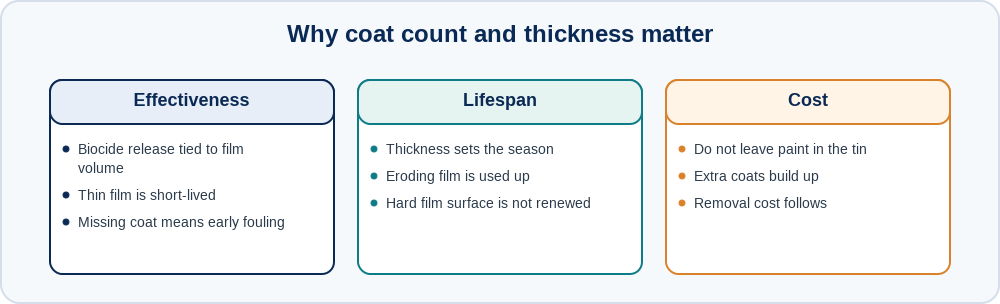
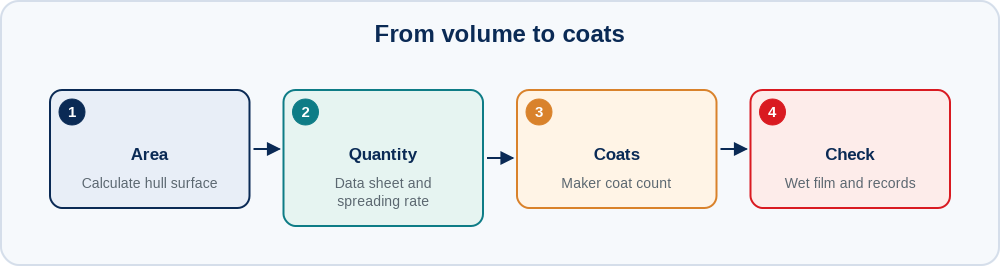
One of the most frequent questions in antifouling is how many coats to apply. Sources often turn this into a question of thickness and volume. YBW’s application guide says antifouling performance is generally directly proportional to the dry film thickness of each coat and that the recommended quantity should therefore be applied as a minimum. International Yacht Paint’s application advice says that if you cannot measure wet film thickness, applying all the paint you worked out for your hull area is a practical route, that the exact number of coats is less important than the correct volume and that it is better to apply all the paint than leave some in the tin to be discarded. This article is a general summary and recommends no coat count, thickness or consumption for any product.
The two views do not conflict: coat count is one way to reach the target film volume. A product data sheet usually gives the recommended coat count, dry film thickness and theoretical spreading rate together. Calculating hull area accurately and budgeting with these values keeps the coat plan realistic.
2. Consequences of thin application#
The antifouling guide of Te Atiawa Trust in New Zealand lists not achieving the specified film thickness among common mistakes and recommends following the manufacturer’s recommended number of coats and film thickness; it writes that thinning paint to spread it further may save a few dollars now but will cost dearly through reduced effectiveness and that failing to reach the recommended coats or thickness can affect the paint’s longevity. This is a regional environmental body’s guide and should be read as a general warning. In practice a thinly applied film has less biocide reserve and may be used up before the season ends, so the hull fouls early.
Another YBW page says that in harsh conditions such as drying moorings liberal coats from the outset and annual re-application are advised and that the number of coats applied at the outset has a significant bearing on performance and consistency. That is a magazine guide; judge it according to your boat and conditions.
| Situation | Possible result | Note |
|---|---|---|
| Thin film | Small biocide reserve; early fouling | Effectiveness may fall before season end |
| Correct film | Expected lifespan | Data-sheet quantity and thickness |
| Thinned paint | Spreads further, thickness drops | Not advised; data-sheet limits |
| Heavy build-up | Layers accumulate on hard types | Removal cost follows |
3. Thickness on hard and eroding types#
International Yacht Paint explains that hard antifoulings do not really wear, that biocide leaching rate falls over the product’s life and that after a few seasons residual build-up may occur, while eroding types slowly erode in seawater, eventually leaving little or no antifouling on the hull. This difference affects the coat plan: on hard types annually re-applied coats accumulate and may in time need removal; on eroding types film thickness directly sets how many seasons the product lasts. Yachting Magazine quotes a manufacturer executive saying the terms “ablative” and “hard” are being blurred by new technology.
Speed and use matter too. YBW writes that hard types can be effective up to very high speeds and are best re-applied annually, while soft self-polishing types are not suited to drying moorings. For product choice see the related articles; this article makes no selection.
4. A practical coat plan#
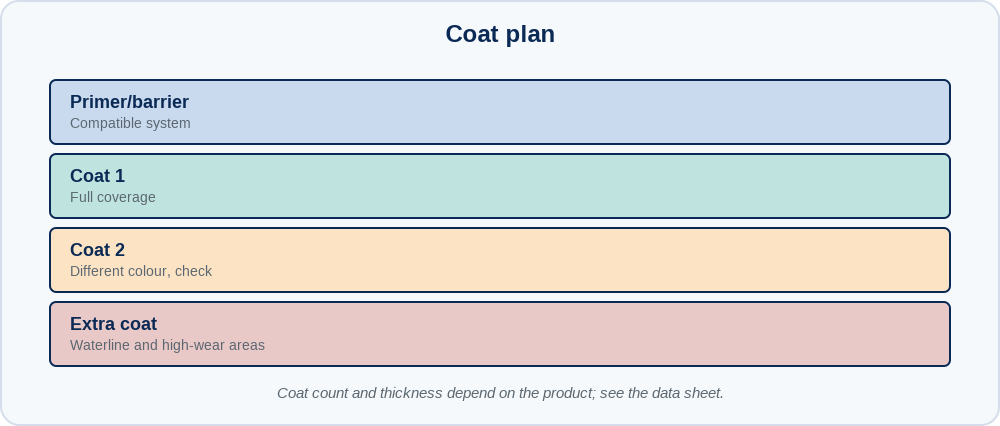
Before planning calculate hull area and set the total paint quantity from the data-sheet spreading rate. If a primer or barrier coat is needed apply it in a compatible system within product intervals. Changing colour between coats (for example a first coat in one colour and a second in another) helps you see that the second coat covers fully. For high-wear and high-fouling areas such as the waterline, around propeller and rudder, the stern and frequently rubbed spots an extra coat may be considered to the extent the maker allows.
Check each coat’s volume with a wet film thickness gauge; if you have none, track the ratio of paint quantity to area. Air and surface temperature, humidity and recoat interval are given in the data sheet during application; do not shorten recoat intervals. Instead of applying one very thick coat keep to the data-sheet coat interval; excessive thickness risks running, blistering and cracking.
- Calculate hull area accurately.
- Take coat count, thickness and spreading rate from the data sheet.
- Set total paint quantity; aim to leave none in the tin.
- Apply the primer or barrier system compatibly.
- Check coverage by changing colour between coats.
- Consider an extra coat at the waterline and wear areas (with maker permission).
- Record wet film and consumption.
5. Records and the next season#
Recording the product applied, batch number, coat count, consumption, weather and dates makes decisions easier next season. When the hull comes out at season end inspect the remaining film: how much film thickness is left on an eroding type, is there residual build-up on a hard type? These observations are valuable for adjusting the coat plan; but one season’s observation alone does not give a firm conclusion.
Excess build-up on a hard type can in time create a rough and cracked surface; Boating magazine says hard paint does not wear away so each repaint adds another layer and over time this can lead to a thick, rough bottom. Periodic sanding or stripping is then needed. This article recommends no removal method; see the related articles.
6. Common mistakes#
- Miscalculating area and buying too little paint.
- Thinning paint to spread it further.
- Leaving paint in the tin and calling it enough.
- Shortening recoat intervals.
- Skipping the waterline and wear areas.
- Applying over an incompatible primer or old coat.
- Not recording consumption and conditions.
7. Checklist#
8. Conclusion#
Antifouling performance is generally proportional to film thickness; the recommended quantity should be applied as a minimum and the paint should not be thinned to spread. Applying the correct volume matters more than the coat count; the meaning of thickness differs between hard and eroding types. Coat count and thickness depend on the product; follow the data sheet and keep records. This article is general information.
Frequently asked questions#
How many coats of antifouling?
It depends on the product; this article gives no number. International says applying the correct volume matters more than the exact coat count; see the data-sheet recommendation.
Does thickness really affect performance?
YBW writes that antifouling performance is generally directly proportional to the dry film thickness of each coat. So the recommended quantity should be applied as a minimum.
Can I thin the paint to cover more area?
Not advised. A New Zealand guide says thinning paint to spread it further reduces effectiveness and may shorten its life.
What if paint is left in the tin?
International suggests applying all the calculated paint rather than leaving some in the tin to be discarded, because the aim is to apply the correct volume.
Is there a difference for hard and eroding types?
Yes. On hard types the surface is not renewed and on eroding types the film is used up over time; so the meaning of thickness and coat plan varies by product.
Was this guide helpful?
Thank you! Your feedback has been saved.
Guide content is for general information; in practice, the current technical data sheet of the product applies.
Keep reading
Related guides
Boat Colour Selection and Solar Reflectance: Effect of Heat Absorption on Surfaces
A study of the effect of boat paint colour on solar reflectance and surface temperature.
2 min read Paint and CoatingsCauses and Diagnosis of Paint Blistering
A study of the sources, types and diagnostic approach to blistering on boat paints.
2 min read Paint and CoatingsNumber of Coats in Epoxy Coating Systems
A study of the effect of the number of coats in epoxy coating systems on protective performance and thickness.
2 min read