
Paint and Coatings
Enclosed Shipyard Paint Booth and Ventilation
An enclosed shipyard paint booth lets you work independently of the weather; but a booth’s value comes from its ventilation. This article summarises in a general frame the purposes of airflow, the design logic and safety and quality control.
Short answer
An enclosed paint booth makes it easier to control temperature, humidity and dust; but without ventilation solvent vapour accumulates, fire, explosion and respiratory risk rise and drying suffers. Ventilation consists of a filtered clean-air intake, a controlled flow and a filtered exhaust. Airflow rates, fire protection and exhaust air requirements depend on local regulation and the product safety data sheet; the booth should be designed by a specialist. This article is general information; it is not engineering design or legal advice.
Key points
- An enclosed booth makes it easier to control conditions but without ventilation solvent vapour and moisture build up.
- Ventilation consists of filtered intake, controlled flow and filtered exhaust.
- For fire, explosion and respiratory risks the safety data sheet and local regulation govern.
- Still measure temperature, relative humidity and dew point inside the booth.
- Consult a specialist for airflow values and equipment choice; this article gives none.
1. What does an enclosed booth solve and why?#
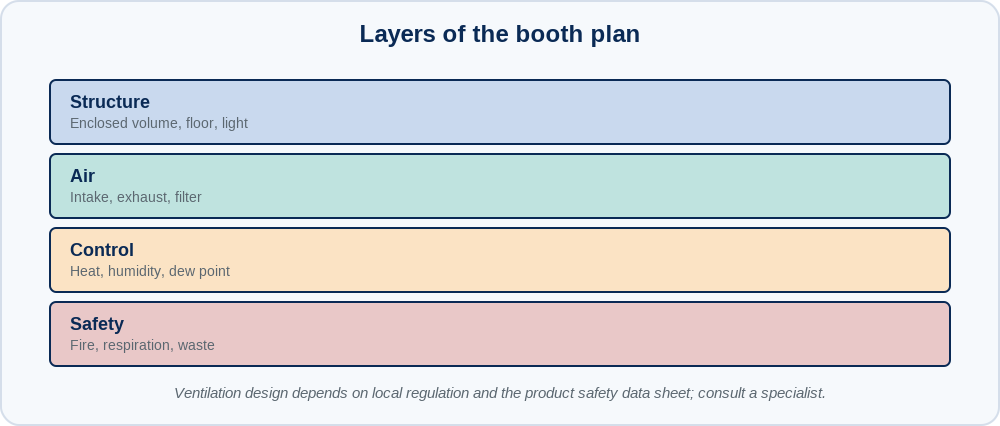
An enclosed shipyard paint booth makes it possible to work independently of the weather. Rain, dew, wind and direct sun stay outside; temperature and humidity can be managed more tightly; dust and spread to the surroundings can be reduced. Most of the outdoor problems covered in related articles are eased this way. But a booth’s value comes not only from its walls but from its ventilation. A booth without ventilation can become a sealed volume that accumulates solvent vapour and moisture. This article offers a general frame; it gives no value for airflow, equipment or regulation.
A short note on the difference between a “booth” and a “tent and protection structure”: protection structures are usually temporary, light covers; a booth is usually a fixed or semi-fixed volume with a designed air intake and exhaust system, lighting and floor. The boundary is blurry and the principles are largely shared.
2. The three purposes of ventilation#
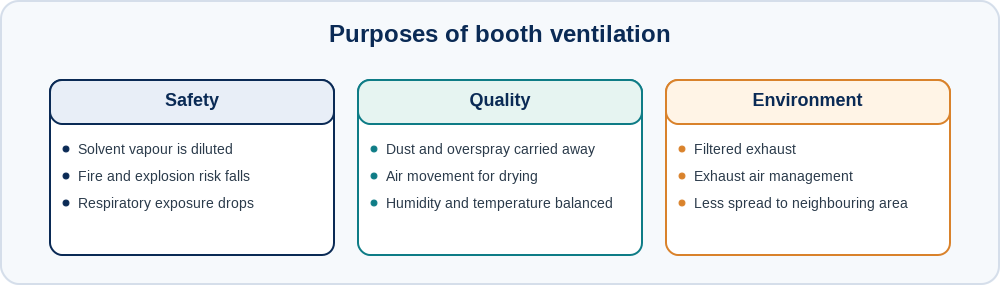
The first purpose is safety. Solvent vapour accumulates in an enclosed volume; it raises fire and explosion risk and respiratory exposure. Ventilation reduces this risk by diluting and removing the vapour. The second purpose is quality: sanding dust, overspray and airborne particles can stick to the surface; a controlled airflow carries them out of the booth and gives air movement suitable for the paint to dry. The third purpose is the environment: a filtered exhaust reduces the spread of exhaust air and particles to the surroundings.
These purposes can sometimes conflict. Strong airflow can kick up dust, over-cool the surface or dry too fast, leading to film defects. So the flow must be designed, not fans added at random; flow type, direction and speed are subject to a specialist’s assessment. This article gives no value.
| Component | Function | Watch |
|---|---|---|
| Filtered intake | Provides clean air, reduces dust carried in | Filter maintenance; clogging lowers flow |
| Exhaust fan | Removes solvent vapour and air | Suitable equipment; must not be an ignition source |
| Exhaust filter | Captures particles | Disposal of waste filters |
| Lighting | Working visibility | Suitable for explosive atmosphere; follow rules |
| Measurement | Flow, temperature, humidity | Calibration and records |
3. Airflow arrangement#
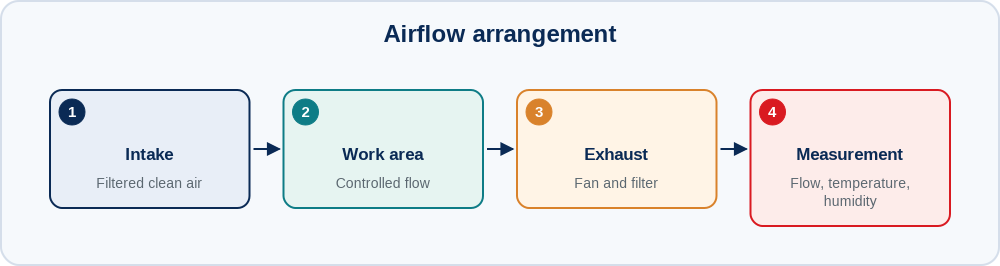
The basic logic is to take clean air into the booth through a filtered intake, pass it through the work area in a controlled flow and remove it through a filtered exhaust. The direction and speed of the flow are arranged to carry off vapour and particles without disturbing the paint. Pressure balance inside the booth also matters: whether the booth is at slightly negative or positive pressure relative to the surroundings affects the direction of dust and exhaust air; which is suitable depends on booth type and regulation.
On large objects with complex geometry such as a boat the flow is not equal everywhere; dead zones (stagnant air) can lead to vapour accumulation. During work pay attention to air movement in lower areas and tight spaces. This article is not a design guide; the booth should be designed by a specialist.
4. Humidity, temperature and dew point#
An enclosed booth makes it easier to control weather conditions but does not guarantee they are suitable. Inside the booth temperature, relative humidity and dew point should be measured; the surface should be at least 3 °C above dew point. In cold winter the booth can be heated and in high humidity dehumidification may be needed; but heating and dehumidifying equipment must not be an ignition source in an atmosphere with solvent vapour. Open-flame or exhaust-venting heaters are dangerous; see the product safety data sheet, the equipment maker and local regulation.
Very strong ventilation can expel heated air quickly, lowering booth temperature and raising the heating load. So ventilation and heating must be planned together. Maintain drying and cure conditions during and after painting according to the data sheet; opening the booth or changing ventilation can expose fresh paint to outside conditions. For the relation of humidity, temperature and dew point see the related articles.
- Design the booth with a specialist and per local regulation.
- Install filtered intake, controlled flow and filtered exhaust.
- Control ignition sources (electrical, heater, static).
- Measure temperature, humidity and dew point inside the booth.
- Apply respiratory protection and fire precautions.
- Make a disposal plan for filters and exhaust air.
- Record the conditions.
5. Safety, fire and exhaust air#
Solvent vapour is flammable; in an enclosed volume at certain concentrations it carries fire and explosion risk. The product safety data sheet and local occupational safety, fire and environmental regulation govern here; suitable (explosion-protected) equipment may be needed for electrical gear, lighting and fans. Those applying paint should use suitable respiratory protection and personal protective equipment. This article is not legal or safety advice; consult a specialist for airflow values and equipment choice.
Filters fill with time and create waste; used filters, paint residue and sanding dust must be disposed of according to local rules. The exhaust air outlet should also be assessed for spread to neighbouring areas and the environment. Record filter maintenance and flow measurement; a clogged filter lowers flow and increases vapour build-up.
5b. Maintenance, training and records#
A booth and ventilation system needs regular maintenance: checking intake and exhaust filters, cleaning fans, repeating airflow measurement and inspecting lighting and electrical gear. Maintenance intervals depend on the equipment maker and local regulation; this article gives no interval. Recording maintenance and measurement results makes it easier to follow both quality and safety.
Everyone working in the booth should know how the system works, what to do in an emergency and how to use personal protective equipment. Before painting starts verify that ventilation is running; after painting keep ventilation going through the drying period according to the product data sheet and safety data sheet. If something goes wrong stop application and consult a specialist.
6. Common mistakes#
- Using an enclosed booth without ventilation.
- Adding fans at random without designing the flow.
- Neglecting filter maintenance.
- Not measuring temperature and dew point inside the booth.
- Not controlling ignition sources.
- Not planning exhaust air and filter waste.
- Not recording conditions.
7. Checklist#
8. Conclusion#
An enclosed paint booth makes conditions easier to control; but a booth’s value comes from its ventilation. A filtered intake, controlled flow and filtered exhaust are needed for safety, quality and the environment; temperature, humidity and dew point must still be measured inside the booth. Consult a specialist and local regulation for airflow values and equipment. This article is general information; your product’s data sheet and safety data sheet govern.
Frequently asked questions#
Is an enclosed booth always better?
It makes conditions easier to control but without ventilation solvent vapour and moisture build up. A booth’s value comes from its ventilation.
Why is ventilation needed?
To dilute and remove solvent vapour, reduce fire and respiratory risk, carry away dust and overspray and give air movement for drying.
What should the airflow rate be?
This article gives no value. Airflow requirements depend on local regulation, the product safety data sheet and booth design; consult a specialist.
Do I need to measure inside the booth?
Yes. Temperature, relative humidity and dew point should be measured inside too; being enclosed does not mean conditions are suitable.
What happens to exhaust air?
A filtered exhaust is used; follow local environmental regulation for exhaust air and filter waste.
Was this guide helpful?
Thank you! Your feedback has been saved.
Guide content is for general information; in practice, the current technical data sheet of the product applies.
Keep reading
Related guides
Boat Colour Selection and Solar Reflectance: Effect of Heat Absorption on Surfaces
A study of the effect of boat paint colour on solar reflectance and surface temperature.
2 min read Paint and CoatingsCauses and Diagnosis of Paint Blistering
A study of the sources, types and diagnostic approach to blistering on boat paints.
2 min read Paint and CoatingsNumber of Coats in Epoxy Coating Systems
A study of the effect of the number of coats in epoxy coating systems on protective performance and thickness.
2 min read