
Paint and Coatings
Application Mistakes and Remedies in Awlgrip-Type Systems
Two-part polyurethane systems such as Awlgrip give high gloss but forgive little. This article summarises common application defects, their causes and prevention, based on paint-maker guides and general coating sources.
Short answer
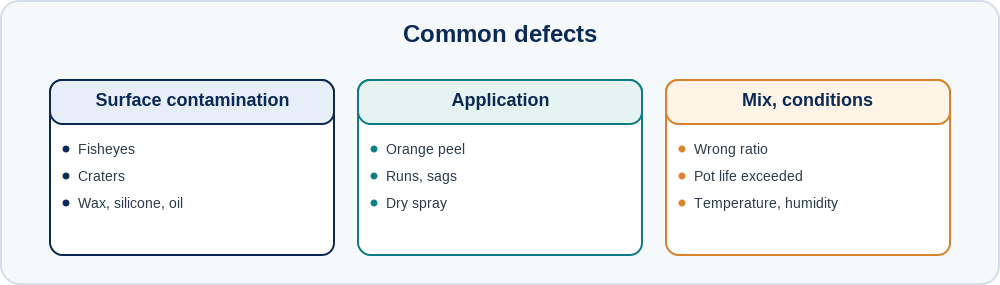
Common defects in two-part polyurethane application are fisheyes (oil, wax, silicone contamination), orange peel (thick paint, fast thinner or hardener, wrong temperature, gun setup), runs and sags (excessively wet film) and mixing or pot-life errors. The core of prevention: degreasing at every stage, following the ratio and times in the data sheet, a test panel, suitable conditions and thin coats. This article is general information and does not replace a particular maker’s guide; the data sheet comes first.
Key points
- Fisheyes mostly come from wax, silicone or oil contamination; degrease at every stage.
- Orange peel can come from thick paint, fast thinner or hardener, wrong temperature and gun setup.
- Runs and sags relate to excessively wet film and too-heavy coats.
- A wrong mixing ratio and exceeding pot life spoil the film; follow the maker’s data sheet.
- A test panel, suitable conditions, thin coats and record keeping reduce defects.
1. Why is tolerance for error low?#
Two-part polyurethanes are mixed just before application and cure by chemical reaction, so mix ratio, pot life, temperature and humidity directly decide the result. A boat guide writes that two-part paint begins to set almost immediately, that painting is a sprint, and that painting one side of a 26-foot boat by roll and tip should take no more than twenty minutes. A paint maker’s application guide stresses working well within pot life, notes that conditions change as the mix inducts, and says unrecommended products should not be substituted into the system, since that can jeopardise the system’s unique characteristics and cosmetics.
The defects and causes below are compiled not from an Awlgrip guide but from general coating-industry troubleshooting sources; although most apply to two-part systems, a particular product’s data sheet always takes priority. When diagnosing, first separate whether the cause is surface, mix, conditions or technique.
2. Fisheyes: a contamination error#
Fisheyes are small craters where paint does not wet. A coating troubleshooting source says they come from surface contamination (wax, silicone, oil) and are in the cosmetic class of defects. A shop magazine writes that fisheyes arise from one of the most frequent mistakes shops make, inadequately cleaning and preparing a job. A guide for amateur painters recommends cleaning with a wax and grease remover before sanding, before priming and before painting to avoid them. An aircraft-paint source says all traces of silicone must be cleaned with a silicone remover and that fisheyes are most effectively prevented by eliminating the source.
The maker’s guide points at this too, indirectly: it says tack cloths other than the recommended one can leave a residue that causes fisheyes and craters. Because silicone polishes, waxes and sprays are so common in boat care, if the history of the surface is unknown assume contamination and clean at every stage. See our related articles on removing gelcoat polish and wax before painting.
| Defect | Likely cause | Remedy |
|---|---|---|
| Fisheyes | Wax, silicone, oil contamination | Degrease at every stage; if severe, sand and recoat |
| Orange peel | Thick paint, fast thinner or hardener, wrong temperature, gun setup | Correct setup and thinning; polish if light, sand if severe |
| Runs, sags | Excessively wet film, gun too close, heavy coat | Thin coats; sand when dry and recoat |
| Dry spray | Gun too far, fast solvent | Correct distance and solvent |
| Wrong mix | Ratio or pot-life error | Follow data sheet; renew the faulty film |
3. Orange peel: a flow and setup problem#
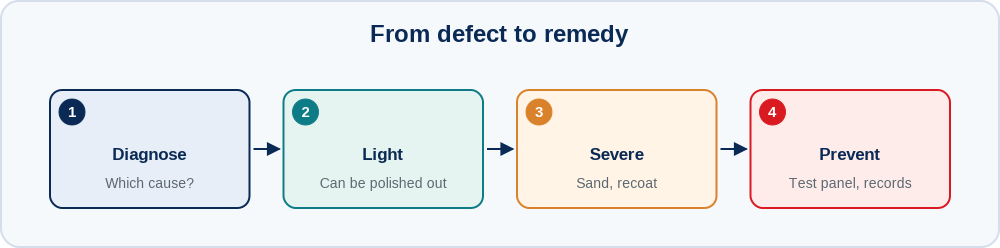
Orange peel is a bumpy surface like the skin of an orange. A paint maker’s guide lists among causes paint that is too thick (spraying viscosity too high), a wrong (fast) hardener or thinner and spraying at extremely high temperatures; for the remedy it says minor cases can be polished out and severe ones sanded and resprayed. An aircraft-paint source names improper adjustment of the spray gun as the first cause. An epoxy troubleshooting guide says cold substrate or cold material prevents levelling while hot substrate or material cures too rapidly to level; the principle applies similarly to two-part polyurethanes.
A coating inspection source writes that orange peel reduces effective film thickness and traps contaminants, so it must be sanded smooth before recoating. So if you see orange peel on a hull, establish cause and remedy before moving to the next coat.
4. Runs and sags: too much paint#
Runs and sags are gravity-driven downward flow of an excessively wet film. A coating troubleshooting source says too high pressure and too large a tip size can lead to over-application and sagging; another stresses that applying too much in a single pass causes runs and sags and that controlled technique is needed. Rushing drying times is also reported to cause orange peel, wrinkling and solvent pop. The practical remedy is thin coats and enough flash time between coats.
Light matters too: a forum user spraying with HVLP names better lighting as the thing he would do differently next time, saying that when you cannot see you get thin spots and runs or sags. That is a single experience, but it matches the general view that watching the film in reflected light helps catch defects early.
5. Mixing, pot life and conditions#
Mixing-ratio errors can ruin the whole job with a single measuring mistake. A troubleshooting guide recommends rechecking colour code, formula number and weights before mixing and spraying a test panel before application. A 2K product guide advises recording information such as mixing and rest times. The maker’s application guide stresses working within pot life; once the mix exceeds it the paint is still curing and film quality suffers.
Conditions: a boating magazine says it is best to paint when the temperature is between 60 and 80 °F with low humidity; the range in the data sheet comes first. Risk of defects rises in very hot, very cold or humid conditions. Protective equipment is essential too: two-part systems need respiratory protection with isocyanate-rated filters and new filters for each job; one source writes that isocyanate filters degrade over time and should be used no longer than 30 days. See our isocyanate safety article for detail.
- Clean the surface with wax and grease remover at every stage (sanding, primer, before paint).
- Check the ratio, thinner and hardener type in the data sheet.
- Spray or apply a small test panel.
- Check temperature, humidity and light; work in suitable conditions.
- Work within pot life in thin, controlled coats.
- Observe flash times between coats.
- If a defect occurs identify the cause and fix it; record every job.
6. Common mistakes#
- Skipping degreasing before sanding, primer and paint.
- Mixing products the maker does not recommend into the system.
- Neglecting mix ratio and pot life.
- Not making a test panel.
- Applying an excessively wet film.
- Painting in poor light and unsuitable conditions.
- Neglecting respiratory protection and ventilation.
7. Checklist#
8. Conclusion#
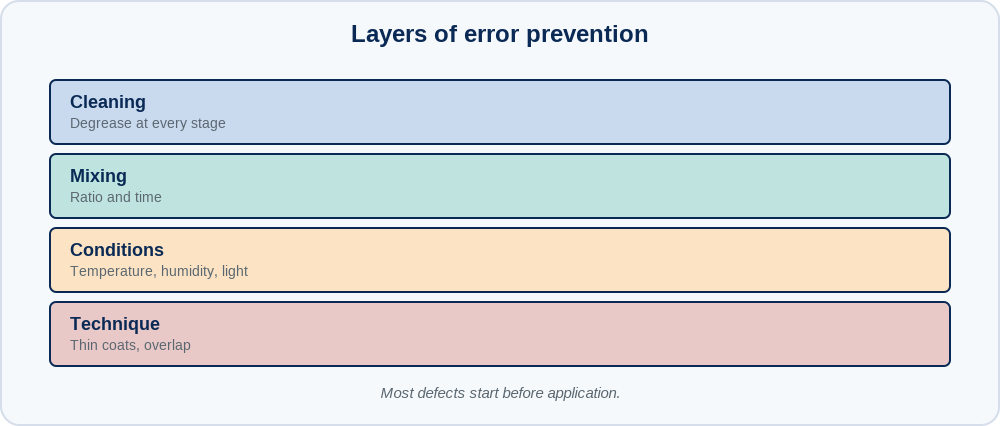
In two-part polyurethane systems most defects start before application: contamination, wrong mixing, unsuitable conditions and hurried technique. Cleaning at every stage, strict adherence to the data sheet, a test panel and thin coats reduce risk. This article is general information and does not replace the maker’s guide.
Frequently asked questions#
Why do fisheyes occur?
Per sources, because of wax, silicone or oil left on the surface; the paint does not wet those spots.
How is orange peel prevented?
Thinning the paint per the data sheet, using the right hardener and thinner speed, suitable temperature and correct gun setup are advised; light cases can be polished out.
Why do runs and sags occur?
They are linked to an excessively thick or wet film, holding the gun too close or wrong pressure and tip size.
What if pot life is exceeded?
The maker’s guide stresses working well within pot life; beyond it the paint keeps curing and film quality suffers.
What if a defect occurs?
A light defect may be corrected by polishing; a severe one usually needs sanding and recoating. See the maker’s guide.
Was this guide helpful?
Thank you! Your feedback has been saved.
Guide content is for general information; in practice, the current technical data sheet of the product applies.
Keep reading
Related guides
Boat Colour Selection and Solar Reflectance: Effect of Heat Absorption on Surfaces
A study of the effect of boat paint colour on solar reflectance and surface temperature.
2 min read Paint and CoatingsCauses and Diagnosis of Paint Blistering
A study of the sources, types and diagnostic approach to blistering on boat paints.
2 min read Paint and CoatingsNumber of Coats in Epoxy Coating Systems
A study of the effect of the number of coats in epoxy coating systems on protective performance and thickness.
2 min read