
Paint and Coatings
Applying a New System over Old Antifouling
On a hauled boat the first question is whether to apply a new system over the old antifouling or strip and start again. This article summarises the decision criteria, the place of the tie coat and the general logic of application after stripping, using general sources.
Short answer
The decision depends on the old film’s condition: if sound, adherent and compatible it can be repainted after cleaning and light abrading; if the product is unknown a sealer/tie coat is considered; blistered, flaking or over-thick film needs stripping. BoatTest says that after a few seasons product build-up can become unsound and need removal; a manufacturer tip in Sail-World says excess build-up can cause cracking and spalling even where the surface looks sound. International says antifouling over a barrier epoxy must go on within the recoat period and that once the epoxy has hardened the antifouling will not adhere strongly. This article is general information; the exact method depends on the product data sheet.
Key points
- The decision depends on the old film’s condition: sound and compatible film can be overcoated; blistered or very thick film needs stripping.
- Build-up can become unsound over time; cracking can appear days later (Altex tip).
- For unknown but sound film consider a sealer/tie coat; a tie coat over unsound film is not a solution.
- Stripping methods (scraping, chemical, mechanical) carry different risks; chemical stripper can attack the primer beneath.
- Antifouling over an epoxy barrier must be applied within the recoat period (International).
1. Inspect first: what condition is the old film in?#
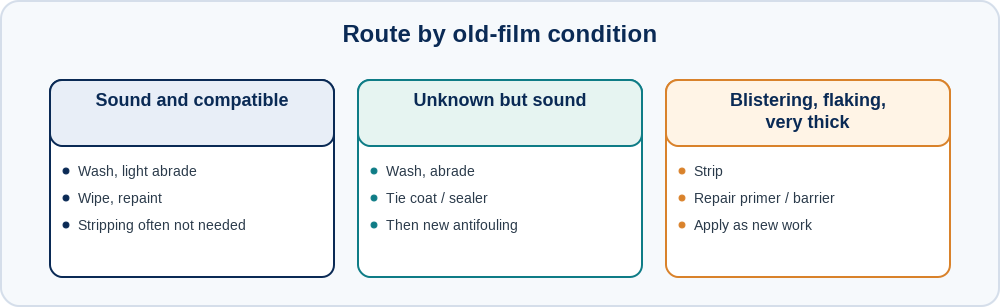
On a hauled boat the first job is to examine the old antifouling. A high-pressure fresh water wash removes loose antifouling, salt and calcium deposits; International Yacht Paint notes that leaving this layer can lead to blistering, delamination and poor antifouling performance. After washing look at the film’s adhesion, cracks and blistering, thickness and overall consistency. West Marine’s guide sketches three routes here: for known paint in good shape, clean, sand, solvent-wipe and repaint; for unknown paint, a tie-coat primer; for deteriorated paint, strip completely before proceeding. This article is a general summary; it recommends no method for a specific product.
During inspection look not just at the surface but at film thickness. On hard types adding a layer each season and on eroding types building up over many years, total thickness can cause trouble. When planning new work see the article on coat count and thickness and the related chart for compatibility.
2. Build-up and cracking#
BoatTest says that after a few seasons you are left with a build-up of product that requires removal because it becomes unsound and does not retain sufficient internal strength to hold together when new product is applied; it adds that eroding antifoulings can also build up over a few seasons and, like hard build-up, eventually lead to an unsound paint system. A manufacturer tip published in Sail-World writes that excess season-to-season build-up can lead to cracking and spalling even though the surface appears sound, that as a rule of thumb stripping back every three or four slippings is advisable and that cracking often does not show for several days after slipping even though it can occur within hours. That is a manufacturer tip; it is not a rule for every product and boat.
So “the surface looks fine” alone is not sufficient criterion. If thickness has built up and adhesion is in doubt, stripping is the safe route. Returning to a sound primer/barrier system after stripping means starting the new season as new work.
| Condition | General approach | Note |
|---|---|---|
| Sound, known, compatible | Wash, light abrade, solvent-wipe, paint | West Marine guide |
| Unknown but sound | Wash, abrade, sealer/tie coat | Tie coat on sound film |
| Blistering, flaking, cracked | Strip and apply as new work | Tie coat is not a solution |
| Excess thick build-up | Consider stripping | Cracking may show days later |
3. Stripping methods and their risks#
PBO’s guide explains that self-eroding antifouling should gently remove most of itself during the year but that hard antifouling and many layers of eroding antifouling will eventually build up, and describes stripping by scraping and chemical stripping. It notes chemical stripping takes some of the effort out of scraping but, in one application, the thinner recommended on the tin cleaned remaining antifouling yet also started to remove the primer underneath. A forum comment says chemical stripper may affect the bond of the next coat and in that case a tie coat can be used between the original primer and the new antifouling; that is a single user’s view. Dust from sanding and stripping is toxic; see the article on protection from toxic dust and never dry-sand antifouling.
Methods such as blasting and ice blasting are covered in a separate article. Whichever method is chosen, stripped antifouling and sanding dust must be disposed of as waste under local rules; see the biocide regulation article. This article recommends no removal method.
4. System and timing after stripping#
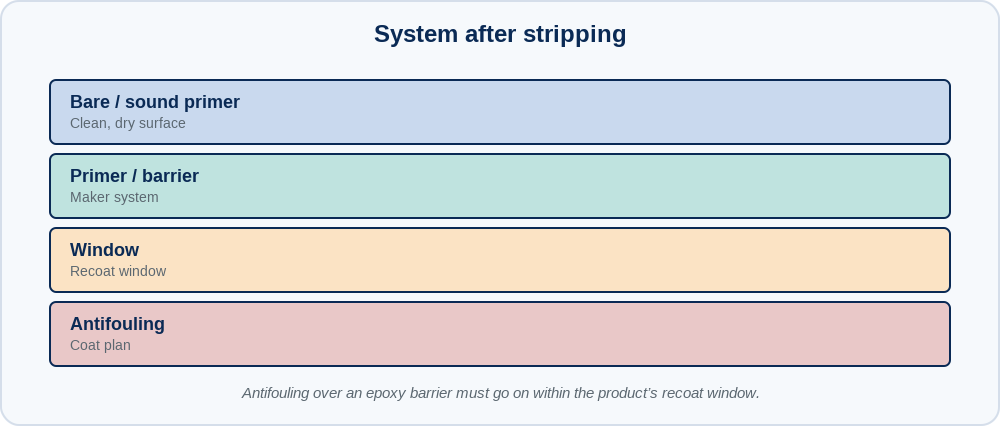
After stripping the hull returns to bare or to a sound primer/barrier system. For new work follow the maker’s system: primer, barrier coat and antifouling. Timing is critical here: International says epoxies such as Gelshield 200 and Interprotect cure to a very hard film, that because they harden so quickly the overcoating times for an antifouling are very short and that if you wait until next day the epoxy will be so hard the antifouling will not adhere strongly; an expert from Pettit in Cruising World says to apply the first coat of antifouling over the last coat of epoxy within the specified overcoating schedule set by the manufacturer and that times are temperature-related. These are maker recommendations and vary by product; read times from the data sheet; this article gives no time.
The layer order is usually primer, if needed a barrier and antifouling; the Boats.com guide says for most boats one coat of primer and two coats of antifouling is right with a third coat on high-wear areas such as waterline, keel and rudder (a magazine guide; rely on the product data sheet). Some systems also need a tie coat; in one PBO application two coats of tie coat followed the primer, then two coats of antifouling, and the tie coat colour set the final hull colour. That is a product-system-specific example.
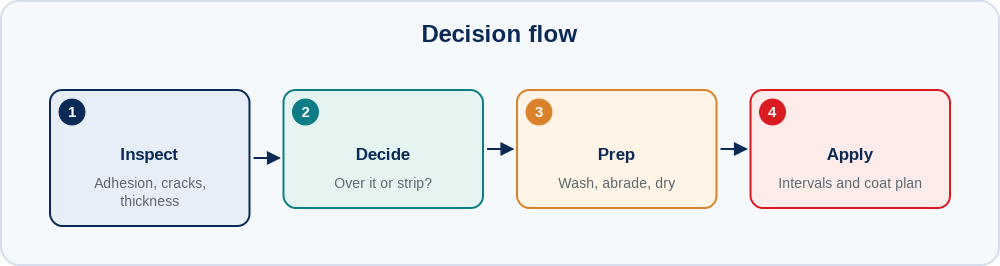
- Wash with high-pressure fresh water; remove loose antifouling and salt.
- Inspect adhesion, cracks, blistering and thickness.
- Decide: overcoat, tie coat or strip?
- If stripping, define the method (scraping, chemical, mechanical) and the waste plan.
- Never dry-sand antifouling.
- Follow the maker system and recoat period.
- Record all steps and products.
5. Cost, time and a realistic plan#
Stripping is laborious and costly; managing build-up (choosing coat count and type correctly from the start, preparing the spent layer) can postpone the need to strip. Inspecting the old film at every haul-out, keeping thickness records and basing the strip decision on evidence help control cost. This article gives no cost value.
Account for the time plan too: waiting times between stripping, drying, barrier coat and antifouling can add up to days and depend on air and surface temperature. Plan the launch date with these times and the antifouling’s out-of-water limit in mind (see the data sheet).
6. Common mistakes#
- Judging by appearance and not checking build-up and adhesion.
- Putting a tie coat over unsound film.
- Not considering that chemical stripper can affect the primer beneath.
- Dry-sanding antifouling.
- Applying antifouling over a barrier epoxy after missing the recoat period.
- Leaving stripping waste and dust without a disposal plan.
- Not recording what was done and which products.
7. Checklist#
8. Conclusion#
Whether to put a new system over old antifouling or strip depends on the old film’s condition: sound, adherent and compatible film can be overcoated; for unknown but sound film a tie coat is considered; blistering, flaking or over-built film needs stripping. Stripping methods carry risks and antifouling over a barrier epoxy must be applied within the recoat period. This article is general information; the product data sheet and maker’s instruction govern.
Frequently asked questions#
Must I strip old antifouling every season?
No. If the old film is sound, adherent and compatible it can be repainted after cleaning and light abrading (West Marine). With excess build-up or a failing film stripping is needed.
When should I strip?
When the film is blistered, flaking, cracked or has built up in many layers. A manufacturer tip in Sail-World says excess build-up can cause cracking even on a sound-looking surface.
Does a tie coat solve everything?
No. BoatTest says not to put a tie coat over unsound old antifouling in the hope it will hold everything together.
Can chemical stripper cause trouble?
It can. PBO relays that a thinner started to remove the primer beneath while cleaning off remaining antifouling; a forum comment says chemical stripper may affect the bond of the next coat (single view).
When is antifouling applied over a barrier epoxy?
Within the product’s recoat period. International says that because epoxy hardens so quickly, if left until the next day the antifouling will not adhere strongly; see your product’s data sheet.
Was this guide helpful?
Thank you! Your feedback has been saved.
Guide content is for general information; in practice, the current technical data sheet of the product applies.
Keep reading
Related guides
Boat Colour Selection and Solar Reflectance: Effect of Heat Absorption on Surfaces
A study of the effect of boat paint colour on solar reflectance and surface temperature.
2 min read Paint and CoatingsCauses and Diagnosis of Paint Blistering
A study of the sources, types and diagnostic approach to blistering on boat paints.
2 min read Paint and CoatingsNumber of Coats in Epoxy Coating Systems
A study of the effect of the number of coats in epoxy coating systems on protective performance and thickness.
2 min read