
Paint and Coatings
Applying Antifouling over Antifouling: Compatibility Guide
You do not have to apply the same product every season, but the new antifouling must be compatible with the old. This article summarises how to read compatibility charts, the general rules and the options if the old product is unknown, using general sources.
Short answer
The precondition for applying new antifouling over old is compatibility; the compatibility charts that makers (International, Pettit, TotalBoat) publish are guides only and product data sheets govern. West Marine writes that in general softer paints can be applied over harder paints but not vice versa and vinyl paints should be applied only over vinyl paints. If the old product is unknown makers and sources suggest a sealer/tie coat after sanding and washing; if the old film is unsound, blistered or flaking, a tie coat over it is not the answer and stripping is needed. This article is general information and declares no compatibility for a specific product.
Key points
- Compatibility is the precondition for new antifouling; maker charts are guides and the data sheet governs.
- General rule: softer paint may go over harder, not vice versa; vinyl only over vinyl.
- If the old product is unknown a sealer/tie coat can be used; the old film must be sound and adherent.
- No application over loose, flaking or blistered old film; stripping is needed.
- A hard type can leave an exhausted resin layer; wet abrading may be needed before the new coat (consult the maker).
1. Why does compatibility matter?#
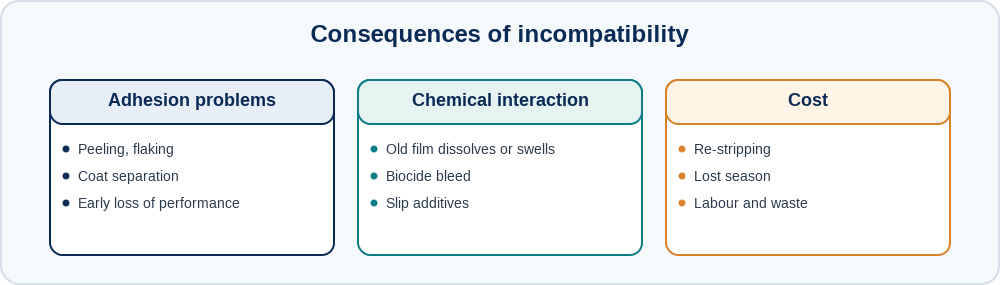
The old antifouling left under the boat is next season’s foundation. If the new product cannot bond to it, blistering, peeling or flaking follows and protection is lost through the season. There is a common principle in the trade: for new antifouling to adhere to old and work there is one major prerequisite, compatibility. A paint maker’s tip published in Sail-World stresses this and advises, when in doubt, stripping the existing antifouling back to the bare hull or a sound primer barrier system and treating it as new work. This article is a general summary; it declares no compatibility for a specific product pair.
Compatibility has several dimensions: chemical interaction (the old film may soften and swell with the new product’s solvent), adhesion (the new product may not grip the old film), bleed (biocide or additives from the old film may come through and affect the new film) and slip additives (films containing vinyl or PTFE can prevent the new paint gripping). Because of these, re-applying the same product is usually the safest option; West Marine also writes that using the same type often avoids compatibility issues.
2. Maker compatibility charts#
Makers such as International, Interlux, Pettit and TotalBoat publish compatibility charts. International’s page says it offers a simple table to check compatibility between its antifoulings and with competitor products and refers you to its technical helpdesk. Pettit’s chart lists hard, durable ablative, soft ablative, modified and freshwater antifoulings as the existing bottom paint and says the chart is a guide only and that additional preparation may be needed depending on the condition and age of the substrate. TotalBoat’s chart is also a guide only and refers to the product data sheets for preparation and application instructions. These tables belong to the makers and generally rest on their own range; matches for competitor products are not always comprehensive.
Pettit’s chart suggests that tin copolymer and modified (SPC technology) paints be sealed with a tie coat primer, allowed to dry four hours and then the new antifouling applied; that is a maker recommendation specific to its products. An old rule of thumb is also cited in Pettit’s application guide: an ablative paint can go over a hard modified epoxy paint. For the reverse guides generally recommend special preparation or a tie coat; see the relevant chart for detail.
| Situation | General rule | Note |
|---|---|---|
| Hard over soft | Not advised | Consult the maker |
| Soft over hard | Generally possible | Verify with the chart |
| Vinyl over vinyl | Vinyl only | Chart for other types over vinyl |
| Unknown old product | Sealer/tie coat or strip | Sound film essential |
| Loose, blistered film | No application over it | Stripping needed |
3. If the old product is unknown#
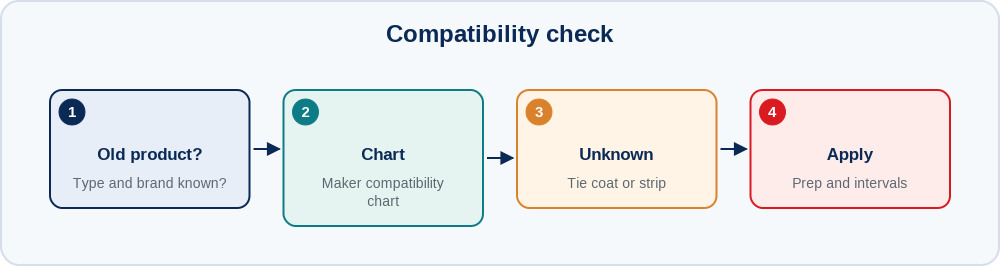
If you do not know what the old antifouling is, the common advice is a sealer/tie coat after washing and sanding. BoatTest advises that for an unknown product, after sanding and washing, you let it dry thoroughly and apply a sealer/tie or barrier coat; it writes that this seals off the old antifouling, avoids unwanted interaction between old and new and gives a good surface for the new antifouling to bond to. West Marine also recommends a tie-coat primer for unknown paint. Interlux says its universal tie-coat primer Primocon will overcoat any antifouling and establish a foundation for a new Interlux antifouling; that is a seller claim and product-specific. A PBO application notes that the colour of the tie coat determines the final hull colour (because the antifouling used was translucent), so choose tie coat colour deliberately.
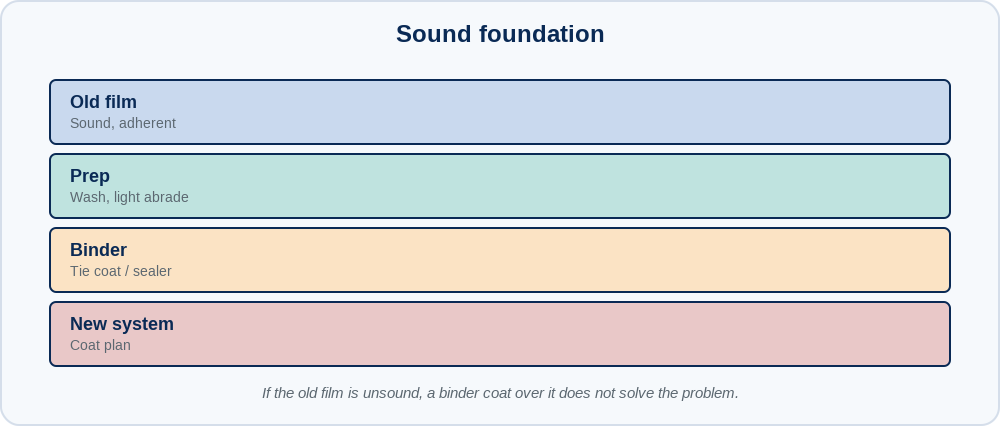
One warning is critical: BoatTest cautions against applying sealer/tie coat over old unsound antifouling in the hope that it will hold everything together. West Marine’s checklist likewise says not to apply new paint over loose, flaky or peeling old paint. So the job of the binder coat is to seal a sound foundation; it does not rescue a failing one. If the old film is unsound follow the stripping route (for detail see the article on applying a new system over old antifouling).
4. The spent layer on hard types#
A YBW forum writer, citing a paint maker’s guidance, says hard antifoulings leave an exhausted layer of resin at the end of the season which cannot be overcoated without some prior preparation, so the old antifouling should be wet abraded before applying a new coat; that is a forum relay and should be verified from the maker’s own document. Another comment in the same forum says applying lots of new paint without rubbing the old down enough leads to build-up in thickness; that is a single user’s view. Never dry-sand antifouling (toxic dust); see the article on protection from toxic dust.
If the hull is hauled every year, survey the old film’s condition: is it adhering, any cracking or blistering, is build-up excessive? These observations underpin the tie coat or strip decision. For metal parts around the old antifouling (propeller, rudder, anode area) see the maker’s instruction for their protection.
- Identify the old product’s name and type (record, invoice, label).
- Check the new product maker’s compatibility chart.
- Is the old film sound and adherent? If not, follow the stripping route.
- If the product is unknown consider a sealer/tie coat after washing and light abrading.
- Follow data-sheet intervals and application conditions.
- Choose tie coat colour deliberately; the final colour can be affected.
- Record product name, batch and date.
5. Records, charts and expert opinion#
The first condition of any compatibility chart is that the old product is known. So record product name, type, batch and date at every application; a marina or yard record helps preserve that information. If there is no record and the old product is uncertain, consulting the maker’s technical support or stripping may be preferable to a chart. Charts are guides; because of boat, water and use conditions a product pair may require special preparation.
A guide on Boats.com says modern antifouling paints give considerably fewer compatibility problems than in the past and that if you are unsure applying a primer as a tie coat between different antifoulings can give a clean slate without stripping back; that is a magazine view and should be verified against your product’s data sheet.
6. Common mistakes#
- Applying the new product without knowing the old.
- Treating the chart as a final ruling.
- Applying a tie coat over unsound old film.
- Reversing the soft-over-hard rule.
- Skipping old paint with vinyl or PTFE additives.
- Not considering tie coat colour.
- Not keeping product and batch records.
7. Checklist#
8. Conclusion#
The precondition for applying new antifouling over old is compatibility. Maker charts are guides; the general rule is that softer paint can go over harder paint, not vice versa, and vinyl only over vinyl. If the old product is unknown a sealer/tie coat or stripping is needed; if the old film is unsound a binder coat is not the answer. This article is general information; the product data sheet and maker’s instruction govern.
Frequently asked questions#
Can I apply new antifouling over the old?
If compatible, yes. See the maker’s compatibility chart and data sheet; West Marine notes softer paints can go over harder paints but not vice versa.
What if I do not know the old product?
Many sources suggest a compatible sealer/tie coat after washing and sanding (for example BoatTest and West Marine); the alternative is stripping. See the maker’s advice.
Can soft paint go over hard paint?
As a general rule yes, not vice versa (West Marine). Exact compatibility depends on the product pair; see the chart.
What if the old antifouling is flaking?
No application goes over loose, flaking or peeling old paint (West Marine); BoatTest advises against applying tie coat over unsound old antifouling.
How do I renew vinyl-based paint?
West Marine says vinyl paints should be applied only over vinyl paints and adds not to apply over paint containing slippery vinyl or PTFE agents. Consult the maker.
Was this guide helpful?
Thank you! Your feedback has been saved.
Guide content is for general information; in practice, the current technical data sheet of the product applies.
Keep reading
Related guides
Boat Colour Selection and Solar Reflectance: Effect of Heat Absorption on Surfaces
A study of the effect of boat paint colour on solar reflectance and surface temperature.
2 min read Paint and CoatingsCauses and Diagnosis of Paint Blistering
A study of the sources, types and diagnostic approach to blistering on boat paints.
2 min read Paint and CoatingsNumber of Coats in Epoxy Coating Systems
A study of the effect of the number of coats in epoxy coating systems on protective performance and thickness.
2 min read