
Paint and Coatings
Copper Oxide Content in Antifouling and Its Effect
When buying antifouling the number most often checked is the copper percentage. This article summarises what that number means, which other factors decide performance and what independent studies on low-copper paints say, using general sources.
Short answer
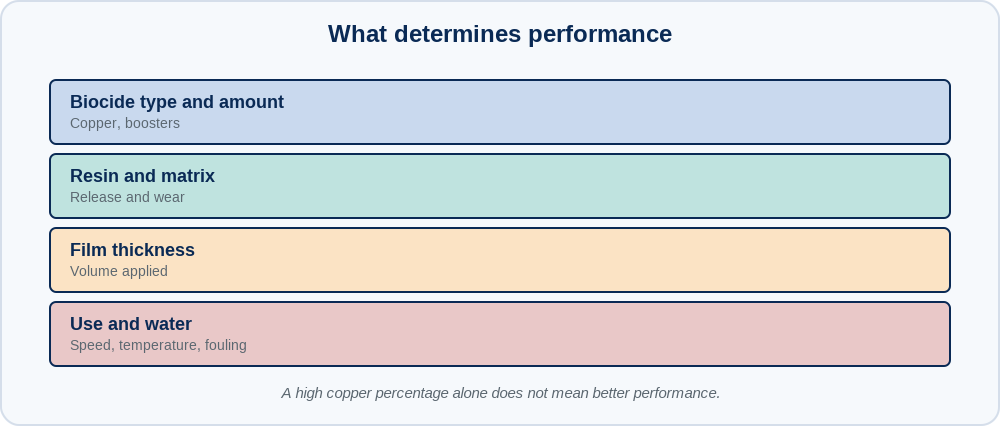
The copper (cuprous oxide) percentage on an antifouling label is usually given by weight and does not decide performance on its own; Practical Sailor notes that a paint with heavy solids and resin may contain more copper than a “thinner” paint. Release rate, resin matrix, film thickness and conditions of use also matter. A six-month independent study by Chalmers University of Technology in Swedish, Danish and French waters found coatings with low copper content can work as well as those with more; a Japanese ship-paint study reports a threshold of about 20 percent for sea animals and about 5 percent for algae. These findings come from particular conditions and cannot be generalised to every product; the exact choice depends on the data sheet and local regulation.
Key points
- The label copper percentage is usually by weight and does not decide performance on its own.
- Release rate, resin matrix, film thickness and conditions of use also affect performance.
- The Chalmers study (Sweden, Denmark, France; six months) found low-copper coatings can work as well as higher-copper ones.
- A Japanese ship-paint study reports a copper threshold of about 20 percent for sea animals and about 5 percent for algae for macrofouling; slime formed on all panels.
- Findings belong to specific conditions; the data sheet, independent tests and local regulation govern the choice.
1. What does the copper percentage on the label say?#
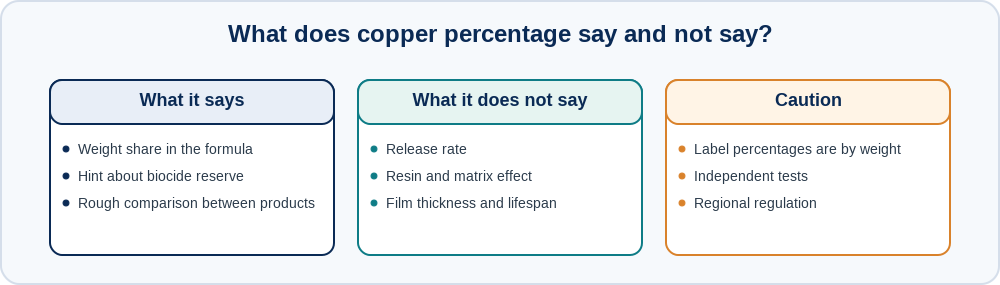
Many boat owners look first at the copper figure on the label when choosing antifouling. Cuprous oxide is the classic antifouling biocide; Soundings explains that it gradually releases copper ions into the water, which is why antifouling is called “copper bottom” paint. But the label percentage is not the only indicator of performance. Practical Sailor notes that the copper percentages listed on paint cans are usually calculated by weight, meaning a paint with heavier solids and resin may actually contain more copper than a “thinner” paint claiming a higher percentage. This article is a general summary; it recommends no copper content for any product.
Ranking products only by label percentage can therefore mislead. The same percentage behaves differently in different resin systems. A retailer’s technical note says antifouling effectiveness is determined by copper concentration in the thin layer of water next to the hull, not by the copper content in the paint, and that a paint with 25 percent copper that polishes continuously may protect better in heavy fouling than a 40 percent paint that releases slowly; that is a seller’s account and not independently verified, but it summarises the mechanism well.
2. What have independent studies found?#
Researchers at Chalmers University of Technology compared seven antifouling paints in the coastal waters of Tjärnö in Sweden, Hundested in Denmark and Arcachon Bay in France: five paints with cuprous oxide from 6 to 32 percent by weight, a biocide-free silicone paint and a paint containing tralopyril and zinc pyrithione, not copper. Panels were immersed for up to six months. According to PBO and Ocean News, which report the study, the finding is that coatings with low copper content can work as well as those with more copper; the researchers argued that paints with the highest copper content are unnecessary and should be phased out. That is one research team’s result from a particular region and period.
A 2015 study on ship paints by Japan’s National Maritime Research Institute ran static raft tests with paints containing cuprous oxide from 0 to 40 percent and reported that the cuprous oxide threshold for macrofouling prevention was about 20 percent for sea animal species and about 5 percent for algae, while all test plates suffered microfouling by slime. That study simulates ship conditions and cannot be translated directly to leisure boats; still, it is an independent data point showing the relation between copper content and effectiveness is not linear.
| Study | Finding | Caution |
|---|---|---|
| Chalmers (Sweden, Denmark, France) | Low-copper coatings can work as well as higher-copper ones | Six months; coastal waters; seven paints |
| Japan ship-paint study (2015) | Threshold: animals ~20%, algae ~5%; slime on every panel | Ship conditions; static raft test |
| Practical Sailor | Label percentage by weight; heavy paint may hold more copper | Magazine analysis |
| Seller technical note | Boundary-layer copper determines effectiveness | Seller claim; not independently verified |
3. Release rate, matrix and booster biocides#
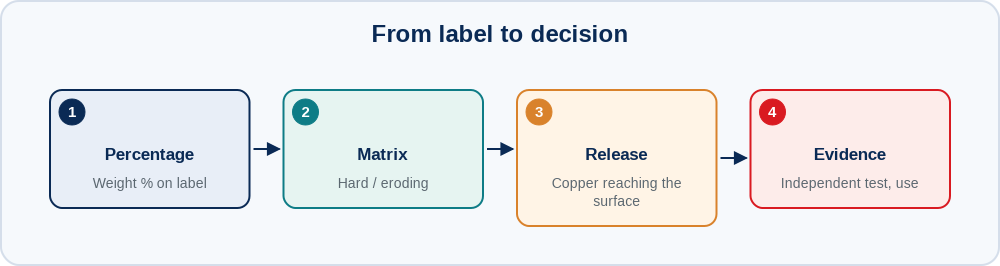
The effect of copper depends on the amount released into the water. Another Chalmers study investigates the minimum copper dose needed to inhibit biofouling from commercial antifouling coatings in European coastal waters, the “critical release rate”, and notes that most antifoulings work by continuously releasing copper into the water, which raises environmental concern. So the aim is not “more copper” but “sufficient and controlled release”. Release rate depends on resin matrix, whether the paint is hard or eroding and water movement; for the difference between hard and eroding types see the related article.
Many formulations contain “booster” biocides in addition to copper. An academic paper writes that to raise antifouling efficiency boosters such as copper pyrithione, zinc pyrithione, zineb, triphenylborane and Sea-Nine are incorporated with the principal copper-based biocide; Ocean Navigator also relays that some Interlux and Pettit paints use boosters from the pharmaceutical industry to cut the need for heavy copper loads. So comparing only the copper percentage of two products is not comparing their total biocide systems.
4. What to look at when choosing#
Treat copper content as one criterion, not the only one. First define your use pattern (speed, mooring, water type); then examine the type (hard, eroding, hybrid) and the data sheet; where possible look at independent test results and user experiences in your region. If your region has a copper limit (for example Sweden allows reduced-copper products on the Baltic) the product must be legal; see the biocide regulation article.
Film thickness is critical too: a high-copper paint applied thinly may be used up earlier than a medium-copper paint applied at the right thickness. For coat count and thickness see the related article. This article recommends no copper content or product.
- Write down your use pattern (speed, mooring, water type).
- Identify the product type and the data-sheet definition.
- Remember the label copper figure is by weight; do not compare on it alone.
- Examine booster biocides and the total system.
- Look for independent tests and many user experiences.
- Check your region’s biocide limits.
- Follow the data-sheet film thickness and record it.
5. Restrictions and the environment#
Copper is a pollutant entering waters; the German Environment Agency relays that in 2016 around 19 percent of the copper load in German surface waters was estimated to come from biocidal antifouling coatings on pleasure craft. The Chalmers researchers’ emphasis on “unnecessarily high copper” gains meaning in this environmental context. Even so Practical Sailor’s 2012 piece notes cuprous oxide still rules the roost in long-term antifouling protection; so the question is not “copper or no copper” but “how much and how”.
6. Common mistakes#
- Ranking products only by copper percentage.
- Thinking the label percentage is by volume.
- Ignoring booster biocides and matrix.
- Treating a seller’s technical note as independent evidence.
- Generalising a regional study to every water.
- Relying on high copper while applying a thin film.
- Not checking regional copper limits.
7. Checklist#
8. Conclusion#
The copper percentage on the label is not the sole determinant of performance: release rate, resin matrix, booster biocides, film thickness and conditions of use also matter. The Chalmers study found low-copper coatings can work as well as higher-copper ones and a Japanese ship-paint study reported threshold values; but findings belong to specific conditions. The data sheet, independent tests and local regulation govern the choice. This article is general information and recommends no product.
Frequently asked questions#
Is a paint with higher copper percentage better?
Not on its own. The Chalmers study found low-copper coatings can work as well as those with more copper; performance also depends on release rate, matrix and use.
What does the percentage on the label show?
Usually the share by weight. Practical Sailor notes a paint with heavy solids and resin may contain more copper than a thinner one, so percentages should be compared with care.
What is a booster biocide?
An additional biocide added to the formulation alongside copper to raise performance; the literature mentions copper pyrithione, zinc pyrithione and zineb among examples.
Do these findings apply to every boat?
No. The studies were done in particular waters, over particular periods and with particular products; your water and use may differ.
Should I choose a low-copper product?
This article makes no choice. Check the data sheet, independent tests and your region’s biocide rules; in some regions low-copper products may be required.
Was this guide helpful?
Thank you! Your feedback has been saved.
Guide content is for general information; in practice, the current technical data sheet of the product applies.
Keep reading
Related guides
Boat Colour Selection and Solar Reflectance: Effect of Heat Absorption on Surfaces
A study of the effect of boat paint colour on solar reflectance and surface temperature.
2 min read Paint and CoatingsCauses and Diagnosis of Paint Blistering
A study of the sources, types and diagnostic approach to blistering on boat paints.
2 min read Paint and CoatingsNumber of Coats in Epoxy Coating Systems
A study of the effect of the number of coats in epoxy coating systems on protective performance and thickness.
2 min read