
Paint and Coatings
The Difference Between Hard and Eroding Antifouling
The first question in choosing antifouling is hard or eroding. This article summarises how the two types work, the differences by use pattern and the blurring boundary with semi-eroding types using general sources.
Short answer
According to International Yacht Paint hard antifouling does not really wear and its biocide leaching rate falls over the product’s life; eroding types slowly erode in seawater, eventually leaving little antifouling on the hull. Hard types are generally recommended for fast and regularly used boats, drying moorings and frequently hauled hulls; eroding types for boats that stay in the water and sail regularly. Build-up occurs over years on hard types, which eroding types reduce. In reality the boundary is blurred; the exact choice depends on the product data sheet and the maker.
Key points
- A hard type does not wear and leaches biocide from the film surface; an eroding type slowly wears to expose fresh biocide.
- For fast and regularly used boats, drying moorings and frequent haul-outs hard types are often recommended.
- Eroding types are not suited to drying moorings and, because the film is lost, reduce the need for sanding and removal.
- On hard types layers build up over years; removal may be needed in time.
- Semi-eroding and hybrid products blur the boundary; the data sheet and use pattern decide the choice.
1. The basic difference: to wear or not to wear#
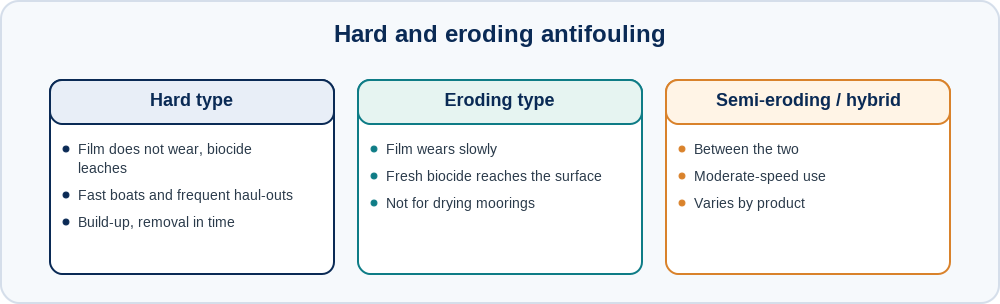
The first decision in choosing antifouling is whether it will be hard or eroding. According to International Yacht Paint hard antifoulings do not really wear; they deter fouling organisms by releasing biocide from the coating surface, but the biocide leaching rate falls over the product’s life and after a few seasons residual build-up may occur. Eroding (soft or ablative) types also release biocide but slowly erode in seawater, eventually leaving little or no antifouling on the hull. Within eroding types the “self-polishing copolymer” subgroup, with more complex chemistry, keeps biocide release and erosion more controlled and the film smooths over time. This article is a general summary and recommends no specific product.
A manufacturer executive tells Yachting Magazine that the terms “ablative” and “hard” are being blurred by new technology. So it is necessary to look at the data-sheet definition and use conditions more than the product name.
2. Which use suits which type?#
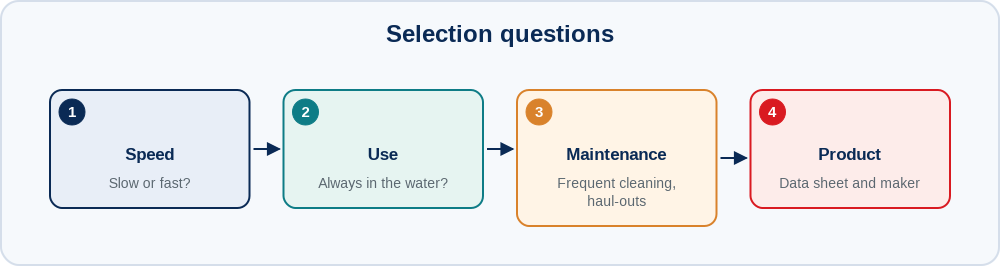
Sources draw a similar picture. International says that if you have a fast boat, or a fast boat used regularly, hard antifouling is usually the best choice. YBW writes that hard types can be effective up to very high speeds and are preferably re-applied annually, that yachts with drying moorings need hard types and that soft self-polishing types are for yachts constantly immersed. BoatTest says for a high-performance boat used regularly hard is probably the way to go and that boats moored in fresh water normally use hard types because eroding types may not erode well. These are magazine and test-site accounts; judge them against your boat and conditions.
Eroding types are considered suitable for cruising yachts and displacement motorboats; Powerboat magazine recommends hard or semi-ablative for fast boats and an ablative for slower boats kept in a marina. Yachting Magazine writes that on boats that often cruise over 30 knots many ablative paints wear too quickly. These limits are approximate and source-dependent; the maker’s data sheet governs.
| Type | Typical use | Watch |
|---|---|---|
| Hard | Fast boat, drying mooring, frequent haul-out | Build-up; removal cost |
| Eroding / self-polishing | Always in water, regular sailing, cruising | Not for drying moorings |
| Semi-eroding / hybrid | Moderate speed, mixed use | Behaviour varies by product |
| Fresh water | Generally hard types | Eroding type may not erode enough |
3. Build-up, maintenance and removal#
The main downside of a hard type is build-up. Boating magazine writes that because hard paint does not wear away each repaint adds a layer and over time a thick, rough, pockmarked bottom can form, which reduces performance and makes periodic sanding or stripping inevitable. Soundings also notes that ablative paints simply need reapplying while hard paints build up and will eventually require sandblasting or another method to remove. In contrast the film on an eroding type thins over time; so thickness at first application sets the number of seasons (for detail see the article “Number of Coats and Thickness in Antifouling Paint”).
Cleaning method varies by type. BoatTest stresses that hard types can be scrubbed, eroding types lightly wet-sanded and that no antifouling should ever be dry-sanded because the dust is toxic. Boating magazine adds that those who scrub the waterline and transom often paint those areas with hard paint even if the hull bottom has ablative antifouling. That is one magazine’s practical tip.
4. Semi-eroding and hybrid products#
Some products aim to fill the gap between hard and eroding. Powerboat magazine writes that there are many hybrid or semi-ablative antifoulings splitting the difference between hard and soft and that with a semi-ablative product hauling about once every 18 months and giving a light wet sand can be enough. A retailer says its own hybrid product combines the durability of hard paint with gradual wear; that is a seller claim and not independently verified. For hybrids in detail see the article “Advantages of Hybrid Antifouling Paints”.
One note: some sellers say hard paint loses its copper faster if left out of water after application and that this is why hard paint is typical for boats kept in the water for long periods (TotalBoat support note); that is a seller statement and varies by product. For your own product see the maker’s launch window.
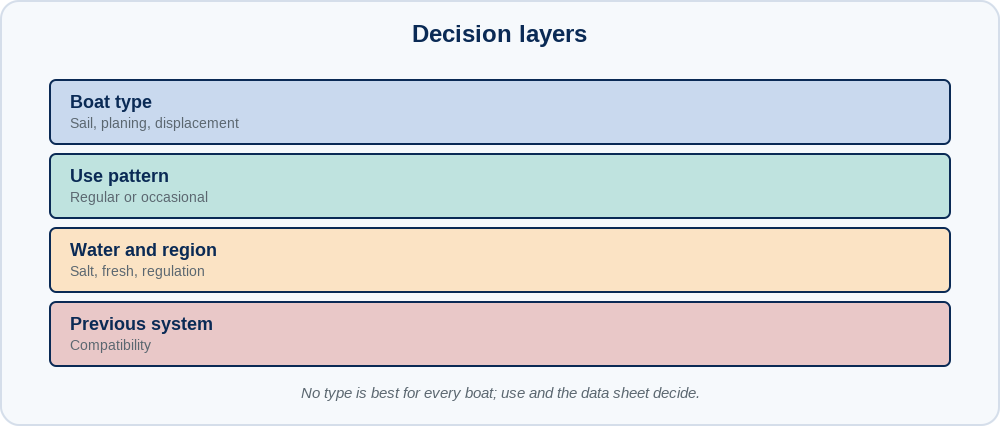
- Write down the boat’s speed and use pattern.
- Assess drying mooring, haul-out frequency and water type.
- Check compatibility with the existing antifouling system.
- Check your region’s biocide regulation.
- Confirm type and coat plan against the data sheet.
- Decide the maintenance method (scrub, wet sand) by type.
- Record observations at season end.
5. Regulation and the environment#
Antifouling choice is not independent of environmental regulation. The RYA notes that antifouling paint can enter the water through wear or during application and removal and can be ingested by marine life, affecting the food chain. Legal requirements vary by region; see the biocide regulation article for detail. This article is not legal advice; check local rules and product approval status.
6. Common mistakes#
- Applying a soft self-polishing type to a boat on a drying mooring.
- Choosing a quickly eroding type for a fast boat.
- Applying a new system incompatible with the old antifouling.
- Dry-sanding antifouling.
- Underestimating coat count and thickness.
- Ignoring build-up on hard types.
- Treating seller claims as independent verification.
7. Checklist#
8. Conclusion#
Hard antifouling does not wear and leaches biocide; an eroding type slowly wears to expose fresh biocide. Hard types are often recommended for fast and regularly used boats, drying moorings and fresh water; eroding types for boats that stay in the water and sail regularly; but the boundary is blurred. The choice depends on use pattern, water type, existing system, regulation and the product data sheet. This article is general information.
Frequently asked questions#
What is the basic difference between hard and eroding antifouling?
A hard type does not wear and leaches biocide from the surface; an eroding type slowly wears in water to expose fresh biocide (International).
Which for a fast boat?
International says hard antifouling is usually the best choice for fast boats used regularly; still see the product data sheet.
Is an eroding type fine on a drying mooring?
YBW says soft self-polishing types are not suited to boats with drying moorings; hard types are more suitable.
What is the downside of hard types?
According to Boating magazine, because hard paint does not wear away each repaint adds a layer and over time a thick rough bottom can form; periodic sanding or removal is needed.
What is a semi-eroding type?
Hybrid products placed between hard and eroding; Powerboat magazine describes them as a middle path. Actual behaviour varies from product to product.
Was this guide helpful?
Thank you! Your feedback has been saved.
Guide content is for general information; in practice, the current technical data sheet of the product applies.
Keep reading
Related guides
Boat Colour Selection and Solar Reflectance: Effect of Heat Absorption on Surfaces
A study of the effect of boat paint colour on solar reflectance and surface temperature.
2 min read Paint and CoatingsCauses and Diagnosis of Paint Blistering
A study of the sources, types and diagnostic approach to blistering on boat paints.
2 min read Paint and CoatingsNumber of Coats in Epoxy Coating Systems
A study of the effect of the number of coats in epoxy coating systems on protective performance and thickness.
2 min read