
Paint and Coatings
Moisture Problems in Foam-Core Sandwich Hulls
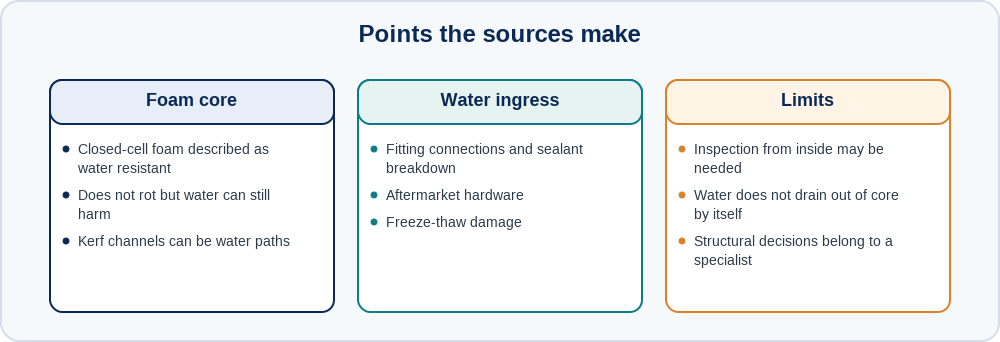
In foam-core sandwich hulls closed-cell foam is described as water resistant, but sources say foam is not entirely immune to water damage and that ingress mostly comes through fitting connections and sealant breakdown. This article summarises the accounts with their limits; it is not survey or repair advice.
Short answer
A sailing magazine writes that plastic foam core is lighter than balsa, its closed-cell construction resists water migration or saturation and it does not rot, making it the dominant choice for cored hulls. Another publication says it is a misconception that foam cores are impervious to water intrusion, that they too can sustain damage and that once moisture enters the core it starts to degrade, compromising the integrity of deck or hull. A boating site says synthetic closed-cell foam cores do not rot per se but can deteriorate when continuously exposed to water. This article recommends no method or repair; a qualified specialist governs.
Key points
- Closed-cell foam cores are described as water resistant and non-rotting but not entirely immune (magazines).
- Ingress mostly comes through fitting connections, sealant breakdown and aftermarket hardware.
- If kerf channels exist the foam’s water resistance is of little use.
- Water that enters the core does not drain out by itself; stiffness loss and delamination can follow.
- For inspection and repair decisions a qualified specialist governs.
1. What is a foam-core hull?#
A sandwich structure has a lightweight core between two fibreglass skins; a sailing magazine lists the three main foam types as styrene acrylonitrile, linear polyvinyl chloride and cross-linked polyvinyl chloride and writes that foam is light, its closed-cell construction resists water migration, it does not rot and so is the dominant choice for cored hulls. This article is a general summary; it gives no diagnosis, survey, repair method or time and is not advice. Sources are magazine, organisation, survey and user accounts and may differ; maker and seller statements are labelled.

2. How water resistant is foam?#
A sailing publication describes it as a misconception that foam cores are impervious to water intrusion, saying these cores can also sustain damage and that once moisture enters the core it starts to degrade, compromising the integrity of the deck or hull. A boating site writes that synthetic closed-cell foam cores do not rot per se but can deteriorate when continuously exposed to water. Another magazine says foam does not rot if it gets wet, unlike balsa, but if there are kerf channels the core’s resistance to water absorption is of little use.
| Topic | Sources’ general account | Caution |
|---|---|---|
| Foam | Closed-cell; does not rot | Not entirely immune |
| Ingress | Fittings and sealant | Grows over time |
| Result | Stiffness loss, delamination | Structural decision to specialist |
3. Ingress sources and limits#
A boating publication writes that cored composite construction has a sometimes fatal weakness, water intrusion and the decay and delamination it can lead to; most water-intrusion problems can be prevented in design and construction, but in many cases problems begin after the vessel is completed when aftermarket hardware such as life rafts, antennas, transducers and canvas brackets is installed.
A British boating magazine writes that as fittings age and sealants break down moisture works its way into the core through these vulnerable areas, sometimes creating very costly problems; it adds that water getting into a foam laminate and freezing can reduce the core to little more than ineffective mush, and that core inspection will almost always have to be from inside the craft, core locations usually being fairly obvious inside anchor lockers, aft cockpit lockers or hull voids.
A powerboat magazine writes that any cored laminate is susceptible to water intrusion, the core material not mattering although plywood and balsa have the added disadvantage of rotting when wet; that water that seeps into the core never seeps back out, gradually meandering through and eventually causing trouble, reducing the stiffness of the sandwich so it flexes more, delaminates more and eventually fractures the core. The same article says years of ingress add excess weight to the boat.
A marine publication writes that in construction the core is relieved around hardware and replaced with solid glass, but that this is in a perfect world and it is not always so; that is a magazine account and may not hold for every boat.
A patent document writes that moisture in hull, deck and other structures tends to weaken structural components, that wood or foam cores can be jeopardised by moisture entry and that even polymeric foam cores can be weakened; that is a patent account promoting a commercial method and is not independent verification.
On user forums people report moisture and staining around hardware appearing over time on foam-cored boats; these are experiences not independently verified and vary by boat.
Shared points: foam does not rot but is not entirely immune to water, ingress mostly comes from hardware and sealant and water in the core does not drain out by itself. The difference lies in how durable each core is, the inspection method and the scope of repair.
Keeping records helps too: when which hardware was refitted, when sealant was replaced and where signs of moisture appeared can ease later diagnosis.
4. A practical frame#
- Note signs (softness, dull sound, stains, moisture around fittings) by eye and tapping.
- Review ingress sources (fitting connections, cracks, edges) with a qualified craftsman.
- Consult a surveyor or specialist on moisture measurement and core inspection, knowing it may need to be done from inside the hull.
- Plan to renew fitting sealing per the maker’s instruction.
- For core damage apply to a qualified repair specialist.
- Separate maker, seller and user accounts.
- Keep records.
5. Limits#
Sources overlap that foam does not rot but is not entirely immune to water, that ingress comes from hardware and sealant and that water in the core does not drain out by itself; they differ on how durable each core is and on inspection and repair method. Patent and user accounts are specific to their contexts. So there is no single right answer; a qualified specialist governs. This article is not survey, engineering or repair advice.
5b. Where sources differ#
A sailing magazine stresses foam’s water resistance; another says foam can be damaged too; a powerboat magazine says core material does not matter; a patent promotes a commercial solution; users report their own experiences. These are sources speaking in different contexts and with different interests. The difference means consulting a qualified specialist for your own boat.
This article is general information; it recommends no product, method, ratio, number of coats or time. The maker’s data sheet and a qualified yard govern.
5c. A practical frame for reading the sources#
The sources are magazines, makers, sellers and forums; each writes in its own context. None knows the source of moisture, the core condition or the repair scope of your boat. So taking the shared message and consulting the maker and a qualified yard for detail is reasonable.
Damp or weakened cored structures can carry structural weakness risk; inspection and repair can carry injury and irritation risk from confined spaces, chemicals and dust. This article describes no method or personal protection; read the safety data sheets of products and consult a qualified specialist. For safety-critical matters such as hull integrity apply to a qualified specialist.
Seller and maker statements are the firm’s own account of its product and have not been independently verified. A product’s compatibility with another coating should always be checked in the product’s technical document; where a document and a guide conflict, the maker’s document and a qualified yard’s assessment should be used. Recording decisions and product details helps later maintenance.
6. Common mistakes#
- Treating foam as completely immune to water.
- Neglecting hardware sealing.
- Looking only from outside and skipping core inspection.
- Not recording signs.
- Treating a patent or seller claim as independent verification.
- Not consulting a specialist on core damage.
- Keeping no records.
7. Checklist#
8. Conclusion#
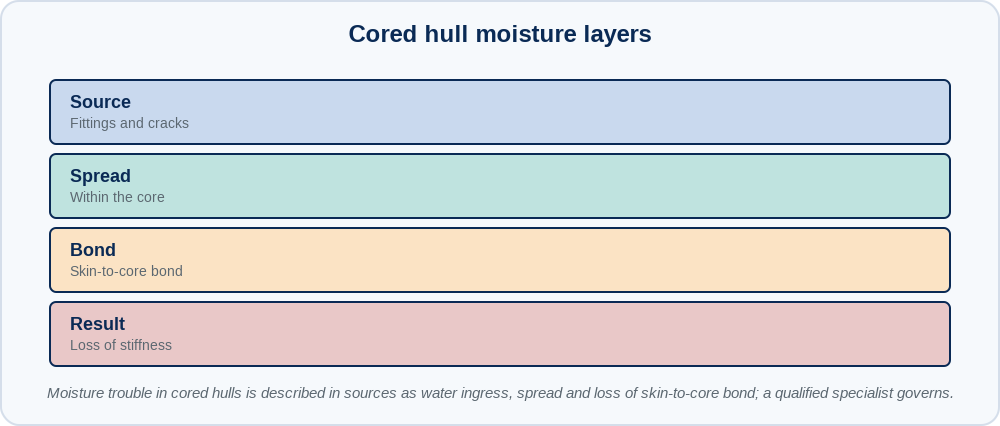
Moisture trouble in foam-core sandwich hulls is described in sources as water ingress, spread in the core and loss of skin-to-core bond. This article is general information; it gives no survey, repair or time and a qualified specialist governs.
Frequently asked questions#
Is foam core waterproof?
Sources describe closed-cell foam as water resistant and non-rotting but say it is not entirely immune.
How does water get into the core?
Sources mostly describe fitting connections, sealant breakdown and holes for aftermarket hardware.
Does water in the core dry out by itself?
A magazine writes that water seeping into the core never seeps back out, meandering through the core and eventually causing trouble.
How is it inspected?
A magazine says core inspection mostly has to be made from inside the boat; this article gives no method.
Should I repair it myself?
Core repair is structural work; apply to a qualified specialist.
Was this guide helpful?
Thank you! Your feedback has been saved.
Guide content is for general information; in practice, the current technical data sheet of the product applies.
Keep reading
Related guides
Boat Colour Selection and Solar Reflectance: Effect of Heat Absorption on Surfaces
A study of the effect of boat paint colour on solar reflectance and surface temperature.
2 min read Paint and CoatingsCauses and Diagnosis of Paint Blistering
A study of the sources, types and diagnostic approach to blistering on boat paints.
2 min read Paint and CoatingsNumber of Coats in Epoxy Coating Systems
A study of the effect of the number of coats in epoxy coating systems on protective performance and thickness.
2 min read