
Paint and Coatings
Barrier Coat Warranty Conditions After Osmosis Treatment
Barrier-coat warranties are described in sources as depending on product, applicator and conditions; it is also stated plainly that no treatment can be guaranteed to succeed. This article summarises the accounts; it is not legal, contract or survey advice and promises no particular warranty.
Short answer
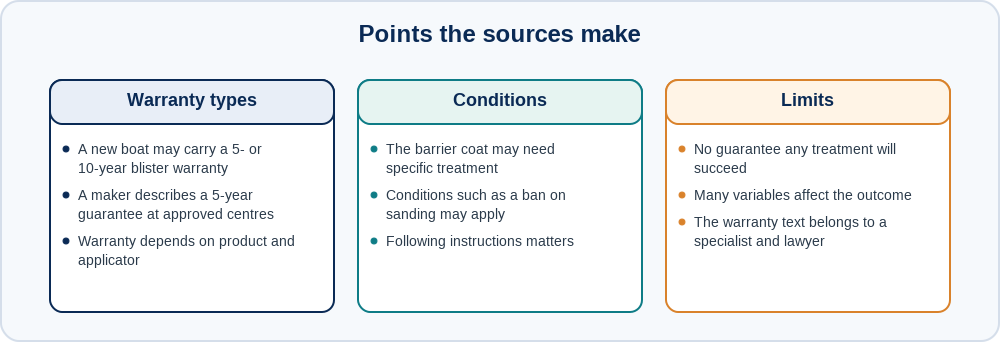
A marine retailer’s guide says new boats are frequently delivered with a barrier coat applied at the factory and may include a five- or ten-year blister warranty, and that the barrier coat may need to be treated in a specific way to keep the warranty intact, for example a prohibition against sanding it. A paint maker’s page says an epoxy product carries a five-year treatment guarantee when applied by approved centres; that is a maker statement. An epoxy maker’s osmosis repair guide says there is no guarantee that any treatment will be successful, that many variables affect the result and strongly recommends engaging a qualified marine surveyor before treatment. This article recommends no warranty or product; read the written text and consult a specialist.
Key points
- New boats may come with a factory barrier coat and a five- or ten-year blister warranty (retailer guide).
- Keeping the warranty may require particular treatment of the barrier coat, for example no sanding.
- A maker describes a five-year treatment guarantee when applied by approved centres; that is a maker statement.
- An epoxy maker writes that no treatment can be guaranteed to succeed.
- Scope must be read from the written text; consult a specialist and, if needed, a lawyer.
1. Why does the warranty matter?#
A marine retailer’s guide describes three kinds of barrier-coat project: preventive coating on new boats, blister repair alone, and blister repair with a barrier coat. The same guide says new boats are frequently delivered with a barrier coat applied at the factory and may include a five- or ten-year blister warranty. This article is a general summary; it gives no legal or contract advice, survey, product recommendation or time and promises no particular warranty. Sources are retailer, maker and survey accounts and may differ; maker and seller statements are labelled.

2. Warranty types and conditions#
The retailer guide says one may have to treat the barrier coat in a specific way to keep the warranty intact, for example there may be a prohibition against sanding it, and that if a new boat has no barrier coat one may investigate whether the builder used resins resistant to osmotic blistering, commonly vinylester. A paint maker’s page describes a two-component epoxy reinforced with glass flakes with a treatment guarantee of up to five years when applied by approved centres; that is a maker statement, scope and conditions must be read from the maker’s document and this article recommends no product.
| Topic | Sources’ general account | Caution |
|---|---|---|
| New boat | Factory barrier coat, 5- or 10-year blister warranty possible | Conditions are in the document |
| Maker | Up to 5 years when applied by approved centres | Maker statement |
| General | Success cannot be guaranteed | Many variables |
3. Limits, differing views and caution#
An epoxy maker’s osmosis repair guide says many variables affect blister formation, a lasting repair needs thorough preparation and adequate application, there is no guarantee any treatment will succeed, and it strongly recommends a qualified marine surveyor be engaged before treatment; the guide also says the maker gives no warranty of fitness for a particular purpose and carries limited-liability terms. That is a maker publication and legal obligations vary by country.
A Tasmanian government maritime agency’s osmosis document says diagnosis and the level of treatment required are decided by considering a number of factors, one being visual examination of the hull for blisters or wicking; that is an agency document and contains no warranty terms. In general, how long a warranty lasts and what it covers varies with product, applicator and contract and the sources offer no single standard.
The retailer guide also notes that conditions such as restrictions on sanding the barrier coat can affect the warranty, so reading the written text first makes sense so that future maintenance, bottom-paint application and hull work do not conflict with it. This article cannot give a detailed list of conditions because they vary by maker and applicator.
On user forums people describe differing experiences of how warranties work in practice, in which cases they were refused and what happens when an applicator company closes; these are individual, unverified experiences and this article draws no general conclusion from them.
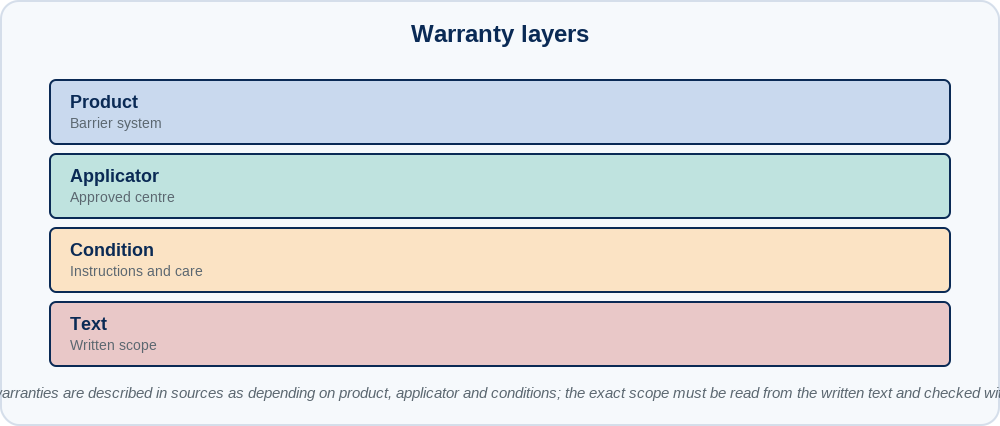
Shared points: a warranty depends on product, applicator and conditions, conditions may affect how the barrier coat is treated and success cannot be guaranteed. The difference lies in duration, scope and relationship with the applicator; seller and maker statements carry commercial context.
Keeping records helps too: the warranty document, application date, product used, applicator details, post-delivery maintenance records and correspondence are useful if a problem arises later.
4. A practical frame#
- Ask for the warranty document in writing and read scope, conditions and exclusions.
- Clarify with the maker and applicator the conditions for keeping the warranty, such as sanding and maintenance limits.
- Have the maker confirm whether the applicator is approved or authorised.
- Keep application records and product and batch information.
- Before bottom paint and hull maintenance check that they do not conflict with the warranty conditions.
- Separate maker, seller and user accounts.
- If unclear, consult a surveyor and, if needed, a lawyer.
5. Limits#
Sources overlap that a warranty depends on product, applicator and conditions and that success cannot be guaranteed; they differ on duration, scope and how it works in practice. Maker and retailer accounts carry commercial context; user experiences are unverified. So there is no single right answer; the written text and a qualified specialist govern. This article is not legal, survey or repair advice.
5b. Where sources differ#
The retailer guide mentions five- or ten-year warranties; a maker describes five years at approved centres; an epoxy maker writes that no treatment can be guaranteed to succeed; users report differing experiences. These are sources speaking in different contexts and with different interests. The difference means reading your own warranty text and consulting a specialist.
This article is general information; it recommends no product, method, ratio, number of coats or time. The maker’s data sheet and a qualified yard govern.
5c. A practical frame for reading the sources#
The sources are magazines, makers, sellers and forums; each writes in its own context. None knows the scope, conditions or legal consequences of a warranty of your boat. So taking the shared message and consulting the maker and a qualified yard for detail is reasonable.
Osmosis work can carry injury and irritation risk from chemicals, dust and sanding. This article describes no method or personal protection; read the products’ safety data sheets and consult a qualified specialist. For safety-critical matters such as hull integrity apply to a qualified specialist.
Seller and maker statements are the firm’s own account of its product and have not been independently verified. A product’s compatibility with another coating should always be checked in the product’s technical document; where a document and a guide conflict, the maker’s document and a qualified yard’s assessment should be used. Recording decisions and product details helps later maintenance.
6. Common mistakes#
- Not reading the warranty in writing.
- Not knowing that actions such as sanding the barrier coat can affect the warranty.
- Not verifying the applicator’s authority.
- Not keeping records.
- Treating a seller or maker statement as contract scope.
- Treating a user experience as a general rule.
- Not consulting a specialist when unclear.
7. Checklist#
8. Conclusion#
Barrier-coat warranties are described in sources as depending on product, applicator and conditions; success cannot be guaranteed. This article is general information; it is not legal advice, a survey or a promise of any warranty.
Frequently asked questions#
Is there a barrier-coat warranty?
A retailer guide says new boats may carry a five- or ten-year blister warranty; a maker describes a five-year treatment guarantee at approved centres. Scope must be read from the written text.
What can void it?
The guide says keeping the warranty may require specific treatment of the barrier coat, such as a ban on sanding; the exact conditions are in the document.
Does a warranty guarantee success?
An epoxy maker writes there is no guarantee any treatment will succeed and many variables affect the result.
Who should apply it?
A maker’s page ties its guarantee to approved centres; that is a maker statement and this article recommends no applicator.
Is this legal advice?
No. This article is not legal or contract advice; consult a specialist and, if needed, a lawyer about the written text.
Was this guide helpful?
Thank you! Your feedback has been saved.
Guide content is for general information; in practice, the current technical data sheet of the product applies.
Keep reading
Related guides
Boat Colour Selection and Solar Reflectance: Effect of Heat Absorption on Surfaces
A study of the effect of boat paint colour on solar reflectance and surface temperature.
2 min read Paint and CoatingsCauses and Diagnosis of Paint Blistering
A study of the sources, types and diagnostic approach to blistering on boat paints.
2 min read Paint and CoatingsNumber of Coats in Epoxy Coating Systems
A study of the effect of the number of coats in epoxy coating systems on protective performance and thickness.
2 min read