
Refit and Maintenance
Tank Inspection, Maintenance and Repair: Holiday Testing, Thickness Measurement and Records
When a tank lining is finished the job is not over: inspection, maintenance, repair where needed and record keeping are the second half of the tank’s life. This article summarises inspection methods, thickness measurement, holiday testing and records for steel boat tanks from source accounts; it is not engineering or survey advice.
Short answer
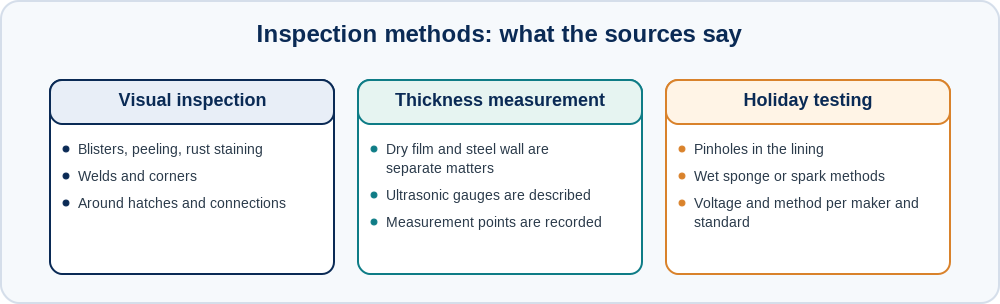
Sources describe tank inspection as starting with visual examination (blistering, peeling, rust staining, welds and corners, around hatches and connections), say dry film thickness and steel wall thickness are separate measurements and that pinholes in a lining can be searched for with holiday testing. Coating makers describe thickness measurement and holiday testing as acceptance checks and say defects found should be repaired to the maker’s instruction and retested. This article recommends no voltage, method, time or thickness limit; the maker’s document, relevant standards, a survey and a qualified specialist govern.
Key points
- Inspection starts with visual examination; blistering, peeling, rust staining, welds and corners and the hatch area are the main findings described.
- Dry film thickness and steel wall thickness are separate measurements; a lining does not restore wall loss.
- Holiday testing is described for finding pinholes in the lining; method and voltage are set by the maker and standard.
- Repair approaches differ for minor, widespread and structural damage; a survey and the maker decide.
- Records (photos, measurements, dates, repairs) form the basis for comparison and warranty.
1. Why inspect? The second half of a lining’s life#
Once a tank lining is finished and in service, its real test begins. Sources say lining life depends not only on the product and application quality but on operating conditions and inspection frequency. A small blister or peel noticed early can be fixed with local repair, while damage noticed late may require widespread recoating or structural repair. This article is a general summary of source accounts; it recommends no inspection method, voltage, thickness limit or repair procedure for any tank. Maker and seller statements are labelled.
2. Visual inspection: what is looked for?#
Sources describe inspection as starting with visual examination. Findings sought are blistering, peeling or cracking of the lining, rust staining or weeping, discolouration, areas of lining loss and signs of leakage. Welds, corners and edges get particular attention because lining tends to be thin there; the area around hatches, connections and pipe penetrations is a separate inspection point. As the drinking-water tank article described, corrosion around a hatch may come from a gasket or sealant unsuited to the tank; that is a magazine expert’s guess and not certain for every case. In waste tanks, sediment build-up, vent blockage and odour are also checked.
| Finding | What is described | Next step |
|---|---|---|
| Blistering | Possible moisture or salt under the lining is described | Maker and survey assess |
| Peeling | Loss of adhesion; may be preparation or local issue | Area is delineated and recorded |
| Rust staining | Sign of lost lining integrity or a wall problem | Thickness and holiday test may be needed |
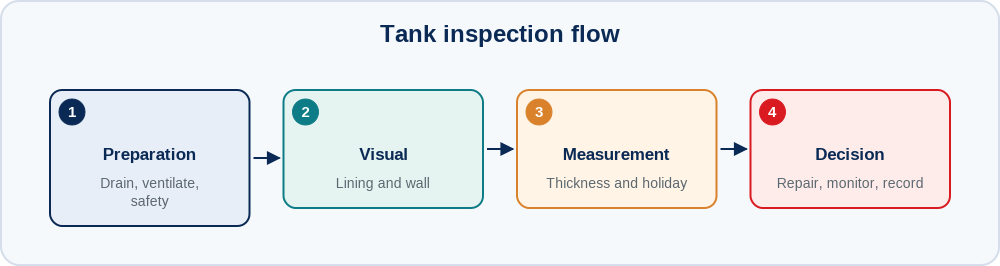
For inspection the tank must be drained, ventilated and made safe to enter; this article presents no safety procedure. Confined-space entry rules, gas testing and ventilation are the responsibility of a qualified specialist. Photographs for lighting and records help document the position of findings; a simple reference for position (such as a weld number or a corner of the tank) is described.
3. Thickness measurement: dry film and steel wall#
There are two separate thicknesses and they must not be confused. Dry film thickness is the coating’s thickness; as described in the earlier articles it should be within the range in the coating maker’s data sheet and, for drinking-water tanks, not exceed the maximum in the certification. Steel wall thickness determines the tank’s structural strength. Sources describe steel thickness being measurable with ultrasonic thickness gauges; the details, calibration and interpretation of that method belong to a qualified inspector. Measurement points are planned in advance and recorded so later comparison can use the same points.
A coating maker’s tank-lining guide says the tank must be structurally sound and that no lining gives structural strength. So if steel wall thickness has fallen noticeably, repairing the coating alone may not be enough; plate replacement or structural repair may be needed, and that decision belongs to a qualified specialist. This article gives no minimum thickness or corrosion allowance; those depend on design and classification rules, boat type and survey.
4. Holiday (pinhole) testing#
Holiday testing is a method used to find invisible pinholes and thin areas in a lining. Sources describe a low-voltage wet-sponge method and a high-voltage spark method and say which is suitable depends on coating thickness and the maker. This article recommends no voltage or method; a wrong voltage can damage the lining and the spark method can be dangerous in a flammable atmosphere. The relevant standard and the maker’s document govern the test. Defects found are marked, repaired to the maker’s repair instruction and retested; results are recorded.
Holiday testing is described not only for new linings but also for later inspections; on an old lining the test method and voltage may need different assessment. Work with the maker and a qualified inspector on this. The scope of the test (the whole tank or critical zones) is decided in advance and recorded.
5. Repair approaches#
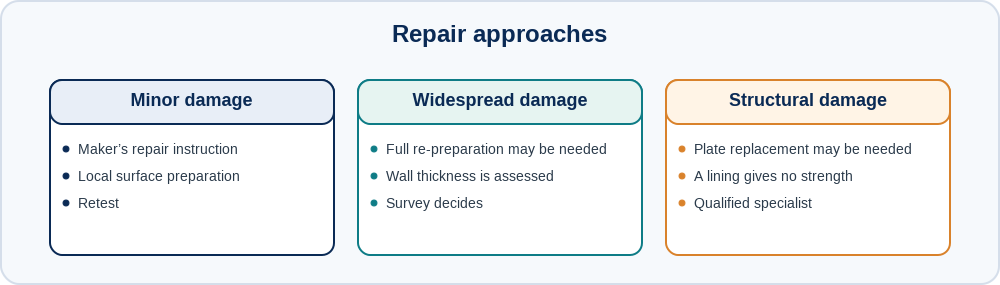
Sources say repair varies with the size of damage. For small local lining damage, local surface preparation and a repair coating to the maker’s repair instruction are described; surface preparation, product compatibility, compatibility of the new coating with the old and cure are decisive. Widespread damage may need the surface re-prepared and the tank recoated, in which case all steps of the first application (blasting, stripe coat, coats, cure, flushing, acceptance tests) come up again. Structural damage needs plate replacement or structural repair rather than coating. A survey and the maker decide which approach is suitable.
Tank type also matters in repair decisions: in a drinking-water tank the repair product must also have a drinking-water document; in a waste tank a chemical-resistance document is sought. After repair, flushing and disinfection of a drinking-water tank are described as being repeated; method and dose depend on the maker and the relevant authority. This article recommends no product or dose.
6. Records: why and what to keep#
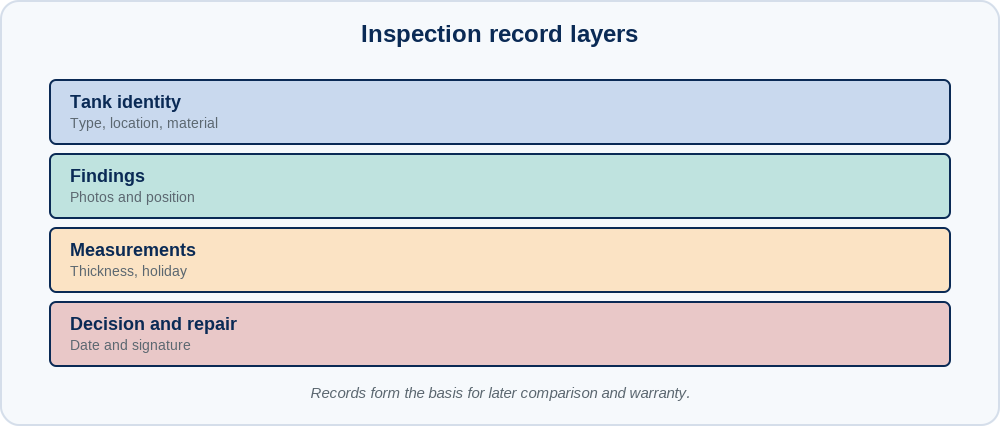
Records are the tank’s life story. The main records described are tank identity (type, location, material, volume), lining system and product batch details, application dates and ambient conditions, thickness and holiday results, inspection findings and photographs, repairs and who did them. These records may be needed later for lining warranty, survey, sale and demonstrating drinking-water suitability. Keeping records in the boat file with a digital backup is a described practice.
Inspection frequency is not fixed by sources: a UK drinking-water regulator’s storage-tank page recommends annual checks of tanks and a sailing magazine describes annual disinfection for drinking-water tanks. These are sources speaking for land installations and particular boats, and over a steel tank’s life the inspection interval should be set with a survey according to the boat, lining and use. This article recommends no interval.
7. A practical frame#
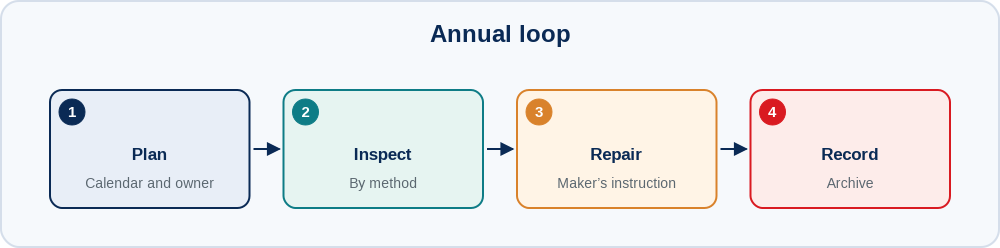
- Write an inspection plan (calendar, owner, method); plan confined-space safety with a qualified specialist.
- Drain and ventilate the tank and make it safe to enter; have gas testing done by a qualified person.
- Carry out the visual inspection; record findings with positions and photographs.
- If needed have dry film and steel wall thickness measurements and holiday testing done by a method suited to the maker and standard.
- If repair is needed do it to the maker’s instruction and the survey’s decision; retest the repair.
- In a drinking-water tank do flushing and disinfection after repair to the maker’s and the authority’s instruction.
- Record all findings, measurements and repairs and archive them.
5. Limits#
Sources say inspection starts with visual examination, that dry film and wall thickness are separate, that holiday testing looks for pinholes and that records matter. They differ on inspection frequency, holiday test method and voltage, repair approach and minimum wall thickness. Organisation and maker accounts are specific to their own contexts. So there is no single right answer; the maker’s document, the relevant standards, a survey and a qualified specialist govern. This article is not engineering, survey or application advice.
5b. Where sources differ#
One body recommends annual tank checks while a magazine describes annual disinfection; one maker describes the wet-sponge method while another the spark method; one user repairs a small blister locally while a survey may recommend full recoating. These are sources speaking in different contexts and with different interests. The difference means applying to the maker’s document and a qualified inspector for your own tank.
This article is general information; it recommends no product, method, ratio, number of coats or time. The maker’s data sheet and a qualified yard govern.
5c. A practical frame for reading the sources#
The sources are magazines, makers, sellers and forums; each writes in its own context. None knows the tank’s inspection method, repair or safety conditions of your boat. So taking the shared message and consulting the maker and a qualified yard for detail is reasonable.
Tank inspection carries confined-space, oxygen deficiency, toxic or flammable gas, solvent-vapour and electrical risk; in particular the spark method of holiday testing is described as potentially dangerous in a flammable atmosphere. This article describes no protection, ventilation or gas-testing method. Follow confined-space rules and plan gas testing with a qualified specialist; do not work alone. For safety-critical matters the opinion of a qualified specialist governs.
Seller and maker statements are the firm’s own account of its product and have not been independently verified. A product’s compatibility with another coating should always be checked in the product’s technical document; where a document and a guide conflict, the maker’s document and a qualified yard’s assessment should be used. Recording decisions and product details helps later maintenance.
6. Common mistakes#
- Confusing dry film thickness with wall thickness.
- Holiday testing with the wrong voltage or method.
- Ignoring small blisters.
- Not checking the repair product’s document for the tank type.
- Keeping no records or photographs.
- Neglecting confined-space safety and gas testing.
- Assuming a lining will restore wall loss.
7. Checklist#
8. Conclusion#
Tank inspection is described in sources as visual examination, thickness measurement, holiday testing, repair approaches and record keeping. This article is general information; it is not engineering, survey or application advice and recommends no method, voltage, thickness limit or interval.
Frequently asked questions#
Why inspect a tank?
Sources describe that early noticing of blistering, peeling and wall loss eases repair; records also allow later comparison.
What is a holiday test?
An acceptance and inspection method used to find invisible pinholes in a lining; wet-sponge or spark methods are described, and voltage and method are set by the maker and standard.
Are dry film thickness and wall thickness the same?
No; dry film is the coating thickness, wall thickness is the steel itself. They are measured by separate methods.
Can I repair a small blister myself?
Sources describe following the maker’s repair instruction; surface preparation and product compatibility matter. A survey and the maker decide.
What records should be kept?
Date, tank identity, findings, photos, measurements, repairs and product batch details are the main records described.
Was this guide helpful?
Thank you! Your feedback has been saved.
Guide content is for general information; in practice, the current technical data sheet of the product applies.
Keep reading
Related guides
Steel Yacht Freshwater Tanks: Design, Material and Internal Lining Guide
The material, design and drinking-water-suitable internal lining of a steel boat’s freshwater tank, summarised from organisation, magazine and maker accounts with their limits.
14 min read Refit and MaintenanceBlasting Inside Tanks: Surface Preparation Standards and Good Practice
How blasting is described for the interior surface preparation of steel tanks: Sa grades, profile, salt and humidity limits and confined-space safety, summarised from standards and maker accounts.
14 min read Refit and MaintenanceDrinking-Water Tank Epoxy Lining: Selection, Stripe Coat, Cure and Disinfection
Product documents, stripe coat, cure, flushing and disinfection steps in epoxy lining of drinking-water tanks, summarised from source accounts with their limits.
11 min read