
Underwater
Biocide-Free Foul-Release (Silicone) Coatings: A Realistic Assessment for Yachts
Foul-release coatings rely on a slippery hull rather than on poisoning organisms. That makes them attractive in the biocide debate, but they are not right for every use profile. This article puts the promises and the limits side by side.
Short answer
Foul-release coatings are silicone-based and contain no biocide; the slippery surface stops organisms attaching strongly, and growth detaches easily as the hull moves or is lightly cleaned. Industry sources report a service life of about 12 to 24 months for most products; the system consists of a primer, a tie-coat and a silicone coat and needs gentle cleaning. On slow boats or boats idle in port the method can fall short; the decision should follow the manufacturer’s region and speed advice.
Key points
- Foul-release coatings are silicone-based, contain no biocide and work through a slippery surface.
- The system usually consists of an epoxy primer, a tie-coat and a silicone topcoat.
- Industry sources report a service life of 12 to 24 months for most products.
- Stiff brushes damage the coating; gentle, frequent cleaning is suitable.
- Low speed and long idle periods are the profile in which the method struggles most.
1. What is foul-release?#
Traditional antifouling paints stop organisms attaching by releasing a biocide from the surface. Foul-release coatings work differently: the surface is ultra-smooth and slippery, so organisms cannot attach strongly, and those that do are easily detached when the boat moves or with light cleaning. These coatings are silicone-based and contain no biocide.
The technology has roots in commercial shipping. Silicone marine coatings have long been used on cargo vessels, while products for recreational craft have become common only in recent years. One manufacturer reports that since 2012 it has made more than ten thousand biocide-free applications to recreational boats in Europe, including heavy-fouling waters such as the Mediterranean. This is a manufacturer’s claim; still, it suggests the technology is beyond the trial stage for recreational craft.
2. Layer structure#
A foul-release system is not a single paint but three linked layers: an epoxy primer acting as a barrier, a tie-coat that bonds the silicone to the primer, and the silicone topcoat. Because silicone does not stick to a surface by itself, the tie-coat is one of the most critical links of the system.
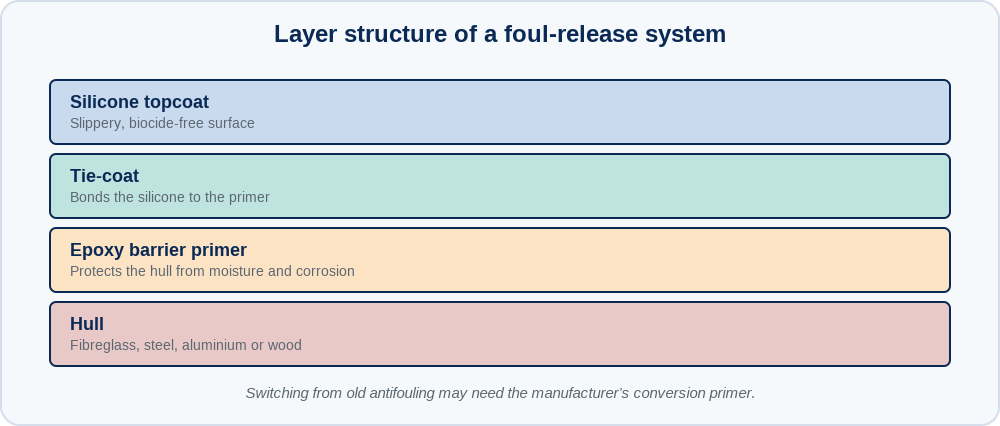
For switching from an old antifouling system some manufacturers offer a conversion primer. Which route is suitable depends on the type and condition of the existing system. The safest route is to remove the old layer in a controlled way and build the system on a clean surface, but that is costly. If a conversion primer is to be used, the manufacturer’s written approval should be obtained.
3. The promises: why is it interesting?#
- It contains no biocide; it is advantageous regarding biocide release and the related rules.
- The smooth surface keeps hydrodynamic friction low; some manufacturers report low speed loss.
- If the speed is sufficient, the surface can clean itself on motor yachts.
- Cleaning can be done with a soft method, so no coating loss is expected as with ablative antifouling.
In a boating-magazine test, a silicone foul-release system stood out because most of its panel stayed clean even when static and slime on the surface was easily wiped off. Tests like this are a promising sign, especially for sailing and low-speed use; but one test should not be generalised.
4. The limits: where does it struggle?#
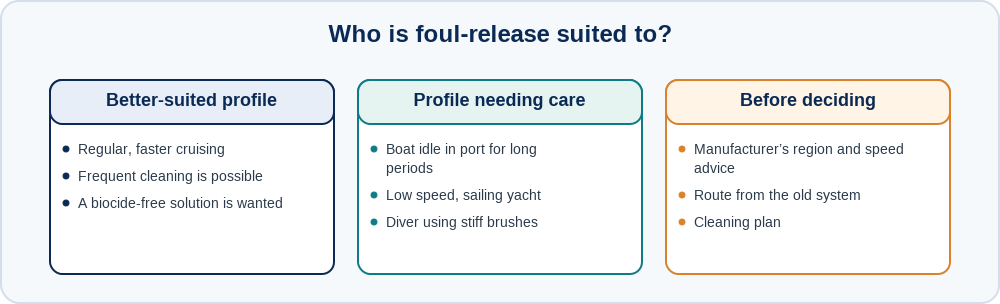
The first limit of foul-release coatings is speed. Some manufacturers recommend a certain service speed for the coating to be able to clean itself. On boats that cruise slowly or stay long in port the surface does not clean itself; slime and some organisms can build up and manual intervention is needed. One source notes that speed is not sufficient on slow boats and that extra help, preferably cleaning with a sponge, is needed.
The second limit is durability. A silicone surface is soft and can be scratched. For service life, industry sources generally state a range of 12 to 24 months, which may be shorter than many biocidal systems. The third limit is that the system is not a single piece: primer, tie-coat and silicone must be applied in line with the manufacturer’s number of coats and waiting times.
| Subject | Promise | Limit |
|---|---|---|
| Biocide | None | None |
| Cleaning | Soft, frequent cleaning is suitable | Stiff brush damages the coating |
| Speed | At sufficient speed the surface cleans itself | Manual intervention needed at low speed |
| Life | Effective if applied correctly | Generally reported as 12 to 24 months |
| Switch-over | Conversion primer or removal | Manufacturer approval and extra cost |
5. Cleaning: soft and frequent#
For foul-release coatings cleaning is used to keep performance, and is generally done with a soft sponge or cloth. One manufacturer states that the coating can be cleaned as often as desired. Boat-washing systems with stiff brushes, common in Scandinavia, are unsuitable because they damage silicone coatings. This information should be given in writing to a diver who will clean in the water.
6. Switch-over steps#
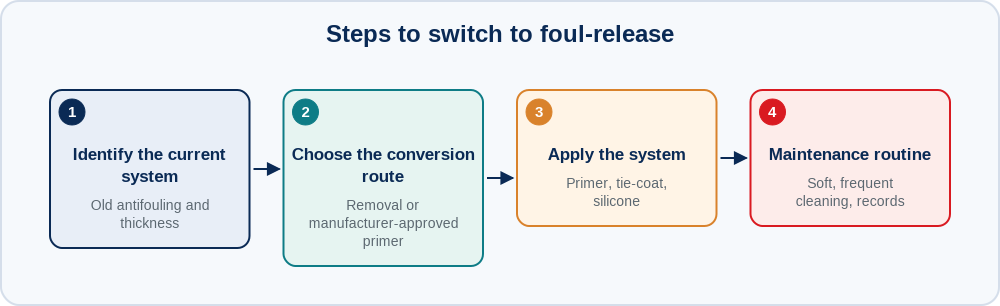
- Identify the current system: the type, thickness and condition of the old antifouling.
- Choose the conversion route: removal or a conversion primer approved in writing by the manufacturer.
- Apply the system: primer, tie-coat and silicone coats according to the manufacturer’s data sheet.
- Set up the maintenance routine: soft, frequent cleaning and records.
7. The region and rules dimension#
Biocide-free coatings draw particular interest in regions where the copper and biocide debate is lively. But “no biocide” does not mean “no environmental effect”; the environmental sustainability of silicone systems is under scientific examination. A research team from Sweden published a study asking whether silicone foul-release coatings are a viable and sustainable alternative to biocidal coatings in the Baltic region. This shows that the subject is still being researched.
8. A short case: two boats, two profiles#
The first boat is a 13-metre motor yacht in the Aegean that cruises three or four days a week at around 9 knots. The second is an 11-metre sailing yacht that spends most of the season in the marina and makes short trips at 4 to 5 knots. For the first boat a silicone system can be a suitable candidate thanks to speed and regular use. For the second the surface does not clean itself; choosing the system requires a frequent and gentle cleaning programme.
If the second owner thinks the programme cannot be kept up, a different system may be considered. Choosing the coating by use profile matters more than the brand.
9. Common mistakes#
- Thinking foul-release is a “maintenance-free” solution.
- Ignoring the profile of low speed and long idle periods.
- Having stiff-brush or abrasive cleaning done.
- Not obtaining the manufacturer’s written approval when switching over.
- Keeping no records on the assumption that the life is long.
10. Questions before deciding#
The questions to ask yourself and the applicator before switching to foul-release prevent surprises in the long run. Most answers are found in the manufacturer’s data sheet and written recommendations; if not, they should be requested from the manufacturer in writing.
If you cannot answer most of these questions clearly, it is healthier to postpone the decision and talk to the manufacturer’s technical representative. Foul-release is strong in the right profile and a disappointment in the wrong one.
11. Conclusion#
Foul-release coatings are a serious biocide-free alternative, but not right for every boat. If speed, use pattern and cleaning discipline suit, they can be a strong solution. Before deciding, look at the manufacturer’s region and speed advice, make the switch-over route clear in writing and make soft, frequent cleaning a maintenance rule.
Frequently asked questions#
Does a foul-release coating contain biocide?
No. Silicone-based foul-release coatings contain no biocide; they make attachment hard through the slipperiness of the surface.
How long does it last?
Industry sources report an effective service life of roughly 12 to 24 months for most silicone foul-release products; the real period depends on the product, the use and the maintenance.
Does it work on a slow sailing yacht?
Manufacturers generally recommend a certain service speed; for slow boats extra help, preferably cleaning with a sponge, may be needed. The use profile is decisive.
Can it be applied over old antifouling?
Manufacturers may offer a conversion primer for switching from an existing system; this route depends on the manufacturer’s written approval. Removing the old system is the safest route.
How is it cleaned?
With a soft sponge or cloth. Boat-washing systems with stiff brushes damage the coating; the manufacturer’s instruction is decisive.
Was this guide helpful?
Thank you! Your feedback has been saved.
Guide content is for general information; in practice, the current technical data sheet of the product applies.
Keep reading
Related guides
Choosing Antifouling: A Decision Based on Usage Profile
A decision-focused study explaining how the type of antifouling should be chosen according to the frequency of use and water conditions.
2 min read UnderwaterFormation of Algae and Biofilm on the Hull
A study of how algae and biofilm form on the hull, the methods of protection and their effect on the surface.
2 min read UnderwaterProtective Systems for Propeller and Rudder Areas
A study of the protective systems used in moving, high-friction areas such as propellers and rudders, and their selection criteria.
2 min read