
Underwater
The Copper Antifouling Debate: Washington, Sweden, the Baltic and the Mediterranean Compared
Most antifouling paints contain copper. The same copper is also the subject of a water-quality debate in enclosed marinas. This article compares Washington, Sweden/Baltic and the EU to help yacht owners see the current picture.
Short answer
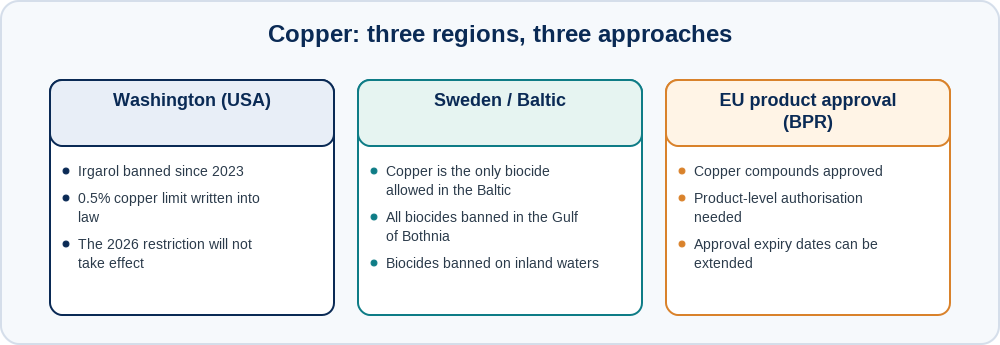
Copper antifouling is being restricted in some regions while remaining the only permitted biocide in others: Sweden leaves copper as the only permitted biocide in the Baltic and bans all biocides in the Gulf of Bothnia; Washington wrote a limit of 0.5% copper into law but did not put the 2026 restriction into force. In the EU, copper compounds are subject to product-level approval. The core rule for yacht owners: check the current rule of the water and marina you will use.
Key points
- In Washington, Irgarol has been banned since 2023; a restriction above 0.5% copper is in the law but will not take effect in 2026.
- In Sweden copper is the only permitted biocide in the Baltic; all biocides are banned in the Gulf of Bothnia.
- A 2026 study reports that leisure-boat and ship paints make up 32% of Swedish coastal copper input.
- In the EU copper compounds are approved under the BPR; products need separate authorisation.
- Rules differ by region and change over time; check once a year.
1. Why is copper debated?#
Copper is the most common biocide in the antifouling paints used on recreational boats. Copper ions released from the surface stop organisms from attaching to the hull. The same copper is a water-quality concern in marinas where many boats lie side by side and water circulation is weak.
The core of the debate is this: keeping the hull clean reduces fuel consumption and the transfer of invasive species, but the biocide used enters the environment. No region has resolved this balance in the same way. Some limit copper, some leave it as the only permitted substance, and some tie products to individual approval.
2. Washington: a copper limit in the law, but postponed#
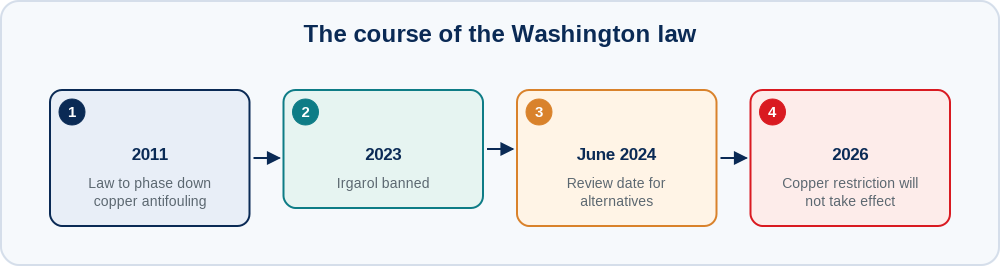
The US state of Washington passed a law in 2011 intended to phase down copper in antifouling paints for recreational boats. Under that law, paints containing Irgarol were banned for recreational vessels from 1 January 2023. The law also restricted, from 1 January 2026, the sale and application of antifouling paints containing more than 0.5% copper if feasible alternatives were found; wooden boats were exempt from this restriction.
After its third report, the state’s Department of Ecology announced that the copper restriction will not take effect in 2026. The Washington example therefore shows that a restriction written into law is not the same as one in force: the decision depends on a scientific assessment of whether alternatives are adequate.
3. Sweden and the Baltic: copper as the only permitted biocide#
The Baltic Sea draws special attention because of its semi-enclosed nature and sensitive ecosystem. In Sweden copper is the only biocide allowed in the Baltic, while all antifouling substances on pleasure craft are banned in the Gulf of Bothnia. Biocidal antifouling is banned on inland waters. Sweden also allows products with reduced copper content for most craft in the Baltic.
A 2026 study from Chalmers University of Technology reports that antifouling coatings on leisure boats and ships account for 32% of the total yearly copper input along Swedish coasts. HELCOM also published biofouling management guidance for recreational craft in January 2025. These works show that copper is still a significant source, but the direction of regulation is moving towards reduction and management rather than the biocide alone.
4. The EU: product-level approval#
In the European Union antifouling products are regulated as product type 21 (PT21) under the Biocidal Products Regulation (BPR, 528/2012). Copper compounds have been approved in that framework: for example dicopper oxide, copper thiocyanate and coated copper flakes. Copper pyrithione was also approved for PT21 by a 2015 implementing regulation. An approved active substance is not enough; products must also be authorised individually, including an assessment of release rate and environmental risk.
Approval periods are not fixed either: in 2025 the European Commission postponed the expiry date of the approval of dicopper oxide. This shows that in the EU the rule is a framework under continuous review.
| Region | Copper status | Point to note |
|---|---|---|
| Washington (USA) | Restriction above 0.5% in law, will not take effect in 2026 | Irgarol banned; wooden boats exempt |
| Sweden / Baltic | The only permitted biocide in the Baltic | All biocides banned in the Gulf of Bothnia |
| EU (BPR) | Copper compounds approved for PT21 | Product-level authorisation required |
| Mediterranean (EU coasts) | BPR framework | Local extra rules may apply |
5. What does it mean for the yacht owner?#
The first conclusion is that there is no single global rule. The second is that rules change over time; the postponement of Washington’s 2026 restriction and the extension of approval periods in the EU are examples. The third is that the copper debate is turning from a “copper or not” pair into the question “which region, which product, with what management”.
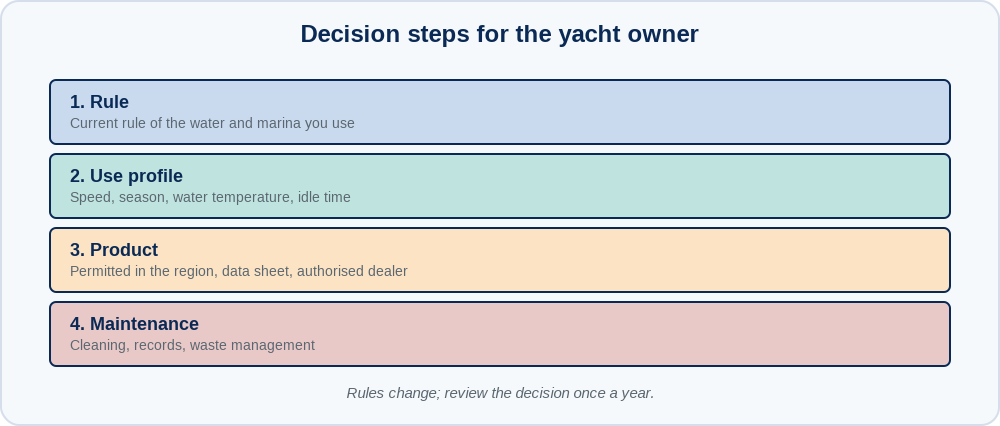
- Rule: learn the current rule of the water and marina you will use.
- Use profile: write down speed, season length, water temperature and idle time.
- Product: buy a product permitted and documented in the region from an authorised dealer; keep the data sheet.
- Maintenance: plan the cleaning method, waste management and records.
6. Biocide-free alternatives#
Foul-release coatings without biocide are an alternative to copper. They are silicone-based; the slippery surface prevents strong attachment. Industry sources state that the service life of silicone foul-release coatings is generally in the range of 12 to 24 months and stress that they need gentle cleaning. On slow boats the surface cannot be expected to clean itself through movement, so light manual cleaning may be needed.
A Chalmers study asked whether silicone foul-release coatings are a viable and environmentally sustainable alternative to biocidal coatings in the Baltic region; in other words the subject is still being researched. The honest approach for the yacht owner is to assess beforehand whether the use profile (speed, season, cleaning possibility) suits foul-release.
7. Microplastics and particle size#
The copper debate is not only about the biocide. Antifouling paint particles also enter the water as microplastics through weathering and removal. A study of Swedish marinas reported that copper-rich paint particles occur at high concentrations in marinas. Waste management and in-water cleaning are therefore inseparable parts of the copper debate.
8. A short case: two marinas, two rules#
A yacht owner whose boat winters in the Mediterranean plans to cruise to the Baltic in summer. In the home port a copper product is used. In the Baltic copper may be permitted, but all biocides are banned in the Gulf of Bothnia, and biocidal antifouling is banned on inland waters. For this owner the question is not whether copper is good or bad but planning in advance the right product and cleaning routine for the route.
If the owner writes the route plan down and checks the rules of the waters to be crossed beforehand, both the route and the coating choice become clear. If needed, a dive check and light cleaning are planned to keep the hull clean during the passage.
9. Common mistakes#
- Assuming a single rule such as “copper is banned” or “copper is free”.
- Mistaking an old news item for the current rule; the Washington case is a typical example.
- Not checking whether the product is permitted in the region.
- Choosing a product without thinking about the use profile.
- Treating waste and cleaning as outside the copper debate.
10. Conclusion#
The copper debate has no single answer and changes by region and time. Washington wrote a restriction into law and postponed it; Sweden left copper as the only permitted biocide in the Baltic and banned biocides in the most sensitive waters; the EU runs a product-level approval process. For yacht owners the safest path is to check the current rules of the waters they will use once a year, buy the product from a documented dealer and record cleaning and waste management.
Frequently asked questions#
Has copper antifouling been banned?
There is no global ban. Washington’s copper restriction will not take effect in 2026; Sweden leaves copper as the only permitted biocide in the Baltic. Rules vary by region.
Are Irgarol and copper the same thing?
No. Irgarol (cybutryne) is a separate biocide and has been banned by the IMO and in Washington. Copper is a different active substance.
In which Swedish waters are biocides banned?
All antifouling substances on pleasure craft are banned in the Gulf of Bothnia, and biocidal antifouling is banned on inland waters.
How is copper antifouling regulated in the EU?
Copper compounds (for example dicopper oxide and copper thiocyanate) are approved for product type 21 under the Biocidal Products Regulation (BPR); each product must also be authorised.
Does a biocide-free alternative work?
Silicone-based foul-release coatings are an option; service life is generally reported at 12 to 24 months and stiff brushes must not be used. The choice depends on the use profile.
Was this guide helpful?
Thank you! Your feedback has been saved.
Guide content is for general information; in practice, the current technical data sheet of the product applies.
Keep reading
Related guides
Chemical Principles of Antifouling Systems
A study of the mechanisms of action and chemical foundations of antifouling systems that prevent marine organisms from attaching to the hull.
2 min read UnderwaterChoosing Antifouling: A Decision Based on Usage Profile
A decision-focused study explaining how the type of antifouling should be chosen according to the frequency of use and water conditions.
2 min read UnderwaterAntifouling Coatings: Function, Layer Structure and Application Principles
A study of the function, layer structure and application steps of the antifouling system used on underwater hull surfaces.
2 min read