
Underwater
Hard (Contact) and Eroding (SPC) Antifouling: Choosing by Region and Use
Antifouling choice is often discussed through brand and price. Yet what really matters is how the paint works. This article explains the three basic matrix types and which uses they suit.
Short answer
Hard (contact) antifouling releases biocide from an insoluble film and the film builds up over the years; eroding (ablative) antifouling has a matrix that slowly wears away and exposes fresh biocide while the layer thins; copolymer (SPC) systems hydrolyse in a controlled way in water and keep the surface smooth. The right choice depends on cruising speed and movement, haul-out frequency, region and water temperature, the cleaning method and compatibility with the existing system.
Key points
- In hard antifouling the film builds up; in eroding systems the layer thins.
- Copolymer (SPC) systems keep the surface smooth through controlled hydrolysis in water.
- Choice depends on speed, haul-out frequency, region, cleaning method and compatibility with the existing system.
- When choosing a new type, confirm compatibility with the old system using the manufacturer’s table.
- Check your region’s biocide rules first; the type is chosen within them.
1. Why is the “type” decision important?#
Many yacht owners talk about antifouling through brand, colour and price. Yet different products of the same brand work on very different logic. The product’s matrix, the binder that carries the biocide, determines how the paint behaves through the season: does the film build up over the years or thin, does it need movement, how does it react to cleaning, and how is the surface prepared at the next maintenance.
So “which is the best antifouling?” is an incomplete question. The right question is: which type suits my boat, my route and my maintenance routine? This article treats the three basic matrix types from that angle.
2. Three matrix types#
2.1 Hard (contact) antifouling#
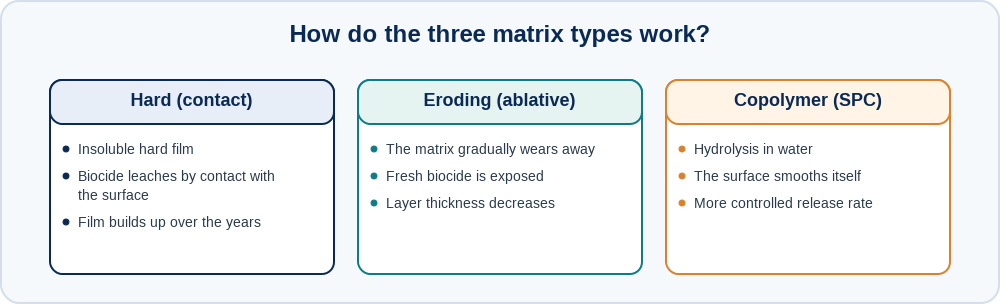
In hard antifouling the biocide sits within a hard film that does not dissolve in water. The biocide passes slowly into the water in contact with the surface while the film stays in place. The film therefore builds up with new coats over time and the surface thickens. A hard surface can be burnished in some products and may give an advantage in friction. On the other hand, the accumulation of old coats at some point requires the surface to be prepared or stripped.
2.2 Eroding (ablative) antifouling#
In eroding antifouling the matrix slowly wears away as it contacts water. Fresh biocide comes to the surface in the process, while the film thickness decreases over time. There is no layer build-up; but because the film thins, checking the remaining thickness before the next season matters. Since the erosion depends on water movement, boats that stay motionless for long periods should ask the manufacturer whether the product will work as expected.
2.3 Copolymer (SPC) antifouling#
In copolymer systems the matrix reacts chemically with seawater (hydrolysis) and separates from the surface in thin layers. This process tries to keep the surface smooth and make biocide release more controlled. Copolymer systems are common in commercial shipping; on recreational boats product names and marketing language vary from maker to maker, so the matrix description in the data sheet must be checked.
| Property | Hard (contact) | Eroding (ablative) | Copolymer (SPC) |
|---|---|---|---|
| Film behaviour | Builds up | Thins | Thins, stays smooth |
| Need for movement | Low | Varies by manufacturer | Varies by manufacturer |
| Burnishing | Possible on some products | Generally not suitable | Surface stays smooth |
| Between-season maintenance | Check coat build-up | Check remaining thickness | Check remaining thickness |
| Haul-out / drying | Per manufacturer | Per manufacturer | Per manufacturer |
3. Four factors that influence the choice#
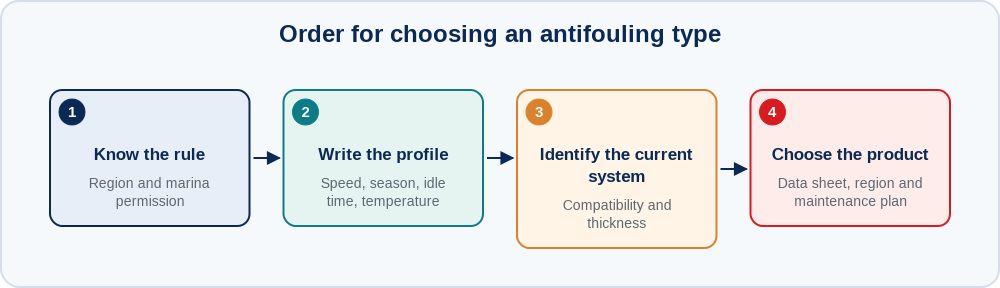
- Speed and movement: the working of eroding systems depends on water movement; for very slow or long-idle boats the manufacturer’s advice is essential.
- Haul-out frequency: hard film builds up; eroding film thins. Which fits your maintenance plan depends on how often you haul out.
- Region and temperature: pressure is high in warm, nutrient-rich water, which can point to a stronger system or more frequent maintenance.
- Cleaning method: if stiff brushes or abrasive pads will be used, confirm that the type and remaining thickness allow it.
4. Compatibility with the existing system#
Switching between types is where most problems arise. Applying an eroding product over a hard film, or the reverse, can lead to adhesion problems, peeling or disturbed biocide release depending on the product pair. A general rule should therefore give way to the manufacturer’s compatibility table and, where needed, written approval. If the type of the existing system is unknown, an adhesion test on a sample or identification of the old layer makes sense.
5. Region and rules#
The choice of type is made within the region’s biocide rules. In some regions the biocide content or type is restricted: in Sweden, for example, copper is the only permitted biocide in the Baltic and all antifouling substances are banned in the Gulf of Bothnia. The rule therefore comes first and then the type. A rule rules out at the outset any type containing a banned substance.
6. Order of selection#
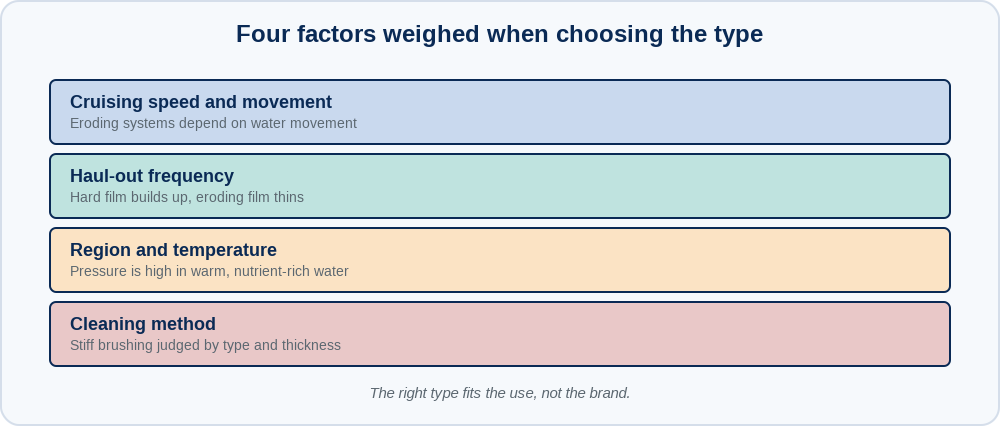
- Learn the rule: region, marina and product permissions.
- Write the profile: speed, season length, idle time, water temperature.
- Identify the current system: type, thickness, condition.
- Choose the product: data sheet, compatibility table, maintenance plan.
- Record: product, batch, application date and maintenance programme.
7. A short case: three boats in one marina#
Take three boats in the same marina. The first is a 12-metre motor yacht making short trips every week; the second is a 10-metre sailing yacht spending most of the season at anchor; the third is a 14-metre gulet hauled out every year. Because the three boats differ in speed, movement and haul-out frequency, being in the same marina does not mean they should use the same antifouling.
For the motor yacht, erosion and a smooth surface may matter; for the sailing yacht, the manufacturer’s low-speed advice and ease of cleaning are decisive; for the gulet, haul-out frequency and control of coat build-up come to the fore. The right choice starts from each boat’s profile.
8. Pre-decision checklist#
9. Common mistakes#
- Choosing the brand before the type.
- Buying last year’s product again even though use has changed.
- Not checking compatibility when switching between types.
- Not measuring the remaining thickness on an eroding system.
- Learning the regional rule at the last minute.
10. End-of-season review: verifying the type#
Choosing a type is not a decision made once and forgotten. The condition of the hull when hauled out at season end is the best evidence of whether the choice was right. Where growth concentrated, where the film thinned and where the paint did not work at all directly shape next season’s product and type decision.
- Measure film thickness around the propeller, rudder and waterline; on eroding systems this is the baseline for next season.
- Take photographs: both sides of the hull, cradle and stand marks and niche areas from the same angles.
- Compare with the passage log: link idle weeks to the areas where growth was heaviest.
- Review the cleaning records: which method, how often, and what mark it left on the film.
These data give concrete ground when talking to the manufacturer about the next decision. Saying “growth appeared in this area at this thickness with this movement pattern” instead of “the paint did not work well” gets you better guidance on both type and product.
11. Conclusion#
Hard, eroding and copolymer antifouling work on different logic and suit different use profiles. The right type is chosen by thinking together about the rule, speed and movement, haul-out frequency, region and cleaning method. Choose the type first, then compare the data sheets of products of that type, and record every step.
Frequently asked questions#
What is the basic difference between hard and eroding antifouling?
In hard antifouling an insoluble film releases the biocide and the film builds up over time. In eroding antifouling the matrix slowly wears away, fresh biocide is exposed and the layer thins.
What does SPC mean?
Self-polishing copolymer. The matrix hydrolyses in a controlled way in water, the surface stays smooth and the release is more controlled.
Which suits a slow sailing yacht?
The decision depends on the product. The working of eroding systems depends on water movement, so the manufacturer’s speed and use recommendation should be checked.
Can I apply a different type over the old system?
Compatibility depends on the type and product pair. Instead of a general rule, follow the manufacturer’s compatibility table or written approval.
Is brand or type more important?
First choose the type that suits the use, then compare the data sheets of products of that type. Brand comes after the type decision.
Was this guide helpful?
Thank you! Your feedback has been saved.
Guide content is for general information; in practice, the current technical data sheet of the product applies.
Keep reading
Related guides
Chemical Principles of Antifouling Systems
A study of the mechanisms of action and chemical foundations of antifouling systems that prevent marine organisms from attaching to the hull.
2 min read UnderwaterChoosing Antifouling: A Decision Based on Usage Profile
A decision-focused study explaining how the type of antifouling should be chosen according to the frequency of use and water conditions.
2 min read UnderwaterWaterline Paint: Protection Strategy for Variable Zones
A study of the effect of the wetting, drying and wave cycle at the waterline on the paint system.
2 min read