
Paint and Coatings
Copper-Free Antifouling Options and Performance
Environmental concern, regulation and aluminium hulls are increasing the search for copper-free antifouling. This article summarises the families of copper-free options, independent findings on performance and the limits of each approach, using general sources.
Short answer
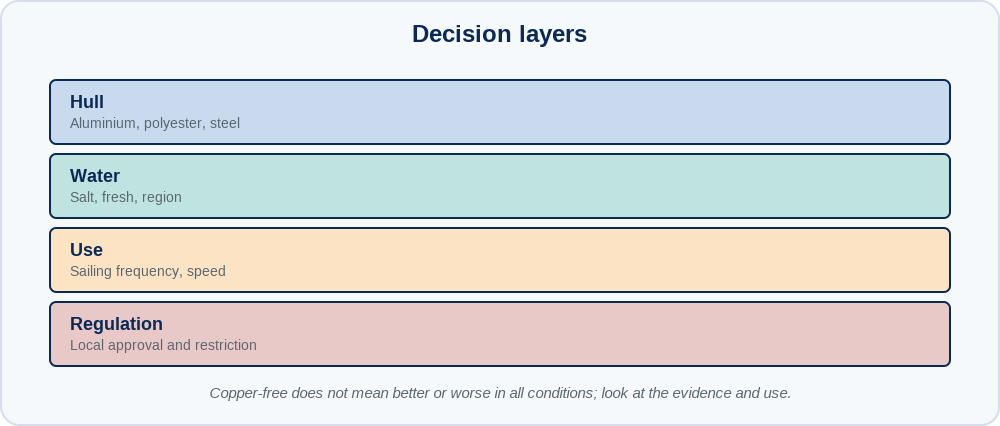
Copper-free antifouling splits into three main families: paints using another biocide instead of copper, biocide-free silicone, hydrogel or hard epoxy coatings and technical solutions such as ultrasonics. Independent comparison tests show some of these options can perform well in some conditions but results vary by product, water and use; the Washington Department of Ecology’s 2024 report says preliminary results showed DCOIT-based products performing worse than other copper-free biocidal paints. According to PBO most UK boats still use biocide-based antifouling. The choice depends on hull material, water, use and local regulation. This article is general information and recommends no product.
Key points
- Copper-free antifouling has three families: those using another biocide, biocide-free and technical solutions.
- In independent tests some copper-free options performed well; results vary by product, water and use.
- In the Washington 2024 report’s preliminary results DCOIT-based paints trailed other copper-free biocidal paints.
- Biocide-free coatings work on a physical principle; they may need speed, regular use and cleaning.
- Aluminium hulls, regulation and the environment drive the search for copper-free; choice should rest on the data sheet and evidence.
1. What does “copper-free” mean?#
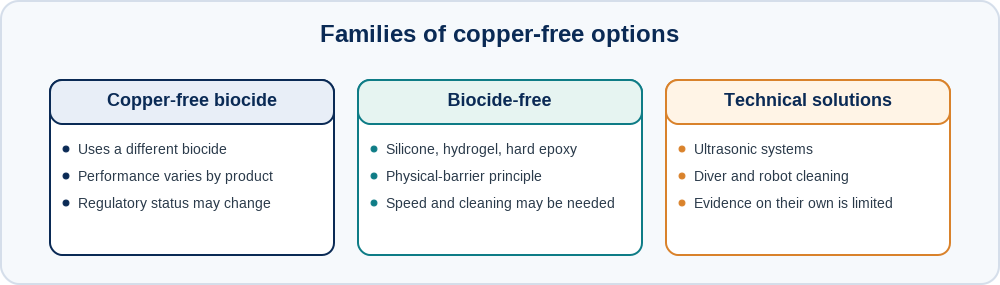
Copper has been the main biocide of antifouling paints for centuries and is still in most products. Even so, copper-free options have lately been on boat owners’ agenda: corrosion risk of copper on aluminium hulls, regional regulation and environmental concern drive the search. But “copper-free” is not a single product type. Sources generally split the options into three families: paints using another biocide instead of copper, coatings with no biocide at all (such as silicone-based foul-release, hydrogel and hard epoxy) and technical solutions such as ultrasonic systems and cleaning services. This article is a general summary; it neither recommends nor praises a specific product.
In a Practical Boat Owner (PBO) roundup for UK boat owners examining foul-release, ultrasonic and biomimetic technology, it is stated that many well-known brands such as International and Jotun offer only biocidal options for sale in the UK and that most UK vessels still use biocide-based antifouling. So copper-free products exist but do not represent the majority of the market.
2. Copper-free biocidal paints#
In this group another organic biocide is used instead of copper. According to West Marine’s account such paints work with a non-copper biocide; but the same source says copper-free ablatives face a steeper challenge than copper paints in some conditions and may need more frequent cleaning (a seller’s account). Practical Sailor writes that despite increasingly strict prohibitions on some of the more effective copper-free biocides such as Econea, manufacturers have been able to develop copper substitutes that deliver comparable performance over the short term. So the field changes quickly and a product’s legal status can differ over time.
The Washington Department of Ecology’s January 2024 update describes a performance test on a variety of antifouling paints in four Puget Sound locations; the preliminary results at six months say products based on DCOIT showed the lowest performance among non-copper biocidal paints and worked less effectively than copper products. A retailer source also relays that the same report identified DCOIT as the one alternative biocide that might be considered “safer” among copper-free alternatives. These are regional and preliminary results; they cannot be generalised to every water.
| Topic | Information from sources | Caution |
|---|---|---|
| Performance | Varies by product and water | See independent tests |
| DCOIT-based products | Trailed in Washington 2024 preliminary results | Regional and preliminary result |
| Need for frequent cleaning | Seller account | Needs verification |
| Legal status | Biocide approvals change over time | Check local rules |
3. Biocide-free coatings#
This group works on a physical principle rather than releasing poison: slickness, softness or a hard surface. The PBO roundup says the Seajet brand sells a biocide-free (Bioclean-Eco) range alongside copper-free products and that a hydrogel coating can be extended another year with just a quick clean with detergent; another PBO page relays a manufacturer statement stressing the consistency of silicone technology in preventing fouling (a manufacturer statement). Fisheries Supply says the question of microplastic release should be researched for silicone and hydrogel paints; so “non-toxic” does not always mean “zero environmental impact”.
Hard epoxy-based copper-epoxy coatings are also part of this discussion. PBO’s 18-month test compares traditional annual copper-based paints with longer-lasting and more environmentally sensitive alternatives; the test included three non-copper paints, three traditional eroding paints, a hard coating and a copper-epoxy coating. It notes that one coating in the test lasts ten years but has a high initial cost, requires the hull to be blasted back to bare GRP for application and, once dry, must be burnished with 400-grit paper to expose the copper. Pantaenius, citing the PBO test, writes that two biocide-free paints came out on top; that is a secondary relay and depends on the test conditions.
4. Ultrasonic and technical solutions#
Approaches such as ultrasonic systems and diver or robot cleaning are used instead of paint or alongside it. PBO examines these options under the question “Can you protect your boat in UK waters using foul-release, ultrasonic or biomimetic technology?”. The general principle is that the effect of these solutions varies with boat, water, fouling pressure and use; evidence on their own is limited and a seller claim for a product does not replace independent verification. For detail see the separate articles on ultrasonic systems and foul-release coatings.
When a copper-free approach is chosen the maintenance approach changes too. With biocide-free coatings regular use and cleaning are often part of performance; technical solutions need correct installation and maintenance. So do not choose with a “apply and forget” expectation.
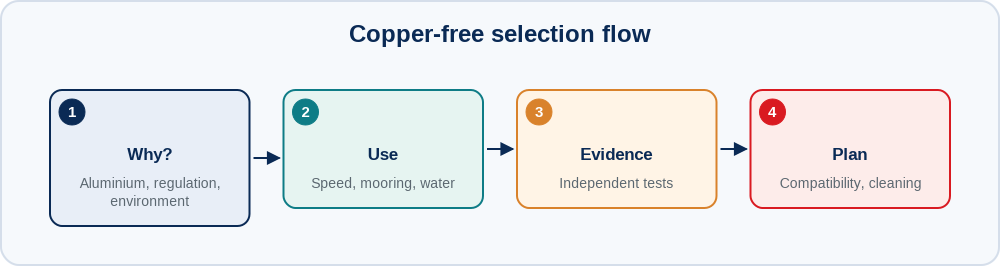
- Write down why you want copper-free (aluminium, regulation, environment).
- Define your use pattern (speed, mooring, water type).
- Study the product families and data-sheet definitions.
- Look for independent tests and many user experiences; do not trust a single comment.
- Confirm compatibility with the existing system with the maker.
- Check local biocide regulation and approval status.
- Plan cleaning and maintenance; record observations.
5. Aluminium, regulation and the environment#
West Marine’s guide finds a copper-free paint suitable for aluminium boats and says its non-metallic composition avoids the corrosion problems aluminium can have in contact with copper (a seller account). For aluminium hulls always check the maker’s compatibility information; for detail see the article on antifouling compatibility under aluminium boats.
On the environment the German Environment Agency relays that in 2016 around 19 percent of the total copper loads in German surface waters were estimated to come from biocidal antifouling coatings on pleasure craft and writes that Sweden allows only reduced-copper products for most craft on the Baltic Sea and prohibits all use of biocidal agents in antifouling on inland waters. These examples show how different regional rules can be; check the rules of your own region. This article is not legal advice.
6. Common mistakes#
- Treating copper-free as a single product category.
- Treating a seller claim as independent evidence.
- Generalising regional and preliminary test results to every water.
- Ignoring regular use and cleaning with biocide-free coatings.
- Not verifying compatibility on an aluminium hull.
- Not checking local biocide regulation.
- Never questioning environmental effects such as microplastics.
7. Checklist#
8. Conclusion#
Copper-free antifouling is not a single product type: there are paints using another biocide, biocide-free coatings and technical solutions. Independent tests show some options can perform well but results vary by product, water and use; in the UK most boats still use biocide-based antifouling. The choice depends on hull material, water, use and local regulation. This article is general information and recommends no product.
Frequently asked questions#
Does copper-free antifouling work?
In some conditions yes; independent tests show some copper-free products giving good results. But results vary by product, water and use; in Washington’s 2024 preliminary results DCOIT-based paints trailed.
Why copper-free on an aluminium boat?
Paints containing copper are said to be unsuitable on aluminium hulls because of corrosion risk; see the maker’s instruction and compatibility information.
How do biocide-free coatings work?
Coatings such as silicone and hydrogel rely on slickness and a physical-barrier principle rather than releasing poison; some sources say they may need speed, regular use or cleaning.
Are ultrasonic systems enough on their own?
Evidence is limited; PBO examines ultrasonic, foul-release and biomimetic options. Their sufficiency alone varies with boat, water and use.
Is a copper-free choice legal?
Regulation varies by region; both biocide approval and regional restrictions apply. Check local rules and product approval status.
Was this guide helpful?
Thank you! Your feedback has been saved.
Guide content is for general information; in practice, the current technical data sheet of the product applies.
Keep reading
Related guides
Boat Colour Selection and Solar Reflectance: Effect of Heat Absorption on Surfaces
A study of the effect of boat paint colour on solar reflectance and surface temperature.
2 min read Paint and CoatingsCauses and Diagnosis of Paint Blistering
A study of the sources, types and diagnostic approach to blistering on boat paints.
2 min read Paint and CoatingsNumber of Coats in Epoxy Coating Systems
A study of the effect of the number of coats in epoxy coating systems on protective performance and thickness.
2 min read