
Hull Repair
Boat Buffing with a Polisher: Step-by-Step
Polishing the gelcoat of a large boat by hand takes hours; a machine speeds the job. But the same machine can leave marks and damage with the wrong pad, speed or technique. This guide outlines machine types and a safe application order.
Short answer
For most boaters the best choice is a dual-action (DA) polisher that both rotates and oscillates; a magazine expert recommends a rotary only if you are experienced. Use a wool pad on oxidised surfaces and a foam pad on less faded ones. Compound must be wet; compound that dries does nothing. According to one expert swirling is a bigger issue than burning gelcoat; cleaning the pad often prevents it. For speed follow the product label: one maker gives 500–1000 rpm at the slow end and 3000–4000 at the fast. This article is general information; the product data sheet comes first.
Key points
- A dual-action (DA) machine is safer and easier for most boaters; a rotary needs experience.
- Use wool on oxidised surfaces and foam on less faded ones.
- Compound must be wet; compound that dries on the surface does not work.
- Swirling is a bigger issue than burning gelcoat; clean the pad often.
- For speed follow the compound and polish label; mind the cord and stainless hardware.
1. Why a machine?#
On a large boat applying compound and polish by hand takes until your arms almost fall off; that makes using a machine attractive. A power-and-motor-yacht magazine writes that being torn between fear of messing up shiny gelcoat and another day of massaging compound by hand is a familiar dilemma. With the right tool machine polishing is both quick and gives a more even result; used wrongly it can leave swirls, burns and scratches.
A boat-insurance body allows a complete day for the topsides of a 26-foot boat; a decent machine is therefore a sensible investment. Before moving to the machine make sure the boat is clean: smearing compound and wax over a dirt-caked hull can do harm. See our separate articles on oxidation and wax.
2. Machine types#
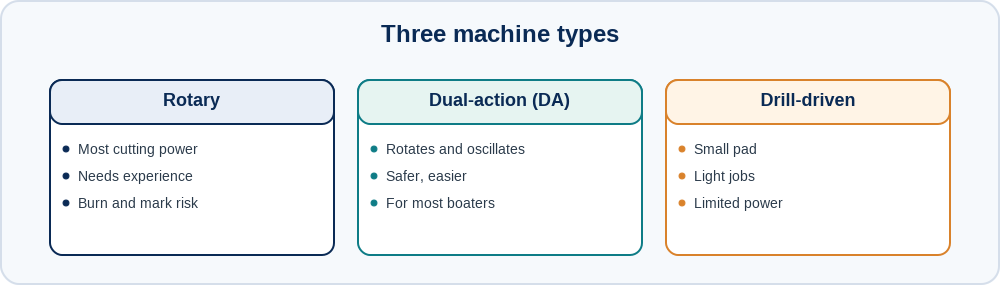
A boating magazine advises that the classic “rotary” machine, which spins at high rpm, be used only by experienced people because misuse can accidentally damage the hull. For the home user it recommends a dual-action polisher: it both oscillates and rotates, making it a lot safer and easier to operate. For most boaters the best choice is a variable-speed dual-action polisher that combines the user-friendliness of a random orbit with the power of a circular polisher; inexpensive random-orbit machines wax fine but do not do much when compounding.
The same magazine recommends a polisher that attaches to a power drill for simple jobs: a kit includes three pads, a more aggressive one for compound work, a soft one for waxing and a middle-ground one for one-step compounding and polishing. For more advanced work you need a dedicated DA machine, where power and pad size rise from 4 inches to 5 to 7. In a user forum one poster says gelcoat is much harder than car clear coat so a rotary is probably the best tool for compounding and polishing, and another prefers a rotary rather than a DA for gelcoat. That view holds for experienced users; for beginners a DA remains safer.
| Type | Strength | Watch for |
|---|---|---|
| Rotary | Most cutting power; heavy oxidation | Needs experience; burn and mark risk |
| Dual-action (DA) | Safe and easy; for most boaters | Slower on heavy jobs |
| Drill-driven | Cheap; small pad; light jobs | Limited power; slow on wide areas |
3. Pad choice: wool or foam?#
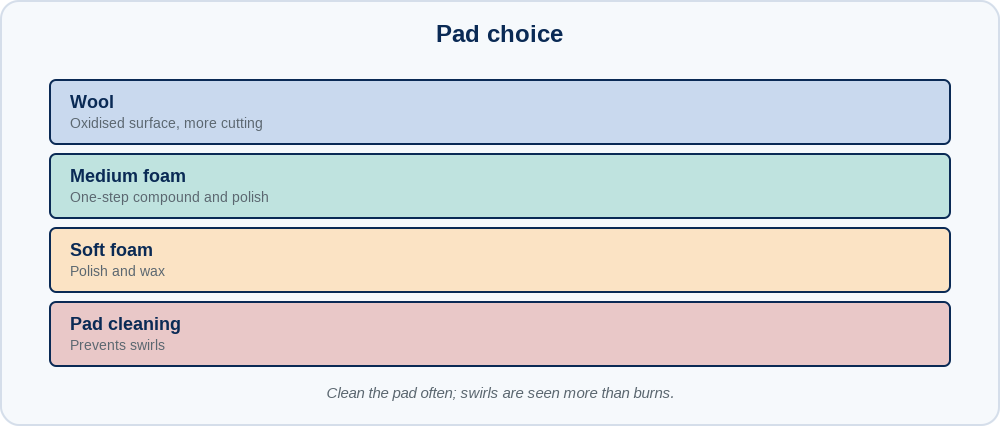
A boating publication writes that a wool pad should be used on more oxidised surfaces and a foam pad on less faded ones. Wool is more cutting; foam is softer and suited to polish or wax. A maker’s data sheet provides a wool pad for compounding and a separate wool or soft pad for polishing; the point is not to forget to change pads: do not use the compounding pad for polish or wax.
Avoid bumping into stainless hardware: an expert writes that banging the buffer against stainless steel can leave a black mark on the pad that transfers to the gelcoat. Masking tape and careful movement reduce this risk. Tying the polisher’s cord and the extension cord into a square knot where they connect prevents the plug being pulled as you move around.
4. Technique: wet, small area, clean pad#
An expert says applying compound with a rag to the whole boat and then buffing it out is the wrong approach: if it dries on the surface you are not going to improve anything because compound needs to be wet to work. One suggested application is to brush polish on with a 1-inch paintbrush in three horizontal strips in a 1- by 3-foot area and then go over it with a wool pad at a slower speed. A magazine recommends applying an X-shaped or circular bead of compound to the pad and pressing the pad against the hull before pulling the trigger to avoid slinging the compound.
On technique, experts suggest carrying the compound down the side with a side-to-side motion and, once at the bottom, making a few passes back and forth. The expert says that if you lay on a spot for a really long time you can burn gelcoat but that swirling is a bigger issue; to avoid swirls clean the pad regularly.
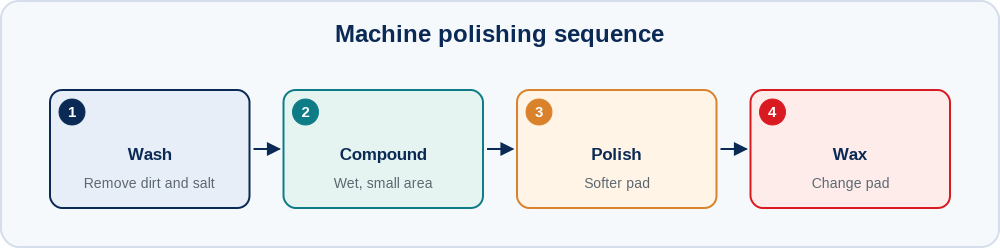
- Wash the boat and work on a dry surface; avoid direct sun.
- Divide the work into small areas (about 1 x 3 ft).
- Put an X or circular bead of compound on the pad; press the pad to the surface and pull the trigger.
- Work at low speed with a wool pad, keeping the compound wet.
- Clean the pad often; use a fresh one if needed.
- Wipe off the residue; move to a softer pad for polish.
- Use a new, clean pad for wax or sealant.
5. Speed setting#
Wax and compound makers often specify machine speed and a magazine advises checking the label. One maker’s guidance for its compound and polish gives 500–1000 rpm at the slowest speed and 3000–4000 rpm at the fastest. Another maker recommends a maximum of 1200–2000 rpm for compounding with a wool pad. An expert describing a DA machine with six speed settings says he uses about 2,500 oscillations per minute for waxing and buffing, 3,900 for polishing and cleaning and 6,500 for removing paint defects and oxidation.
Higher speeds are useful for removing paint defects and swirls; but speed alone does not decide the result. Product, pad and pressure work together. If you are using it for the first time test in a hidden area and do not be needlessly aggressive, to preserve the thickness of the gelcoat or paint.
6. Common mistakes#
- Spreading compound over the whole boat and then buffing; dried compound does nothing.
- Using a rotary with a hard pad when inexperienced.
- Carrying on without cleaning the pad and leaving swirls.
- Banging into stainless hardware and leaving a mark on the pad.
- Using the compounding pad for polish and wax.
- Starting the machine without washing the surface.
7. A short case: the same hull, two techniques#
Two boats have the same oxidised hull. The first owner spreads compound over a wide area with a rag and then runs the machine; the compound dries, does nothing and swirls are left in the hull. The second owner works in small sections, puts compound on the pad and keeps it wet, works with a wool pad at low speed, cleans the pad often and then polishes with a soft pad. The second approach is a more patient job; but the result is more even and mark-free.
8. Checklist#
9. Conclusion#
Machine polishing saves a great deal of time with the right machine, pad and technique. For most boaters a dual-action machine is a safe start; use wool on oxidised surfaces and foam on less faded ones, keep compound wet, work in small areas and clean the pad often. Set speed by the product label. This guide is a general framework; the product data sheet comes first.
Frequently asked questions#
Rotary or dual action?
For most boaters a dual-action machine is safer and easier; a magazine expert recommends a rotary only for the experienced. One forum view prefers rotary because gelcoat is hard; decide by your experience.
Wool pad or foam pad?
Wool on more oxidised surfaces, foam on less faded ones.
How is compound applied?
A bead in an X or circle on the pad; press the pad to the surface before pulling the trigger. Compound must stay wet; if it dries it does nothing.
What causes swirls?
A dirty pad and poor technique; according to one expert this is a bigger issue than burning gelcoat. Clean the pad often.
What speed should the machine run?
Follow the product label. One maker gives 500–1000 rpm to 3000–4000 rpm for its compound; 3M products give 1200–2000 rpm. Speed varies by product.
Was this guide helpful?
Thank you! Your feedback has been saved.
Guide content is for general information; in practice, the current technical data sheet of the product applies.
Keep reading
Related guides
Boat Colour Selection and Solar Reflectance: Effect of Heat Absorption on Surfaces
A study of the effect of boat paint colour on solar reflectance and surface temperature.
2 min read Paint and CoatingsNumber of Coats in Epoxy Coating Systems
A study of the effect of the number of coats in epoxy coating systems on protective performance and thickness.
2 min read Paint and CoatingsCauses and Diagnosis of Paint Blistering
A study of the sources, types and diagnostic approach to blistering on boat paints.
2 min read