
Hull Repair
UV Damage on a Yacht Hull and How to Protect Against It
Boaters in sunny climates escape winter but cannot escape UV. Gelcoat fading, chalking and turning porous are the quiet, cumulative effect of UV. This guide explains the mechanism and the protection options.
Short answer
UV light breaks down the polymer chains in gelcoat resin (photodegradation) and fades the pigments; the result is faded colour, lost gloss and a chalky surface. Unless the boat is stored indoors it is very hard to stop UV completely; the most effective measure is physical protection such as shade and a cover. UV-additive wax, sealant and ceramic coatings can slow the damage but do not prevent it entirely; in one test publication waxes claiming UV protection did not absorb the rays meaningfully. Regular washing, salt removal and early restoration limit progress. This article is general information; the product data sheet comes first.
Key points
- UV light breaks down gelcoat polymer chains and fades pigments; the result is fading and chalking.
- Oxidation makes the surface porous; dirt, stains and water entry become easier.
- The most effective protection is physical: shade, covered storage and a cover.
- UV-additive wax, sealant and ceramic slow the damage but do not prevent it entirely; wax absorption is limited.
- Regular washing, salt removal and early restoration limit progress.
1. What is UV damage?#
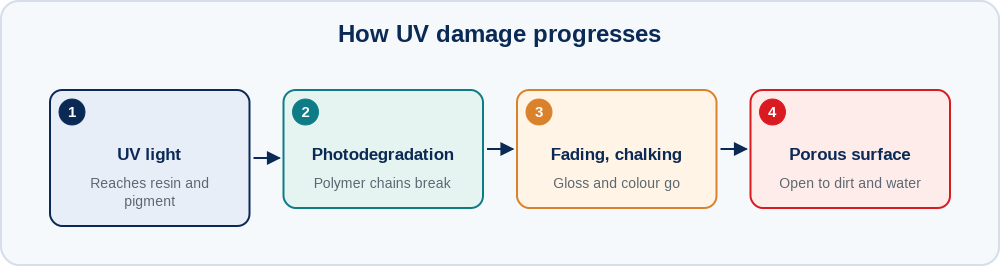
Gelcoat is the outer resin layer of a fibreglass boat and usually contains the pigment that gives the colour. A boat-care article explains that UV rays break down the pigments in gelcoat, fading the boat’s colour to a dull shade of its former self, and that the outer surface can turn chalky and the gelcoat deteriorate over time; it adds that unless the boat is stored indoors it is very difficult to stop UV light. So UV damage is among the costliest problems of boaters in sunny climates.
The mechanism is summarised in a marine retailer’s log: when fibreglass is exposed to prolonged sunlight, UV radiation interacts with the resin and pigments in the gelcoat, initiating a chemical reaction that causes the gelcoat to degrade gradually; this process, called photodegradation, breaks down the polymer chains in the resin, leading to loss of structural integrity and surface gloss, and the pigments fade too. The result is a matt, chalky-looking surface.
2. Not just cosmetic#
A detailing service writes that oxidation breaks down the protective layer, making the surface more porous and susceptible to water intrusion, stains and further fading, with consequences such as cracking or flaking and reduced resale value. That is a vendor claim; but it agrees with other sources that a porous surface holds dirt more easily and is harder to clean. The same source says salt residue accelerates UV damage by holding moisture and minerals against the surface; washing and salt removal are therefore part of protection.
Once started over a few years this process raises the cost and effort of restoration. A user on a paddling forum writes that gelcoat repair over an entire hull is a major pain (or expense if you do not DIY), so start by protecting the boat. That is one person’s view; but it fits the general idea that early protection and upkeep are cheaper.
3. Physical protection: shade and cover#
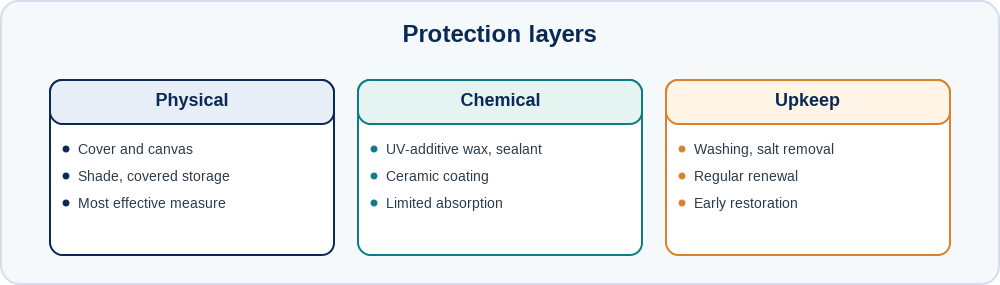
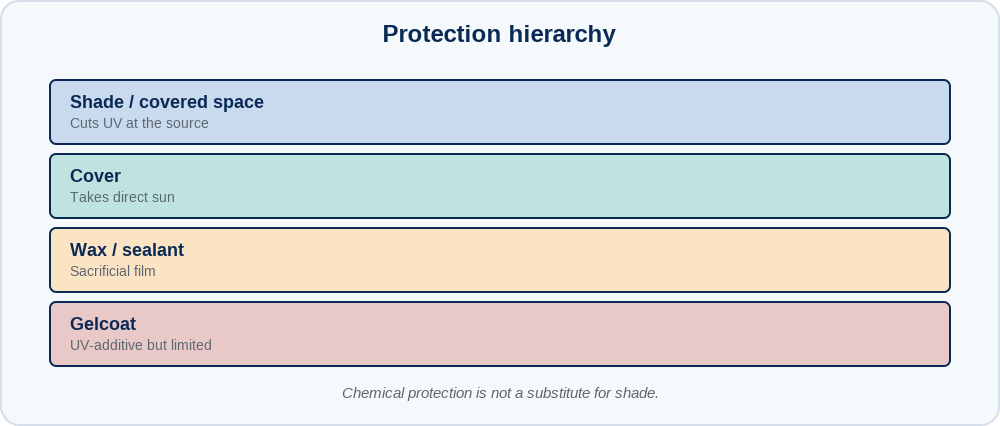
The most effective method is to cut UV at the source. A maker blog says it is very difficult to stop UV unless the boat is stored indoors, while a retailer log says storing the boat in a covered area or under a cover blocks direct sunlight and minimises oxidation. For boats waiting in a marina temporary shading and a cover, and for sailing boats deck covers and protective sleeves, do this job. A brand describing its product states plainly that a UV protectant does not take the place of keeping things covered or in the shade; like sunscreen it decreases the damage but cannot totally eliminate it.
When using a cover moisture management matters: a damp cover touching gelcoat can cause other problems. On a paddling forum one user writes that he saw hydrolysis blisters over the gelcoat after a tarp was in direct contact with it and suspects the tarp as the cause. That is a single observation; but see our separate article on covers and moisture for keeping air moving between cover and hull.
| Method | Strength | Limit |
|---|---|---|
| Shade, covered storage | Cuts UV at the source | May not be possible for every boat |
| Cover, canvas | Takes direct sun | Moisture and contact issues; needs upkeep |
| UV-additive wax, sealant | Fills pores, sacrificial film | Limited UV absorption; frequent renewal |
| Ceramic coating | Promises long life | Preparation hard; can make oxidation visible |
4. Chemical protection: wax, sealant, ceramic#
A maker blog says UV-resistant wax or polish forms a protective barrier over gelcoat, shielding it from harmful UV rays and prolonging its life. But an independent test publication reports testing a handful of waxes claiming UV protection for UVA and UVB absorption and finding that no product, even in a thick film, absorbed a significant percentage of the rays; the primary goal of a wax is to protect the top layers of gelcoat that already contain UV-protection agents. So do not load protective products with exaggerated expectations: they keep the surface clean and sealed but do not replace the sun’s shade.
A boating magazine says protective coatings provide ample UV protection but their clarity will reveal remaining oxidation, even amplify it in some cases and allow it to continue beneath the surface. Another boating magazine writes that if there is any oxidation on the gelcoat, applying the ceramic coating over it will accelerate the hazing process. These two findings show why correcting the surface first is essential.
5. Upkeep rhythm and early intervention#
Because salt residue accelerates UV damage, a fresh-water rinse after every trip matters on boats used in salt water. See our washing and salt articles. A retailer guide says gelcoat is rescued far more easily when intervention starts early; nearly all gelcoat can be restored provided it is not completely worn through. So acting at the first sign of dullness with polish and protection is cheaper and uses less gelcoat than starting to compound after heavy oxidation.
A simple rhythm for upkeep: rinse after every trip, wash with soap every few weeks, wax or sealant at the start of the season and check the gelcoat at the end of the season. Heat and fading can be more marked on dark hulls; see our article on colour and heat.
- Put the boat in shade or covered storage if possible; if not, use a suitable cover.
- Rinse with fresh water after each trip; wash regularly with soap.
- At the first sign of dullness apply light polish and protection.
- Correct the surface before protection; do not apply ceramic or wax over oxidation.
- Renew wax or sealant at the maker’s interval.
- At season end inspect gelcoat and paint by eye; intervene early.
6. Common mistakes#
- Treating UV-additive wax as a replacement for shade and a cover.
- Applying ceramic or wax over oxidation.
- Leaving a damp cover in contact with gelcoat.
- Letting the boat dry in the sun without rinsing off salt.
- Waiting when dullness starts and letting it become heavy oxidation.
- Skipping protection at the start of the season.
7. Checklist#
8. Conclusion#
UV light breaks gelcoat down by photodegradation; the result is fading, chalking and a porous surface. The most effective protection is physical: shade, covered storage and a cover; wax, sealant and ceramic slow the damage but do not prevent it and need a corrected surface. Limit progress with regular washing, salt removal and early restoration. This guide is a general framework; the product data sheet comes first.
Frequently asked questions#
How does UV harm gelcoat?
UV light breaks down the resin’s polymer chains (photodegradation) and fades the pigments; the surface loses gloss and turns chalky.
Can I prevent UV damage entirely?
Unless the boat is stored indoors it is very difficult to stop UV completely; shade, a cover and regular protection slow the damage.
Does wax protect from UV?
In one test publication waxes claiming UV protection did not absorb a significant percentage of the rays; wax’s real job is to protect the top layers of gelcoat that already contain UV additives.
Can faded gelcoat be restored?
If not completely worn through it can often be restored with compound, polish and protection; see our oxidation article.
Why remove oxidation first?
A magazine test reports clear protective coatings make oxidation visible and in some cases let it continue beneath the surface; for ceramic coating, applying over oxidation is said to speed hazing.
Was this guide helpful?
Thank you! Your feedback has been saved.
Guide content is for general information; in practice, the current technical data sheet of the product applies.
Keep reading
Related guides
Boat Colour Selection and Solar Reflectance: Effect of Heat Absorption on Surfaces
A study of the effect of boat paint colour on solar reflectance and surface temperature.
2 min read Paint and CoatingsCauses and Diagnosis of Paint Blistering
A study of the sources, types and diagnostic approach to blistering on boat paints.
2 min read Paint and CoatingsNumber of Coats in Epoxy Coating Systems
A study of the effect of the number of coats in epoxy coating systems on protective performance and thickness.
2 min read