
Hull Repair
Boat Polish and Wax: Which Protects How Well?
On a marina dock the word “wax” is used for three different things: classic paste or liquid wax, synthetic sealant and ceramic coating. Each differs in protection time, look and application effort; and none works on an unprepared surface.
Short answer
Wax, polymer sealant and ceramic coating do different jobs. Wax gives a bright, warm look but is renewed more often; sources cite protection of roughly three to four months. A synthetic polymer sealant generally lasts longer (four to twelve months according to sources, vendor claims) and takes a little longer to apply. Ceramic coating promises the longest life but is hard to apply. A test publication reports that none of the waxes claiming UV protection absorbed the rays meaningfully; wax’s real job is to protect the top layers of gelcoat with a sealing film. Do not wax oxidised surfaces. This article is general information; the product data sheet comes first.
Key points
- Wax, polymer sealant and ceramic do different jobs; their durations vary widely by vendor claims.
- Wax gives a bright look but is renewed more often; sealant lasts longer.
- According to a test publication waxes claiming UV protection did not absorb the rays meaningfully.
- Protection goes on a corrected, clean surface; wax over oxidation seals in damage.
- Ceramic coating promises long life but is hard to apply and preparation is meticulous.
1. “Wax” can be three different things#
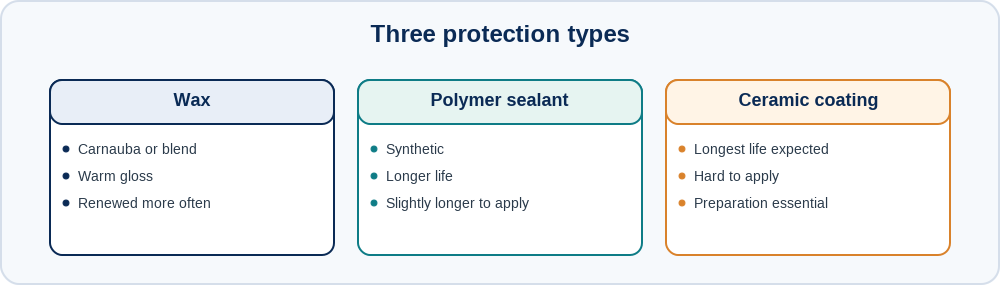
A boat-care site describes how on the dock three owners use the word “wax” for three different things: one means classic paste or liquid wax, another a synthetic sealant and another a spray protection. The same source suggests sorting products by the job each is meant to do: wax adds a finished protective coat, sealant aims for a longer-wearing barrier and spray protection helps maintain the finish between larger jobs. A third option is ceramic coating. This article compares these three kinds of protection on the basis of sources; product data sheets and maker advice come first.
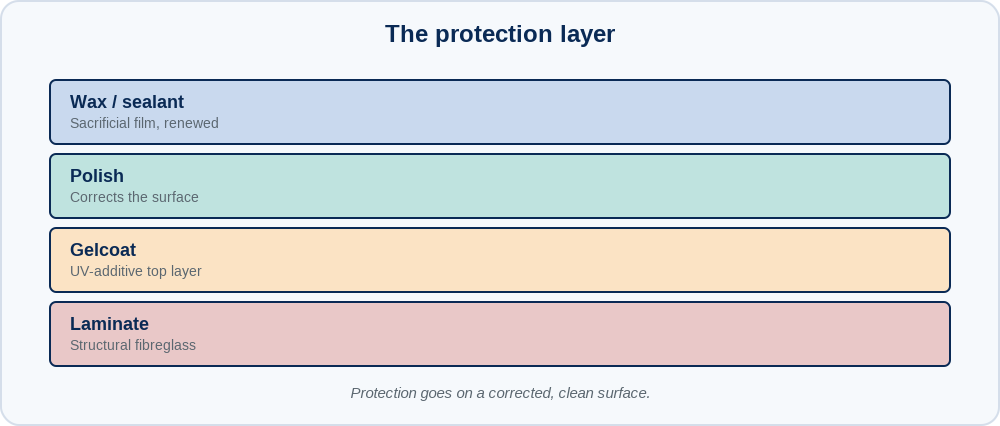
A boating publication says gelcoat creates a durable, water and UV-resistant shell but is porous and susceptible to oxidation, stains and contaminants. A protective coat aims to fill those pores and slow soiling and oxidation. But protection works only on a corrected, clean surface.
2. Wax: carnauba and blends#
A retailer guide says wax seals out oxygen, which prevents oxidation, and most waxes contain UV inhibitors; choices include pure carnauba, carnauba/polymer blends and polymer-only formulations. Carnauba/polymer blends combine the shine of carnauba with the longer-lasting protection of polymers and are considered a good all-around choice for most boaters. A magazine writes that wax provides a very high level of shine as well as some level of protection, and that the boat looks great right after application so the results are admired.
A boat-care site calls carnauba the “queen of waxes” and says nothing quite matches the rich, three-dimensional shine it gives; it quotes three to four months of protection. That is a vendor claim and varies with conditions; but it is the general view that wax needs frequent renewal. A manufacturer’s representative says that if the gelcoat is in good condition conventional wax is enough to protect the surface.
3. Polymer sealant: longer life#
Synthetic polymer sealants are engineered in a lab to bond to the surface. A boat-care site recommends them when the number-one priority is long-lasting protection and gives protection of about six to twelve months (or, on another site, four to six months). These figures are vendor claims and they differ, so keep to the interval in the product data sheet. A manufacturer’s representative says polymer sealant takes more time to apply but lasts longer and is better for the gelcoat, and likens it to suntan lotion for the boat.
A test publication writes that a formula high in carnauba may be best for short-term brilliant shine, while one with a hard polymer or glass-like coat and UV inhibitors may give the best long-term protection; it says even brand-new boats need the gelcoat sealed and protected and suggests starting with a good marine sealant and polish, preferably one of the new synthetic polymer-based types.
| Type | Protection time (vendor claim) | Note |
|---|---|---|
| Carnauba wax | About 3–4 months | Warm, deep shine; frequent renewal |
| Polymer sealant | About 4–12 months | Lasts longer; slightly longer to apply |
| Ceramic coating | About 1–2 years; yearly touch-up | Hard to apply; meticulous preparation; often professional |
4. UV protection: an overstated claim?#
A test publication says some waxes do contain UV protection but the amount of UV protection that a microscopically thin layer of wax can provide is limited. The publication reports testing UVA and UVB absorption among a handful of waxes claiming UV protection and finding that no product, even when applied in a thick film, absorbed a significant percentage of these rays. According to the same publication the primary goal of a wax is to protect the top layers of gelcoat that already contain UV-protection agents. So rather than seeing wax as a sunscreen it is more correct to see it as a sacrificial film insulating the gelcoat from oxygen and dirt.
This finding is a reminder that protection alone will not prevent oxidation entirely; it must be considered together with regular washing, renewal at the right interval and physical protection such as shade or a cover. For ceramic coating an insurance body writes that the coating is expected to repel dirt, bead water and protect from UV damage for a vastly extended period compared with wax; but that is an expectation and a maker’s promise.
5. The right order: correct first, then protect#
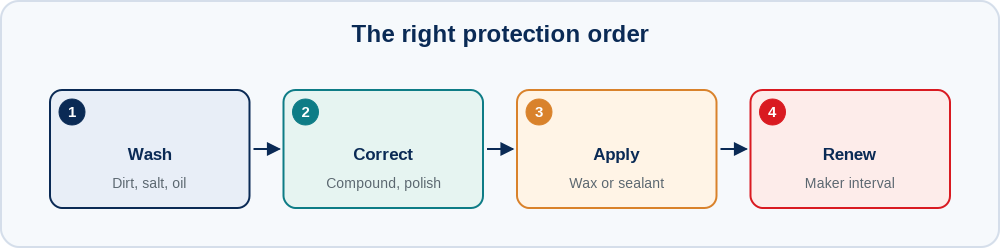
A retailer guide says the correct sequence is compound (if needed), polish, wax, adding that wax contains no abrasive and merely seals and protects. Another guide stresses that wax or sealant should be applied to a clean, corrected surface and that wax does not remove oxidation by itself. Do not wax oxidised or stained gelcoat: wax seals the damage in. Invisible contaminants such as hard-water spots, oily films and mineral build-up also stop a protective coat bonding, so preparatory cleaning is essential.
- Wash the boat with marine soap; remove stains and oil.
- If needed remove oxidation with compound and polish.
- Clean and dry the surface; wipe off residue.
- Apply wax, sealant or ceramic coating thinly and evenly per the data sheet.
- Do not apply in the sun or on a hot surface.
- Write the maker’s renewal interval into the calendar.
6. Which for which boat?#
A boat-care site says traditional wax suits owners for whom appearance is a priority and who do not mind refreshing protection more often; sealant makes sense for boats in stronger sun, harsher salt or a longer season where you want the protection window to stretch farther. It adds that spray is handy for quick reapplication and between larger jobs. For boats kept in the water and used in sunny regions, sealant or ceramic may be considered; for show boats and those that can be maintained more often, carnauba wax may be preferred.
Expert views differ: one manufacturer’s representative finds conventional wax sufficient if the gelcoat is in good condition while another finds polymer sealant longer lasting and better for the gelcoat. So there is no single right answer; choose by your own upkeep rhythm, budget and appearance expectations.
7. Common mistakes#
- Waxing an oxidised or stained surface.
- Expecting wax UV protection to be an endless shield.
- Washing with household detergent and stripping the existing protective coat.
- Waxing non-skid and creating slipperiness.
- Applying ceramic without preparation or in the wrong conditions.
- Not writing down the maker’s renewal interval.
8. Checklist#
9. Conclusion#
Wax, polymer sealant and ceramic coating answer different expectations: wax brings shine and frequent renewal, sealant longer life, ceramic the longest promise and the hardest application. None works on an unprepared surface; wash and correct first, then protect. Keep expectations about UV protection limited and renew regularly. This guide is a general framework; the product data sheet comes first.
Frequently asked questions#
Wax or sealant?
Wax means a bright, warm look and more frequent renewal; polymer sealant generally lasts longer. If the gelcoat is in good condition conventional wax may suffice; expert views differ.
Does wax protect from UV?
In one test publication waxes claiming UV protection did not absorb a significant percentage of the rays. Wax’s real job is to protect the top layers of gelcoat that already contain UV additives.
How often is it applied?
One retailer guide says at least once per season, ideally at the start; another source says roughly every three months for wax and a yearly touch-up for ceramic. Times are vendor claims and vary with conditions.
What is ceramic coating?
A durable coating said to repel dirt and water and protect from UV; according to one source for much longer than wax. It is hard to apply and often done professionally.
Can I wax oxidised gelcoat?
No. Wax seals in the damage; restore first with compound and polish.
Was this guide helpful?
Thank you! Your feedback has been saved.
Guide content is for general information; in practice, the current technical data sheet of the product applies.
Keep reading
Related guides
Boat Colour Selection and Solar Reflectance: Effect of Heat Absorption on Surfaces
A study of the effect of boat paint colour on solar reflectance and surface temperature.
2 min read Paint and CoatingsNumber of Coats in Epoxy Coating Systems
A study of the effect of the number of coats in epoxy coating systems on protective performance and thickness.
2 min read Paint and CoatingsCauses and Diagnosis of Paint Blistering
A study of the sources, types and diagnostic approach to blistering on boat paints.
2 min read