
Paint and Coatings
Wooden Handrail and Toerail Care Guide
In wooden handrail and toerail care the choice between oil, sealer and varnish is described as depending on the balance between looks and effort; sources differ on it. This article summarises the accounts with their limits; it is not a product, method or time recommendation.
Short answer
A boat-supplies retailer’s wood-finish guide writes that there is no universally best finish and the choice depends on the wood, its location on the boat and expectations for appearance and maintenance; it describes oil for places where natural texture and easy care matter more than maximum gloss, and varnish for those who want maximum gloss and are ready for thorough preparation and regular upkeep. An insurer’s guide writes that oiling teak is about recovering and maintaining the golden glow rather than protecting the wood. A public agency’s clean-marina guide says a varnished finish holds up better than an oiled one. User accounts describe sealers as a lower-maintenance option and varnish adhesion trouble on oiled teak as a warning. This article recommends no product; the maker governs.
Key points
- There is no universally best finish; the choice depends on wood, location and maintenance expectations (retailer guide).
- Oil is described as simple to apply with a soft look but needing more frequent renewal.
- A public agency guide says varnished surfaces hold up better than oiled; sealers are described as a lower-maintenance alternative.
- Varnish adhesion trouble on oiled teak appears in user accounts.
- For product, coats and time the maker and a qualified yard govern.
1. Why do toerails and handrails need special attention?#
Wooden parts such as toerails and handrails are exposed to sun, salt, water and constant handling. A boating magazine writes that cost considerations today limit the use of teak aboard recreational boats mainly to trim and decking and that a well-varnished toerail or rubrail can elevate even a modest boat. This article is a general summary; it gives no product, number of coats, grit or time and is not application advice. Sources are magazine, insurer, retailer, public agency and forum accounts and may differ; user accounts are labelled.
2. Oil, sealer and varnish#
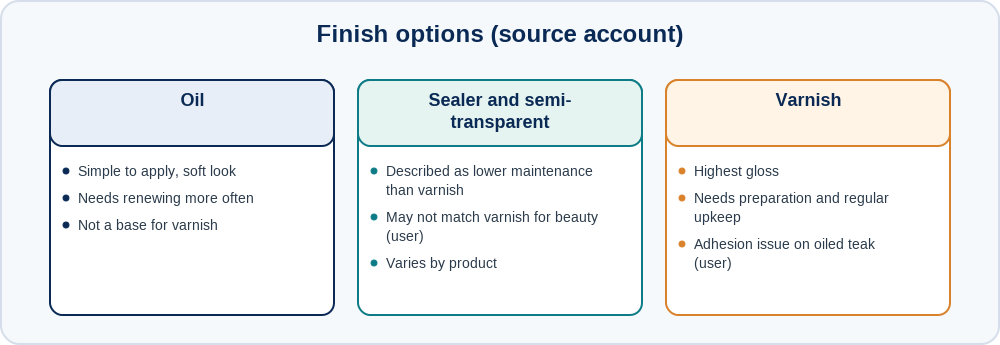
A boat-supplies retailer’s wood-finish guide writes that there is no universally best finish, the right choice depending on the wood, its location on the boat and expectations for appearance and maintenance. It describes oil for decks, handrails and cockpit furniture where natural texture and ease of maintenance matter more than maximum gloss, adding that oil is not appropriate as a build finish for fine exterior brightwork where high gloss is the goal; and varnish if maximum gloss and the classic appearance are the goal and one is prepared for thorough surface preparation and regular upkeep. That is a seller’s guide.
An insurer’s guide writes that oiling teak is not about protecting the wood but about recovering and maintaining the golden glow that made people want teak on the boat; it says teak oils are mainly linseed or tung oil, linseed tending to darken the teak but being much cheaper, while tung does not darken the wood and is more water resistant. It also advises choosing by the recommendations of other boat owners in your area. A public agency’s clean-marina guide says exterior teak trim may be varnished to protect it, that a varnished finish actually holds up better and offers more protection than an oiled one and that some boaters like the convenience of a polyurethane finish as a substitute for varnish.
| Option | Sources’ general account | Caution |
|---|---|---|
| Oil | Simple application, soft look; renewed more often | Not a base for varnish |
| Sealer and semi-transparent | Lower maintenance than varnish; less beautiful (user) | Varies by product |
| Varnish | Highest gloss; holds up better than oil per agency guide | Preparation and regular upkeep |
3. User experiences and differences#
In a sailboat owners’ forum one user writes he used oil for years, applying it several times a year, tried varnish once and it crazed after a year, then switched to a sealer and a year later it still looked good; another says varnish looks great but needs constant maintenance and that an adhesion problem may arise if the teak was previously oiled. In a trawler forum one user writes a sealer can be wiped on with a rag, is not as beautiful as properly done varnish but looks good enough for non-purists, and that oil is a twice-a-year project. These are user accounts, not independently verified, and vary with climate and product.
In a yacht forum one user writes of trying traditional varnish next to a polyurethane product on teak handrail cappings of a vintage motor yacht and eight of ten people at the yard preferring the look of the second; that is a user observation about one maker’s product, not a test. In another forum thread users contradict one another about teak oil composition: one says cheap oils are mostly white spirit and that black staining is from mould not UV, while another attributes blackening to UV. This contradiction shows user accounts cannot be taken as firm rules.
A boating magazine says the work can be daunting so it should be broken into manageable pieces, for example burning off and sanding one handrail before moving to the next area and thoroughly dusting the area afterwards with a vacuum and a dusting brush. A forum user writes that the easiest way to sand a cabin-top handrail is to take the handrails off first. These are general tips; whether they apply to your boat is unknown.
4. A practical frame#
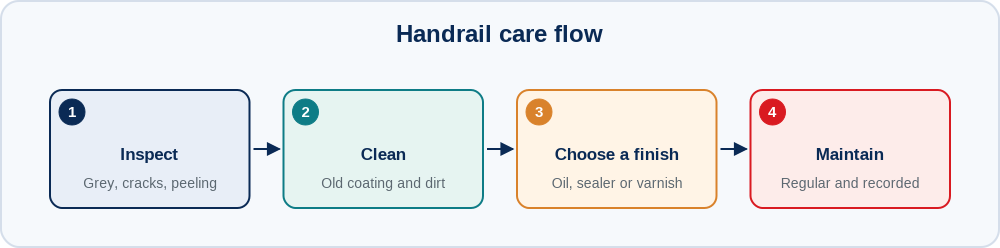
- Inspect: look for greying, cracks, peeling and leak marks around fastenings.
- Establish the existing coating type; whether oiled, varnished or sealed affects preparation.
- Decide the goal: maximum gloss or low maintenance; consider climate and how much effort you can give.
- Prepare and finish per the maker’s data sheet; confirm varnish compatibility on oiled teak with the maker.
- Break the job into pieces; ask a craftsman whether to remove the rail.
- Plan regular inspection and upkeep.
- Keep records; read the safety data sheet.
5. Limits#
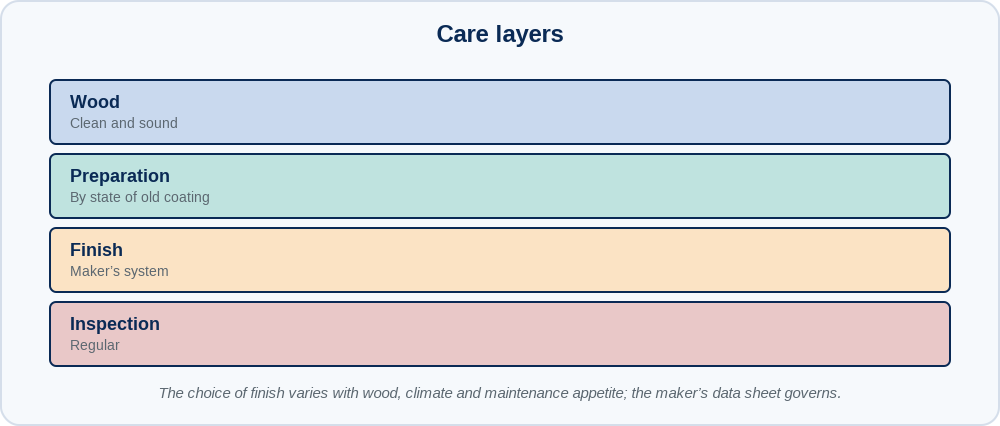
Sources overlap that for teak toerails the choice depends on the balance of looks and effort and that regular upkeep is needed; they differ on which finish is better. A public guide says varnish holds up better than oil while forum users describe sealers as less effort than varnish; an insurer guide says oil is about appearance rather than protection. So there is no single right answer; the wood, climate, maintenance appetite and the maker’s instruction govern. This article is not application advice.
5b. Where sources differ#
The retailer guide says there is no universally best finish; the public agency guide finds varnish more durable than oil; the insurer guide describes oiling as appearance not protection; forum users say they prefer sealers, a polyurethane product or oil and contradict each other on teak oil composition and the cause of blackening. These are sources speaking in different contexts and with different interests. The difference means consulting the maker and a qualified yard for your own rails.
This article is general information; it recommends no product, method, ratio, number of coats or time. The maker’s data sheet and a qualified yard govern.
5c. A practical frame for reading the sources#
The sources are magazines, makers, sellers and forums; each writes in its own context. None knows the condition of the wood, the climate, the existing coating or the effort you can give of your boat. So taking the shared message and consulting the maker and a qualified yard for detail is reasonable.
Sanding dust, solvents and varnish vapours can carry health and fire risks; oil- and varnish-soaked rags can self-heat. Removing old coatings with heat or chemicals adds further risks. This article describes no personal protection, ventilation or waste method; read the product’s safety data sheet, consult a qualified yard and follow the relevant safety rules. Handrails and toerails are load-bearing safety parts; if there is looseness or rot consult a qualified specialist.
Seller and maker statements are the firm’s own account of its product and have not been independently verified. A product’s compatibility with another coating should always be checked in the product’s technical document; where a document and a guide conflict, the maker’s document and a qualified yard’s assessment should be used. Recording decisions and product details helps later maintenance.
6. Common mistakes#
- Varnishing without knowing the existing coating.
- Varnishing oiled teak without precautions.
- Treating oil as protection and neglecting upkeep.
- Covering loose or rotten rails with finish only.
- Treating a forum account as a firm rule.
- Not reading the safety data sheet.
- Keeping no records.
7. Checklist#
8. Conclusion#
In wooden handrail and toerail care sources tie the choice between oil, sealer and varnish to the balance of looks and effort and stress regular upkeep; they differ on which is better. This article is general information; it gives no product, number of coats or time and the maker and a qualified yard govern.
Frequently asked questions#
Oil or varnish for a toerail?
A retailer guide writes there is no universally best finish, with oil described for natural texture and easy care and varnish for maximum gloss. The choice depends on wood and maintenance appetite.
Does teak oil protect the wood?
An insurer guide writes that oiling teak is about recovering and maintaining the golden glow rather than protecting the wood.
What about sealers or semi-transparent finishes?
User accounts describe sealers as a lower-maintenance alternative to varnish; one user writes it is not as beautiful as varnish but looks good enough. These are user accounts.
Will varnish stick to oiled teak?
Forum users write that teak’s natural oils and previous oiling can make varnish adhesion harder; that is a user account, see the product instruction.
Should I sand the handrail in place?
One user writes removing the handrails first makes sanding easier; a magazine describes breaking the job into pieces. These are general tips.
Was this guide helpful?
Thank you! Your feedback has been saved.
Guide content is for general information; in practice, the current technical data sheet of the product applies.
Keep reading
Related guides
Boat Colour Selection and Solar Reflectance: Effect of Heat Absorption on Surfaces
A study of the effect of boat paint colour on solar reflectance and surface temperature.
2 min read Paint and CoatingsCauses and Diagnosis of Paint Blistering
A study of the sources, types and diagnostic approach to blistering on boat paints.
2 min read Paint and CoatingsNumber of Coats in Epoxy Coating Systems
A study of the effect of the number of coats in epoxy coating systems on protective performance and thickness.
2 min read