
Paint and Coatings
Gelcoat or Paint? The Right Choice for a Fibreglass Boat
The classic question on a fibreglass boat with tired gelcoat is whether to repaint or renew the gelcoat. The answer varies with the boat’s condition, budget and expectations; but on either route preparation decides most of the cost and quality.
Short answer
There are three ways to renew an old fibreglass hull. One-part paint can be applied directly to gelcoat and, according to a maker, is the most cost-effective method. Two-part polyurethane (Awlgrip, Awlcraft, Alexseal and the like) increases durability and appearance; its service life is usually two to five times that of one-part paint but the cost is substantially higher. New gelcoat is less commonly chosen and its cost is usually in between. According to one user, preparation matters more than paint brand and most of the labour cost lies there. This article is general information; the product data sheet comes first.
Key points
- Three routes: one-part paint, two-part polyurethane and new gelcoat.
- One-part paint is most economical; a two-part system usually lasts 2–5 times longer but costs much more.
- New gelcoat is less common; its cost lies in between.
- Preparation makes up most of the labour and cost; it matters more than brand.
- A professional polyurethane finish can last a decade or more with proper care; each polish thins the clear layer.
1. Why is the question asked?#
Over the years gelcoat oxidises, scratches and yellows; when polishing no longer works owners are left between two options: repaint or renew the gelcoat. There is no single right answer. A yacht-paint information page says fibreglass is the most common hull material and the most forgiving to paint, but it is not a blank canvas: every fibreglass hull arrives with a gelcoat surface that has its own chemistry, ageing characteristics and compatibility constraints.
This article compares two-part polyurethane, one-part paint and new gelcoat using maker and publication sources. Maker accounts may stress the advantage of their own products; forum views are single experiences. So for the final decision have your own boat inspected on site and get several quotes.
2. The three options#
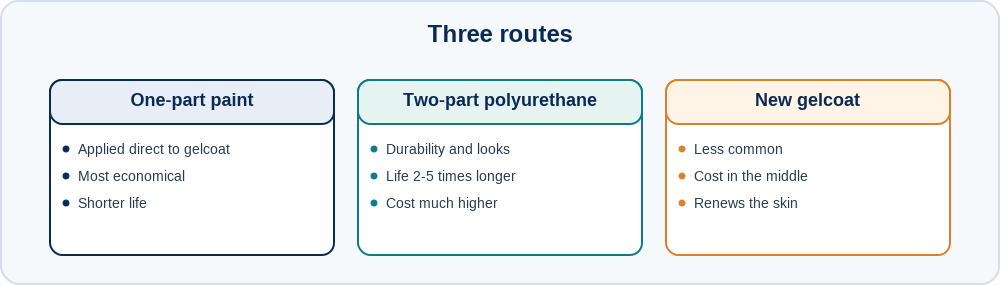
A paint maker’s support page lists three options for painting or resurfacing an old fibreglass hull. First, one-part paint: it can be applied directly to gelcoat, fibreglass or previously painted surfaces in serviceable condition; it is the most cost-effective method for painting a boat and offers a wide variety of colour options. Second, two-part paint such as Awlgrip, Awlcraft, Epifanes polyurethane or Alexseal: it increases durability, performance and the quality of the finished appearance; the service life is usually two to five times longer than one-part and the cost is substantially higher; it offers the most colour options and some systems include special effects such as metallic finishes. Third, applying new gelcoat: less common, but it can restore existing gelcoat to like-new condition; its cost is usually between a one-part and a two-part paint system.
| Option | Strength | Watch for |
|---|---|---|
| One-part paint | Most economical; can go straight on gelcoat | Shorter service life |
| Two-part polyurethane | Durability, appearance, colour choice | Substantially higher cost; needs skill to apply |
| New gelcoat | Can renew the existing surface | Less commonly chosen; mid cost; heavy preparation |
3. Lifespan and polishing: how paint wears#
A power-and-motor-yacht magazine writes that a professionally applied polyurethane finish gives that porcelain look and, with only minimal maintenance, can last a decade or more, which helps amortise the cost of an expensive paint job. But the same article quotes an expert saying that every time you polish you take away the clear layer on top of the pigment and that this is one way of wearing out your paint job. So polishing a painted hull as often and aggressively as gelcoat is not right; follow the paint maker’s maintenance instructions.
On gelcoat an annual compound and wax is routine, and each time it uses up a little gelcoat. On a boat-design forum one user describes the life cycle of a gelcoated boat: repair dings and scratches with gelcoat each season and then after 10 to 15 years, when the whole hull is covered in gelcoat repairs, paint it with Awlgrip. This is a forum view; but it shows the two routes are not exclusive: gelcoat is maintained for years and painted at the end of its life.
4. Cost: is paint or gelcoat cheaper?#
On a forum one user says that while the cost of the paint can be higher than gelcoat the total cost should be lower, since the cost of sandpaper can really add up. Another user writes that for him the price to paint versus gelcoat would have been the same, so he chose paint. A third relays an email from a surveyor saying that over a 20-year period gelcoat becomes more cost-effective compared with paint. These views conflict because cost varies with boat size, existing gelcoat condition and labour rates.
So do not look only at the unit price. Calculate preparation, coating system, job duration, upkeep rhythm and expected life together; see our separate article for the real per-square-metre budget. Getting written quotes of the same scope from several yards makes comparison easier.
5. Preparation: more important than brand#
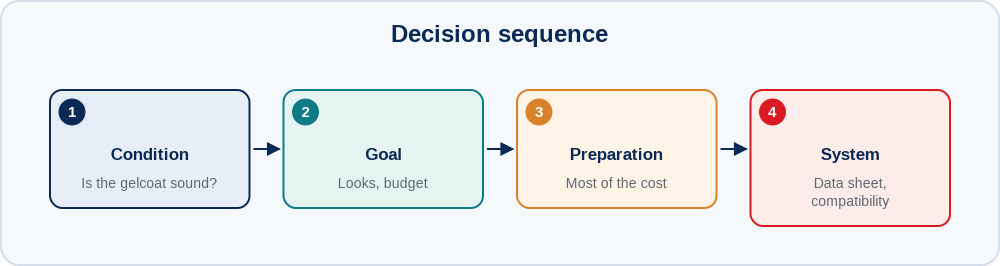
One user, who repainted with Alexseal and got a good result, stresses that surface preparation is more important than which paint brand you use and that this is where the bulk of the labour hours, and cost, will be. Another user writes that gelcoat is porous and intended for use within a mould with fibreglass against it, so painting it on is not as effective. These two views show that preparation is decisive regardless of coating type.
The preparation steps are: wash and degrease the surface, repair damaged gelcoat, sand, remove dust and sanding residue and follow the paint-system maker’s primer and compatibility instructions. Remember that sealant and silicone residue can stop paint from adhering; see the related article.
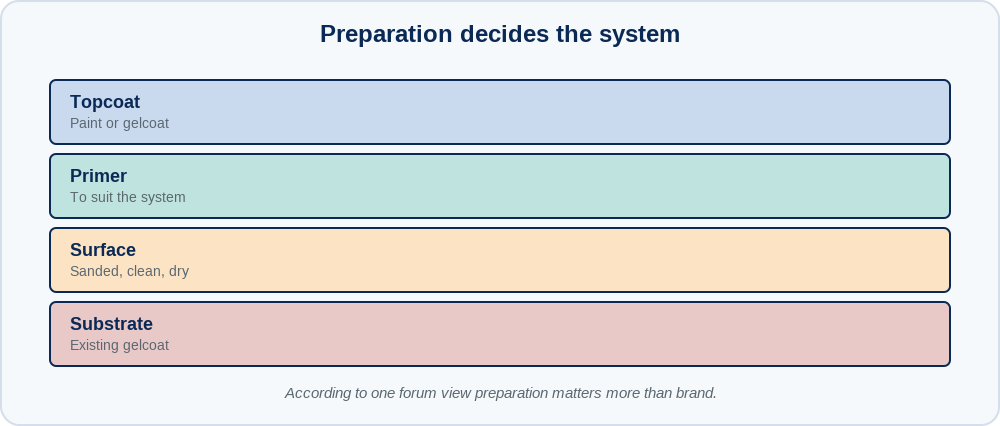
- Assess the existing gelcoat: oxidation, cracks, blisters, damp.
- Set the goal: appearance, life, budget, colour.
- Get several written quotes; compare on the same scope.
- Choose the system (one-part, two-part or gelcoat) and follow the maker’s data sheet.
- Do preparation carefully; do not rush if possible.
- Get the post-application care instructions in writing.
6. Which in which situation?#
If the gelcoat is sound and only oxidised, trying restoration (compound, polish, wax) first is the lightest option. On a hull that is heavily scratched, stained or faded, one-part paint can be a reasonable route if the budget is limited; if high appearance quality, long life and wide colour choice are wanted, two-part polyurethane comes forward. New gelcoat is considered especially if the existing surface is badly scratched and a mould-like surface is wanted, but finding an applicator can be hard.
If there are structural problems such as blisters, delamination or water absorption, remove these first whichever surface coating you choose. Painting or applying gelcoat while there is damp does not solve the problem; see our moisture-detection and blistering articles.
7. Common mistakes#
- Cutting preparation short and applying expensive paint.
- Coating over a structural or moisture problem.
- Looking only at unit price without calculating total cost.
- Polishing a painted hull as often and aggressively as gelcoat.
- Taking delivery without the maker’s care instructions.
- Not comparing written quotes of the same scope.
8. Checklist#
9. Conclusion#
The gelcoat-or-paint question has no single answer: one-part paint is the most economical, two-part polyurethane the most durable and visually strongest and new gelcoat sits between and is less commonly chosen. Whichever you choose, preparation decides most of the cost and quality; fix structural problems first and get written quotes. This guide is a general framework; the product data sheet and the applicator’s advice come first.
Frequently asked questions#
Can paint go over old gelcoat?
Yes. According to a maker one-part paint can be applied directly to gelcoat, fibreglass or previously painted surfaces in serviceable condition. Preparation still decides.
How long does two-part paint last?
According to a maker its service life is usually two to five times that of one-part paint; a magazine writes that a professionally applied polyurethane can last a decade or more with little upkeep.
Does applying new gelcoat make sense?
It is less commonly chosen; according to a maker its cost is between one-part and two-part paint and it can restore existing gelcoat to like-new.
Which is cheaper in the long run?
Sources disagree; an expert view relayed on a forum says gelcoat can be more cost-effective over a 20-year period. Get quotes for your own boat.
Is brand or preparation more important?
One user says surface preparation is more important than which brand you use and that most of the labour hours and cost lie there.
Was this guide helpful?
Thank you! Your feedback has been saved.
Guide content is for general information; in practice, the current technical data sheet of the product applies.
Keep reading
Related guides
Boat Colour Selection and Solar Reflectance: Effect of Heat Absorption on Surfaces
A study of the effect of boat paint colour on solar reflectance and surface temperature.
2 min read Paint and CoatingsNumber of Coats in Epoxy Coating Systems
A study of the effect of the number of coats in epoxy coating systems on protective performance and thickness.
2 min read Paint and CoatingsCauses and Diagnosis of Paint Blistering
A study of the sources, types and diagnostic approach to blistering on boat paints.
2 min read