
Paint and Coatings
Boat Sealant Choice: Teak Seams, Deck and Hull
Sealant choice is described in sources by application location: teak seams, deck hardware, hull-deck joints and underwater carry different needs. This article summarises the accounts with their limits; it is not a product, ratio or time recommendation.
Short answer
A test publication writes that in 2006 it evaluated seven caulks advertised for teak-deck seams on ease of application, adhesion, durability and chemical resistance, one product rating only fair after two years. A retailer says polysulfide seam products are common for teak decks and wooden parts, full cure is measured in days and varies between products, and polyurethane is described for hull-deck joints. A maker’s guide describes seam depth, bond-breaker tape and wood movement; a boating magazine reminds that sealant should not be over-painted with solvent-based paint before it has skinned and begun to cure. A sealing blog writes that sealant keeps water out of a sound joint while a structurally failed joint is rebuilt with epoxy. This article recommends no product; the maker governs.
Key points
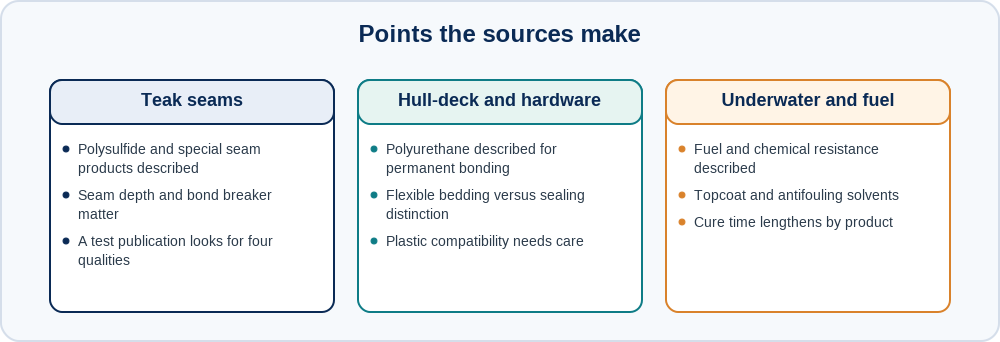
- Sealant choice is described by application location: teak seam, hull-deck, hardware bedding and underwater.
- For teak seams polysulfide and special seam products are described; seam depth and bond breaker matter (maker).
- Polyurethane is described for permanent bonding such as hull-deck joints.
- Sealant should be given time to skin and begin curing before over-painting with solvent-based paint (magazine).
- For product, depth and time the maker and a qualified yard govern.
1. Choice by location#
The same sealant may not suit everywhere: a boat-test website writes that sealing divides into above and below the waterline and is needed where solid hardware is not necessarily used, for example a through-hull, a hull-to-deck joint or between the planks of a wooden boat. This article is a general summary; it gives no product, seam depth, cure time or time and is not application advice. Sources are test publication, magazine, retailer and maker accounts and may differ; maker and seller statements are labelled.
2. Teak seams#
A test publication writes that in June 2006 it began testing seven caulks advertised for teak-deck seams, the goal being to evaluate the four basic qualities anyone choosing a teak-deck caulk would want: ease of application, adhesion, durability and resistance to chemicals; products were one- and two-part, silicone, polyurethane and MS polymer based. It writes that a two-part polysulfide product rated only fair for chemical resistance and longevity after two years and that a silicone-based product was advertised as resistant to teak cleaners, oils and fuel; that is an old test and a seller claim and products may have changed.
| Location | Sources’ general account | Caution |
|---|---|---|
| Teak seam | Polysulfide and special seam products; seam depth and bond breaker | Teak moisture and cleaning |
| Hull-deck and hardware | Polyurethane for permanent bonding | Plastic compatibility |
| Underwater and fuel | Fuel and chemical resistance | Cure and topcoat |
3. Maker, retailer and magazine accounts#
A maker’s application guide describes teak-deck seam dimensioning by wood movement, the deep-joint method being preferred when possible, bond-breaker tape at the seam base preventing three-sided adhesion, seam width not being too small and limited seam depth in refurbishment raising the risk of water penetration; that is a maker’s guide, specific to its system and no substitute for the product instruction.
A retailer guide writes that two-part polysulfides have long been popular for teak-deck seams or bedding wooden parts such as rubrails, that full cure can be long, around ten to twenty days, while the strongest slow-cure polyurethane versions take five to seven days; it describes polyurethane for hull-to-deck joints and through-hull bonding but says it may be incompatible with ABS and similar plastics and that the wrong chemistry on plastic can do permanent damage. That is a seller guide and times vary by product.
A British boating magazine says polyurethane sealants are moisture-cured, that when bonding large areas of teak deck to fibreglass or steel the sealant may struggle to find enough moisture to cure and a fine mist can help, that there are two main ways to caulk a wooden deck, the second very labour-intensive but wasting less sealant and needing less sanding, requiring each joint masked. The same magazine says sealant should be given enough time to skin off and start curing before over-painting with solvent-based coatings and that antifoul solvents can affect sealant between keel and hull.
A sealing blog writes that sealant keeps water out of a sound joint and epoxy is used to rebuild a joint that is no longer sound; that is a blog account, a generalisation not valid for every boat. A yachting magazine says polyurethane is the strongest adhesive sealant; the pairing of product and job should be confirmed from the data sheet.
So sources give different weight: some favour special seam products for teak seams, some polyurethane for hull-deck, some polysulfide around fuel. These choices vary with boat, wood and climate; for your own boat consult the maker and a qualified yard.
4. A practical frame#
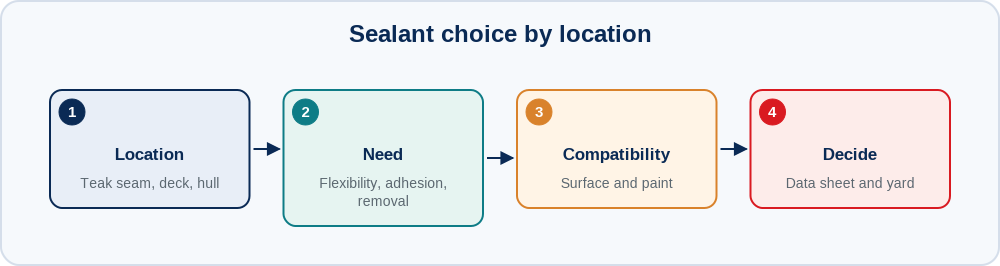
- Establish the location: teak seam, deck hardware, hull-deck joint, underwater or around fuel.
- Establish the need: flexible bedding, permanent bonding, or will it be disassembled later?
- Confirm surface and plastic compatibility from the data sheet.
- Decide details such as seam dimensioning and bond breaker with a craftsman per the maker’s instruction.
- Allow the sealant enough time to cure before topcoat.
- Plan regular inspection.
- Keep records; read the safety data sheet.
5. Limits#
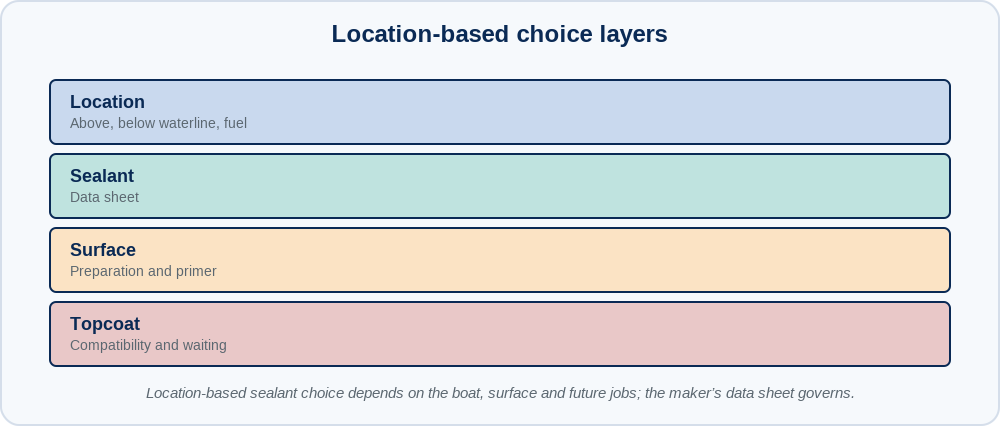
Sources overlap that sealant choice depends on location and need, that compatibility must be confirmed from the data sheet and that cure time should be allowed before topcoat; they differ on which product suits which place and on lifespan. Maker and seller accounts are specific to their products; old test products may have changed. So there is no single right answer; location, surface and the maker’s instruction govern. This article is not application advice.
5b. Where sources differ#
The test publication looks for four qualities in teak-seam caulk; the maker describes seam depth and bond breaker; the retailer gives cure times for polysulfide and polyurethane; the magazine describes moisture cure and solvent effects; the blog says sealant for sound joints, epoxy for failed ones. These are sources speaking in different contexts and with different interests. The difference means consulting the maker and a qualified yard for your own boat.
This article is general information; it recommends no product, method, ratio, number of coats or time. The maker’s data sheet and a qualified yard govern.
5c. A practical frame for reading the sources#
The sources are magazines, makers, sellers and forums; each writes in its own context. None knows the location, the surface or the future need to disassemble and paint of your boat. So taking the shared message and consulting the maker and a qualified yard for detail is reasonable.
Sealants, primers, solvents and cleaners can carry skin and respiratory irritation or allergic risk; removal and cutting work carries injury risk. This article describes no personal protection, ventilation or waste method; read the product’s safety data sheet, consult a qualified yard and follow the relevant safety rules. At safety-critical places such as a hull-deck joint and seacocks apply to a qualified specialist.
Seller and maker statements are the firm’s own account of its product and have not been independently verified. A product’s compatibility with another coating should always be checked in the product’s technical document; where a document and a guide conflict, the maker’s document and a qualified yard’s assessment should be used. Recording decisions and product details helps later maintenance.
6. Common mistakes#
- Using the same sealant everywhere.
- Ignoring seam dimensioning and bond breaker in teak seams.
- Not confirming compatibility on plastic.
- Applying solvent-based coatings before the sealant has cured.
- Treating old test results as current.
- Not reading the safety data sheet.
- Keeping no records.
7. Checklist#
8. Conclusion#
Boat sealant choice is described in sources by location: teak seams, deck hardware, hull-deck joints and underwater carry different needs. This article is general information; it gives no product, depth or time and the maker and a qualified yard govern.
Frequently asked questions#
Which sealant for teak seams?
Sources describe polysulfide and special seam products; a test publication looked for ease of application, adhesion, durability and chemical resistance. Product and method depend on the maker.
What is used on the hull-deck joint?
Many sources describe polyurethane for places needing permanent bonding; the exact choice depends on the data sheet and the maker.
When can I paint over sealant?
A boating magazine says to give the sealant enough time to skin off and begin curing before over-painting with solvent-based coatings.
What is bond-breaker tape?
A maker’s guide writes that bond-breaker tape at the seam base can give two-sided adhesion and that the deep-joint method is preferred.
Does sealant make a structural repair?
A blog writes that sealant keeps water out of a sound joint and a failed joint is rebuilt with epoxy; that is a blog account.
Was this guide helpful?
Thank you! Your feedback has been saved.
Guide content is for general information; in practice, the current technical data sheet of the product applies.
Keep reading
Related guides
Boat Colour Selection and Solar Reflectance: Effect of Heat Absorption on Surfaces
A study of the effect of boat paint colour on solar reflectance and surface temperature.
2 min read Paint and CoatingsCauses and Diagnosis of Paint Blistering
A study of the sources, types and diagnostic approach to blistering on boat paints.
2 min read Paint and CoatingsNumber of Coats in Epoxy Coating Systems
A study of the effect of the number of coats in epoxy coating systems on protective performance and thickness.
2 min read