
Paint and Coatings
Water Entry and Sealing Under Deck Hardware
Water entry under deck hardware is linked in sources to core damage, delamination and interior harm; sources give bedding compound and core closeout different weight. This article summarises the accounts with their limits; it is not a product, method or time recommendation.
Short answer
A boat-owners’ organisation guide writes that a leak around deck hardware is not only annoying but probably damaging the boat, a core going wet leading to rot and delamination; it adds that fasteners on the underside of the deck should never be sealed, because if the seal with the outer skin breaks you want the water to pass into the cabin where it will be noticed. A sailing magazine writer says deck hardware and its fasteners may be contaminated with waxes and oils and that no penetration should rely on sealant alone to keep water out of the core. One forum user says epoxy can be too rigid and crack, another that closing off the core with epoxy is a must. This article recommends no product; the maker and a qualified yard govern.
Key points
- Water entry under hardware can lead to core damage, delamination and interior harm (organisation guide).
- Bedding acts as a flexible gasket; squeeze-out indicates no voids (sailing magazine).
- Underside fasteners are not sealed so water is noticed if the seal fails (organisation guide).
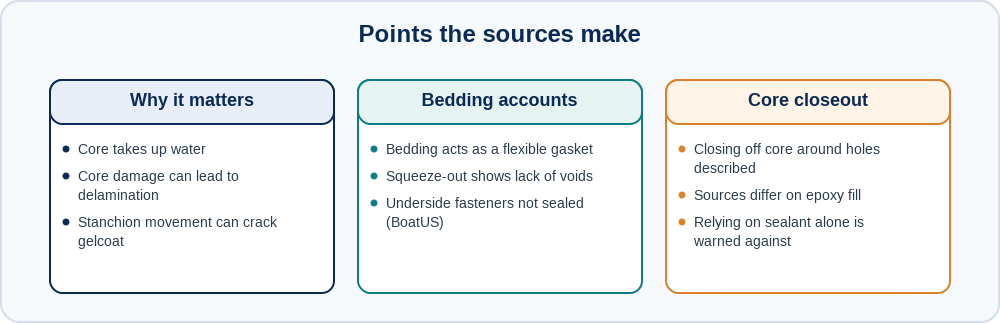
- No hole should be left relying on sealant alone; core closeout is described and sources differ on epoxy.
- For extensive damage, decision and method belong to the maker and a qualified yard.
1. Why is under hardware a weak area?#
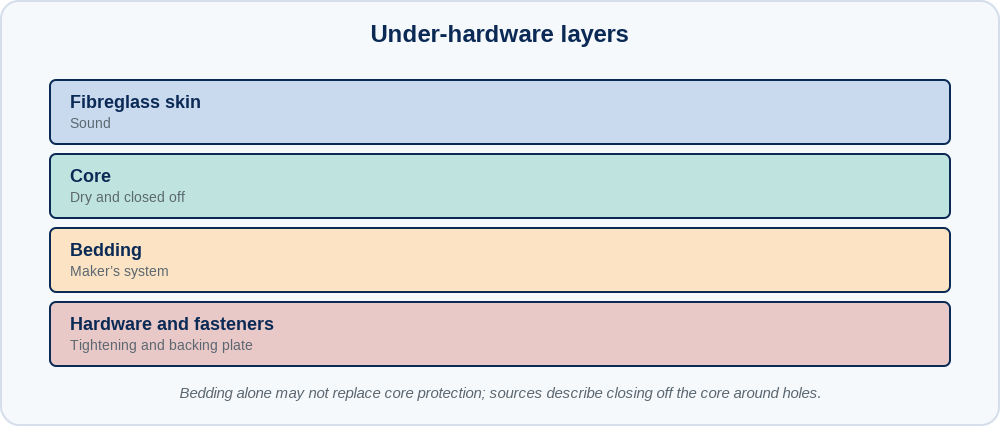
Deck hardware such as cleats, stanchion bases, genoa tracks, winches and pulpits is mounted by penetrating the deck. A boat-owners’ organisation guide describes most decked boats having a wood core in the deck to stiffen it, rot being the usual consequence if water enters, and smaller powerboats using a similar technique in the transom. This article is a general summary; it gives no product, bedding type, torque or time and is not application advice. Sources are organisation guide, sailing magazine and forum accounts and may differ; user accounts are labelled.
2. Core and bedding compound#
Another guide from the same organisation writes that as bedding breaks down water finds its way in, that as soon as the smallest cracks develop it will find its way into the core, that water contacting core material can cause many problems and worst case lead to delamination. A sailing magazine writer says bedding serves as a flexible gasket between hardware and the deck surface, its aim being gap filling to stop water passing between them, that ample squeeze-out when pressing hardware indicates no voids, and that fastener heads should be bedded too, which can prevent water entrapment and crevice corrosion.
| Topic | Sources’ general account | Caution |
|---|---|---|
| Bedding | Flexible gasket role; squeeze-out indicates no voids | Dirty surface can spoil adhesion |
| Core closeout | Core protected around holes | Method and material differ |
| Underside fasteners | Not sealed; failure noticed | Organisation guide |
3. Surface, closeout and differences#
Another article by the sailing magazine writer says that by his tests virtually all deck hardware, whether stainless, aluminium or plastic, and its fasteners are contaminated with waxes or oils, and that using the wrong solvent can stop the sealant fully curing; he adds that in a cored composite deck, cabin or hull no penetration should rely on sealant alone to keep water from migrating into the core, describing a closeout approach resistant to crushing when through-bolts are torqued. An organisation guide also says that where the deck is cored the core must be sealed around penetrating holes, one option being digging out additional core to thicken the barrier and reinforce the deck.
The organisation guide says fasteners should not be sealed on the underside of the deck, the aim being that failure is noticed, and that not over-tightening matters; a club newsletter article describes selective rebedding, starting with the most abused hardware such as stanchion bases, genoa tracks and mooring cleats, and says a moisture meter can quickly show where water is seeping into the core.
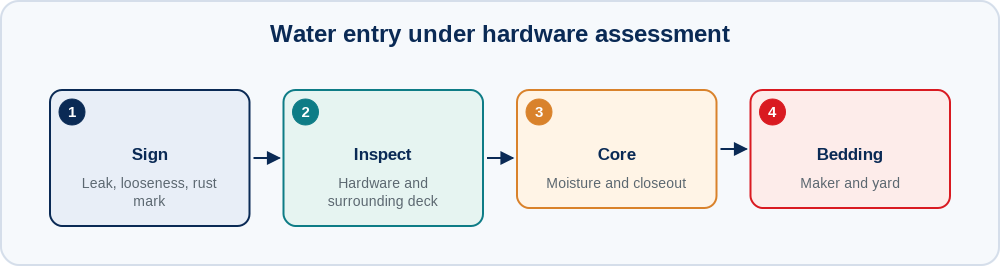
A sailing magazine says for sound stanchion mounting backing pads spread loads, flexible bedding seals joints against leaks and sealed bolt holes keep a cored deck dry, stainless bolts, nuts and washers giving strength; it writes that rebedding is called for if bases move, the deck around is cracked or depressed, they leak or rust stains show, and that if stanchions haven’t been removed and serviced in about seven years one might consider removing, inspecting and rebedding. That is one author’s account and may not apply to every boat.
In forums users differ: one writes that overdrilling holes and filling with epoxy is a must, another that epoxy is too rigid and may crack when force comes on the stanchion or cleat, leading back to the same water entry, so he uses butyl and large backing plates; a third describes overdrilling, digging out core, soaking with unthickened epoxy, filling with thickened epoxy, redrilling and installing with butyl and oversized backing plates. These are user accounts, not independently verified, and not method recommendations.
This difference shows there is no single right method. Where core damage is extensive or the hardware has a structural role (safety parts such as stanchions, pulpits, winches or anchor gear), decision and method belong to a qualified yard. Keeping records makes it possible to know which hardware was bedded when and with which system.
4. A practical frame#
- Inspect: look for looseness, deck cracks, depression, leaks and rust stains.
- Assess core moisture; a moisture meter is described, with extensive damage consult a qualified specialist.
- Decide the bedding, core closeout and backing plate approach with a craftsman when rebedding.
- Confirm hardware and fastener surfaces are clean and per the maker’s instruction.
- Discuss the organisation guide’s approach to underside fasteners with a craftsman.
- Plan regular inspection.
- Keep records; read the safety data sheet.
5. Limits#
Sources overlap that water entry under hardware can lead to core damage, that bedding matters and that sealant alone should not be relied on; they differ on core closeout method and epoxy use. Organisation guides, magazine writers and forum users speak in different contexts. So there is no single right answer; the boat, the hardware’s structural role and the maker’s instruction govern. This article is not application advice.
5b. Where sources differ#
The organisation guide says underside fasteners should not be sealed; the magazine writer says fastener heads should be bedded; in a forum one user says epoxy fill can crack and another says closing off the core with epoxy is a must. These are sources speaking in different contexts and with different interests. The difference means consulting the maker and a qualified yard to choose a method on your own boat.
This article is general information; it recommends no product, method, ratio, number of coats or time. The maker’s data sheet and a qualified yard govern.
5c. A practical frame for reading the sources#
The sources are magazines, makers, sellers and forums; each writes in its own context. None knows the deck structure, the core type or the hardware’s load role of your boat. So taking the shared message and consulting the maker and a qualified yard for detail is reasonable.
Bedding compounds, solvents, epoxy and sanding dust can carry health, skin-sensitisation and fire risks. This article describes no personal protection, ventilation or waste method; read the product’s safety data sheet, consult a qualified yard and follow the relevant safety rules. If load-bearing safety parts such as stanchions, pulpits, winches and anchor gear have looseness, cracks or rot apply to a qualified specialist.
Seller and maker statements are the firm’s own account of its product and have not been independently verified. A product’s compatibility with another coating should always be checked in the product’s technical document; where a document and a guide conflict, the maker’s document and a qualified yard’s assessment should be used. Recording decisions and product details helps later maintenance.
6. Common mistakes#
- Leaving the core relying on sealant alone.
- Bedding onto a dirty, waxy surface.
- Leaving fastener heads unbedded.
- Sealing underside fasteners and hiding water entry.
- Treating a forum method as a firm rule.
- Not reading the safety data sheet.
- Keeping no records.
7. Checklist#
8. Conclusion#
Water entry and sealing under deck hardware is linked in sources to core damage risk; bedding, surface cleanliness and core closeout matter and sources differ on method and epoxy. This article is general information; it gives no product, torque or time and the maker and a qualified yard govern.
Frequently asked questions#
Why does a leak under hardware matter?
A boat-owners’ organisation writes a leak is probably damaging the boat, a wet core leading to rot and delamination.
What does bedding compound do?
A sailing magazine describes bedding as a flexible gasket between hardware and deck; squeeze-out indicates no voids.
Are underside fasteners sealed?
An organisation guide writes they should not be, because if the outer seal fails you want water to pass into the cabin and be noticed.
Is core closeout needed?
A sailing magazine writer says no penetration should rely on sealant alone; sources differ on method and material.
When should stanchion bases be rebedded?
A sailing magazine writes if bases move, the deck around them is cracked or depressed, they leak or there are rust stains; a qualified yard governs.
Was this guide helpful?
Thank you! Your feedback has been saved.
Guide content is for general information; in practice, the current technical data sheet of the product applies.
Keep reading
Related guides
Boat Colour Selection and Solar Reflectance: Effect of Heat Absorption on Surfaces
A study of the effect of boat paint colour on solar reflectance and surface temperature.
2 min read Paint and CoatingsCauses and Diagnosis of Paint Blistering
A study of the sources, types and diagnostic approach to blistering on boat paints.
2 min read Paint and CoatingsNumber of Coats in Epoxy Coating Systems
A study of the effect of the number of coats in epoxy coating systems on protective performance and thickness.
2 min read