
Hull Repair
Boat Washing Routine: How, How Often and in What Order
Washing is the simplest boat-care job and the one most often done wrong. Salt crystals are abrasive, the wrong soap strips wax, one bucket leaves scratches. This guide explains order, frequency and common mistakes.
Short answer
When washing, first pre-rinse with fresh water, then wash top to bottom with two buckets (soap and clean rinse) and a soft mitt, rinse until no suds remain and dry to avoid water spots. For salt water use a fresh-water rinse after every trip is recommended; a retailer guide calls it a five-to-ten-minute, highest-return habit. For soap quantity and product choice the label comes first. This article is general information.
Key points
- A pre-rinse removes salt and sand; skip it and the mitt scratches the gelcoat.
- The two-bucket method (soap and clean rinse) cuts scratch risk.
- In salt water rinse with fresh water after every trip; soap wash regularly.
- A soft mitt, pH-balanced soap and drying cut water spots and scratches.
- The final rinse must leave no suds or detergent residue.
1. Why washing matters so much#
A boating writer says he washes his boat after every use, removing salt and residues of bait and fish that would otherwise dry and become part of the fibreglass. A public agency guide says a boat used in salt water should be rinsed with fresh water at the end of each day. A maker blog calls a thorough wash with marine soap after every use a must. A magazine notes that bird droppings and environmental residue baking in the sun damage fibreglass and wood finishes and that waiting makes the job harder.
Washing is not just looks: salt and contaminants build up on gelcoat and paint and, combined with UV, speed damage. So regular washing is also a basic step for UV protection and for preventing oxidation. See our UV damage and salt residue articles.
2. Step-by-step washing#
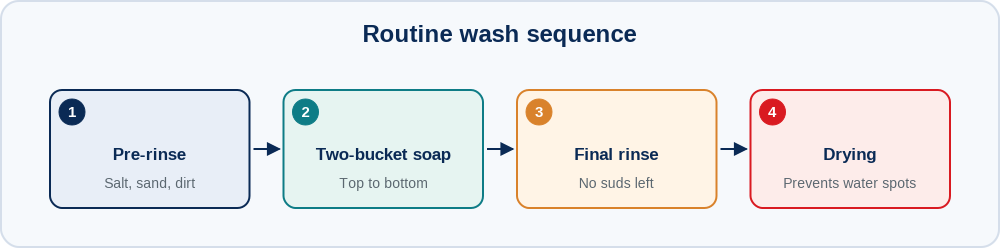
A retailer guide gives this order. First pre-rinse the whole boat with fresh water before any soap touches it: this removes loose salt crystals, sand, bird droppings and surface debris; skip it and the mitt grinds them into the gelcoat. The guide names a skipped pre-rinse as the single biggest cause of micro-scratching in routine washing on salt-water boats, because salt crystals are abrasive. Rinse top to bottom; pay attention to cockpit drains, toe-rail bases and horizontal surfaces where salt collects.
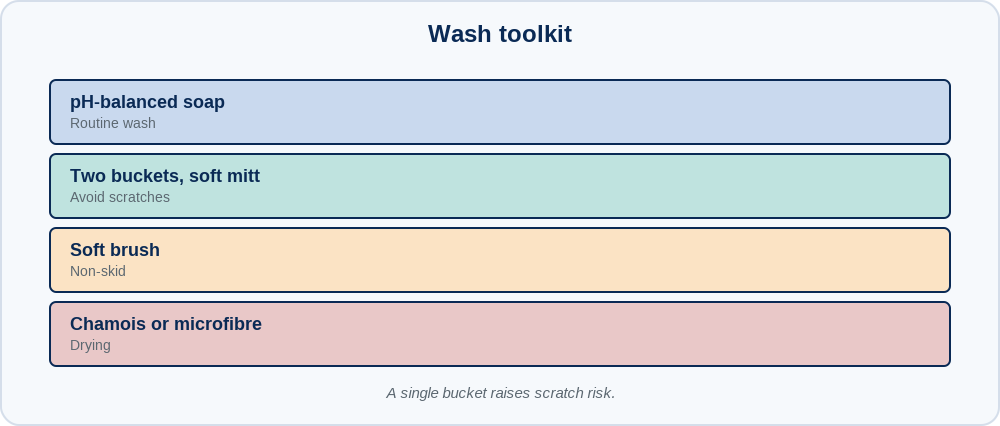
Then prepare the soap solution: the guide suggests roughly one to two ounces of concentrate per gallon for routine washing and two to three for a deep clean; this must agree with the label, which comes first. Use two separate buckets: one for soap, one for clean rinse water; the guide says a single bucket causes swirl marks. Rinsing the mitt in the rinse bucket before it goes back to the soap keeps abrasive particles out of the soap solution. Wash one section and rinse it at once, then move on.
| Tool | Why | Note |
|---|---|---|
| pH-balanced marine soap | Removes salt and dirt | Dilute per label |
| Two buckets | Mitt is rinsed | A single bucket can scratch |
| Soft mitt | Protects the surface | Microfibre preferred |
| Soft brush | Non-skid | No stiff brush on gelcoat |
| Chamois or microfibre | Drying | Air drying leaves spots |
3. Frequency: salt and fresh water#
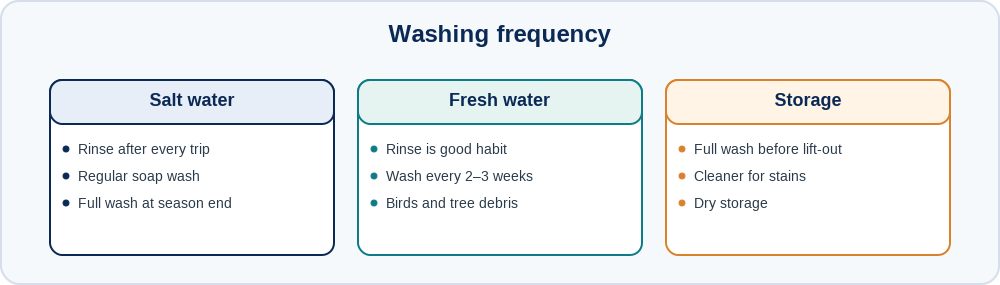
A retailer guide recommends rinsing salt-water boats with fresh water after every trip without exception; for fresh-water boats the urgency is lower but washing is still needed because of birds, spray and shoreline debris. The same guide in table form mentions soap washing about every two to three weeks for fresh-water boats and a full wash before storage; this is a seller guide and should be adjusted to your use. It also says a five-to-ten-minute fresh-water rinse is the single highest-return maintenance habit for salt-water boaters.
During heavy use quick washdowns and spot cleaning matter; mid-season or after a run of hard-use weekends plan a longer reset for areas routine washing misses. A boat brand also recommends rinsing plentifully after washing so the surface is free of salt and sediment.
4. Soap, residue and product choice#
Marine soap removes salt, dirt, bird residue and light biological growth; a pH-balanced concentrate is called the most versatile option. A boat brand says all surfaces should be rinsed thoroughly with fresh water after cleaning with detergents or solvents because latent solvent residue can attack the topcoat while detergent residue will attract dirt. A fishing magazine advises avoiding bleach, noting it can damage gelcoat. Another boat brand says dish soap may be fine on some vinyl but generally a product made for the material is preferred.
Whether soap strips wax also matters: one writer says he uses only soaps that are mild and formulated to protect wax. Think of your wax renewal interval together with your soap choice. Products that may contain acid, such as hull cleaner, strip wax and must not be used on antifouling; see our salt residue article for detail.
5. Drying and final check#
After washing a retailer guide recommends drying at once to avoid water spots; in salt-water environments minerals concentrate as water evaporates and make spots lasting. A magazine guide advises wiping relatively dry with a synthetic chamois or clean towel. Do not use high-pressure water at seals and ports; a guide advises a steady flow.
- Plan washing in shade or morning/evening, before the sun heats the surface.
- Pre-rinse top to bottom with fresh water.
- Prepare the buckets: one soap, one clean water.
- Wash section by section top to bottom; rinse each section at once.
- Do the final rinse until no suds remain.
- Dry with a chamois or microfibre.
- If stains or dullness remain plan a deep clean or correction.
5b. Bird droppings, fish residue and stubborn stains#
Bird droppings, tree sap and fish residue stick once dry. A public guide notes these are tough to remove; a boat brand says such soils stick less to waxed surfaces. So rinse them while still wet rather than waiting, and do not scrape hardened stains with a stiff brush or abrasive. Soak with water first and let it dwell, then wipe gently with a microfibre mitt. One writer reports that the cuff of the mitt is effective on stubborn spots and bird droppings without scratching; that is a user experience.
A retailer guide says if after a soap wash you still see a brown or black waterline stain, a green biological film or grey non-skid, that is a different job from routine washing, namely a deep clean. In a deep clean the product order and dwell times differ; see our salt residue article and the product label. On painted surfaces try any product you use to remove a stain on a hidden area first.
6. Common mistakes#
- Skipping the pre-rinse and rubbing in salt with the mitt.
- Using one bucket.
- Using bleach or harsh detergent.
- Not rinsing detergent and solvent residue.
- Washing a hot surface and letting soap dry.
- Using hull cleaner on antifouling.
- Leaving bird droppings to wait.
7. Checklist#
8. Conclusion#
Correct washing is a pre-rinse, two buckets, suitable soap, plenty of rinsing and drying; in salt water a fresh-water rinse after every trip is the most effective habit. This routine protects gelcoat and paint and slows UV and salt damage. This article is general information; the product label comes first.
Frequently asked questions#
How often should I wash my boat?
In salt water a fresh-water rinse after every trip is recommended; soap washing regularly, and in fresh water about every two to three weeks according to sources.
Why pre-rinse first?
Salt crystals, sand and bird droppings scratch if rubbed in with the mitt; a retailer guide names a skipped pre-rinse as the biggest cause of micro-scratching in routine washing.
Why two buckets?
One for soap, one to rinse the mitt; abrasive particles do not return to the soap solution and surface.
Is bleach OK?
A fishing magazine advises avoiding bleach because it can damage gelcoat.
Must I dry?
Recommended to avoid water spots; in salt water minerals concentrate as water evaporates.
Was this guide helpful?
Thank you! Your feedback has been saved.
Guide content is for general information; in practice, the current technical data sheet of the product applies.
Keep reading
Related guides
Boat Colour Selection and Solar Reflectance: Effect of Heat Absorption on Surfaces
A study of the effect of boat paint colour on solar reflectance and surface temperature.
2 min read Paint and CoatingsCauses and Diagnosis of Paint Blistering
A study of the sources, types and diagnostic approach to blistering on boat paints.
2 min read Paint and CoatingsNumber of Coats in Epoxy Coating Systems
A study of the effect of the number of coats in epoxy coating systems on protective performance and thickness.
2 min read