
Hull Repair
Nano Coating and Boat Protection: What It Promises and How to Judge It
Nano coating is a term heard often in boat care; many products are sold under ceramic, graphene or nano labels. This article explains what the term means, how to read the claims and what to look at when deciding.
Short answer
Nano coating is a general name for products that leave a very thin film, usually described with ingredients such as silicon dioxide (SiO2) or graphene oxide. Makers claim high hardness, water repellency and long life; these claims are mostly vendor claims and independent measurement is not guaranteed for every product. Sources stress the result depends on surface preparation and upkeep; one boating magazine reports about one year of efficacy claimed for one product and three months for a rinse-on type. This article is general information; the data sheet comes first.
Key points
- Nano coating is a general name for thin-film products based on silica or graphene.
- Claims of hardness, hydrophobicity and life are mostly maker claims.
- The result depends on flawless prep and upkeep; if oxidation exists, correct it first.
- Durations vary by product type: rinse-on short, harder systems claimed longer.
- Read the data sheet, independent tests and application cost together when deciding.
1. What does “nano coating” mean?#
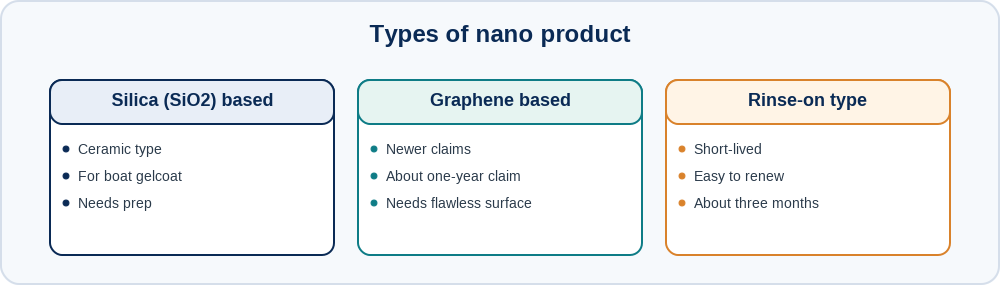
Nano coating is not a standard; it is a term mostly used in marketing. Under this name boat products often include silicon-dioxide (SiO2) based ceramic-type coatings and, in recent years, sprays containing graphene oxide. A detailing educator presents his product as a nano ceramic coating specially formulated for gelcoat that seals the surface with a high concentration of nano-sized SiO2; that is a maker and seller description. A boating magazine says graphene oxide is mechanically and chemically separated from graphite into translucent molecular plates that, laid in a thin layer, align and bind over the surface in an armour-like layer.
When reading such descriptions note this: although a product is presented with a “molecule” story, what can be measured is the outcome: water repellency, ease of cleaning, UV resistance and life. To judge whether a product really works, look for independent experience in conditions close to your own boat’s.
2. Claims and their source#
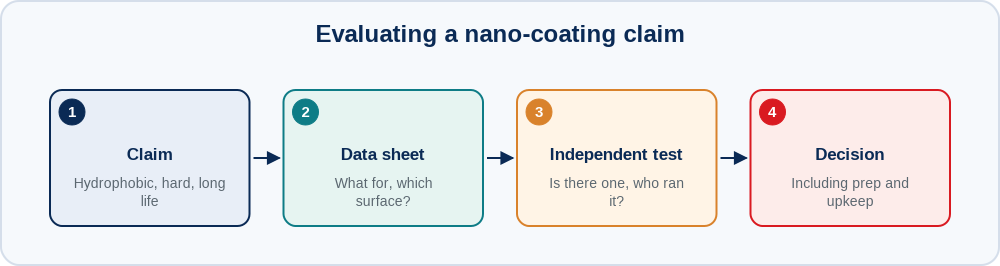
Makers usually describe a very hard, hydrophobic, long-lasting and easy-to-clean surface. One maker says its coating has a hardness rating (9H) well above ordinary paint and is super-hydrophobic; a magazine writer reports this using the word “claims”. A boat-service says its product gives scratch and chip resistance. These are vendor claims; scales such as hardness grades may not map one-to-one onto real scratch resistance of boat gelcoat.
A magazine implies lumping all products together would mislead: some promise three months, some a year, some longer. A test publication says high silicon content is a good rule of thumb but not the only determinant of success. Do not equate the word “nano” in a product name with quality.
| Type | Typical claim (per sources) | Watch for |
|---|---|---|
| Rinse-on ceramic | About three months | Easy renewal, short life |
| Graphene spray | About one year | Needs flawless surface |
| DIY ceramic | About 1–3 years (in sources) | Prep is most of the job |
| Professional system | Claimed longer | Cost and application quality |
3. Preparation decides#
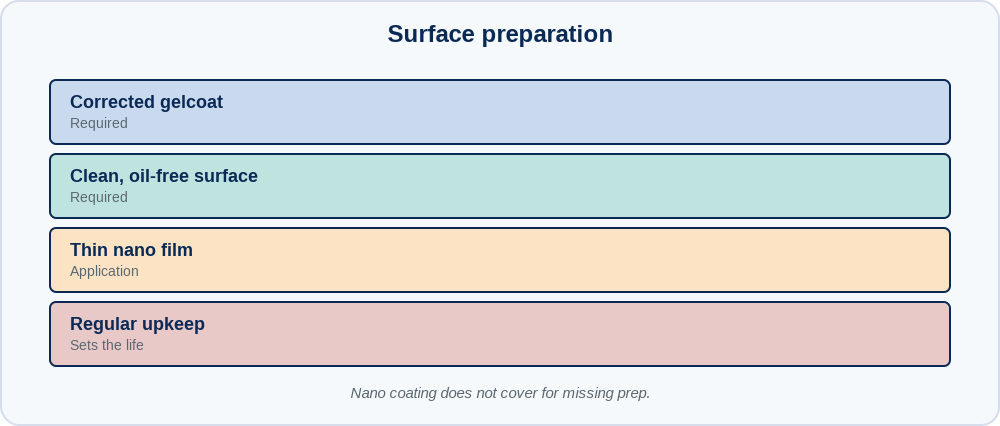
A magazine writes that even a rinse-on ceramic product requires the same flawless surface preparation as the graphene product; another publication names skipped prep as the single biggest reason DIY applications fail. A coatings magazine says graphene oxide is unforgiving of anything less than perfect. These sentences stress that before application the surface must be corrected and oil-free.
There are also warnings on oxidation: a magazine writes that protective coatings, because of their clarity, make remaining oxidation visible and in some cases can amplify it. So if the hull is oxidised, remove the oxidation first. See our articles on oxidation and ceramic coating.
4. Practical gains and limits#
Applied correctly, expected gains are: easier cleaning when washing, water beading and less spotting, and slower fading with UV absorbers. These lighten boat upkeep. But a coating is not a shield: it reduces the effect of salt, UV and pollution, it does not remove it. One brand states plainly that a protectant does not take the place of shade and covers; likewise for nano coating it does not replace physical protection. See our UV damage article.
Limits: repairs and repainting on a coated surface may become harder, so consult the data sheet and your painter about how the coating may affect paint adhesion. And in the underwater zone a nano coating does not replace antifouling; see our waterline article. Even if a maker says it is hard for weed and barnacles to attach, that is no guarantee.
4b. How to test a product on your own boat#
The most reliable way to weigh vendor claims is a small test area. Choose a little-seen panel of hull or deck, correct and degrease the surface, apply the product per its data sheet and put wax or sealant on a neighbouring panel. For a few weeks wash both under the same conditions and watch how water runs off, how easily dirt comes away and how the colour holds. Such a trial gives far more relevant information than a user review, because it includes the sun, salt and bird traffic of your own berth.
During the test watch for: water contact during curing, the first-wash wait, streaks or high spots after application, and compatibility of the coating with upkeep products (soap, salt remover). Note results and date them. If the test panel shows a problem you learn it early instead of living with it across the whole hull. Also ask the seller in writing for the application conditions (temperature, humidity, applying in sun or shade).
5b. Wax, sealant and nano coating: a short comparison#
A boating site explains that many options exist to protect a hull, such as wax, synthetic sealant and ceramic, and that each group has its own variations. Wax gives shine and protects in the short term but is renewed more often; sealant is polymer based and lasts longer; nano or ceramic-type products promise longer life but need more prep. Which one you pick depends on budget, the time you will give to upkeep and what you expect of the boat. See our separate article on wax and sealant.
When choosing also count renewal frequency: renewing a light product a few times in a season may suit better than a system applied once after heavy prep. What matters is to see what the product really gives you in your own conditions; small tests are the way.
5. How to decide#
- Read the data sheet: for which surface, with what prep, in what curing conditions?
- Look for independent tests or reliable magazine reviews; do not rely on the seller page alone.
- Work out the real cost: product, prep labour and renewal.
- Try a small test panel; compare with wax side by side.
- Correct an oxidised surface first.
- Plan renewal and upkeep from the start.
6. Common mistakes#
- Equating the word “nano” with quality.
- Taking a maker hardness grade for real scratch resistance.
- Skipping prep.
- Applying to an oxidised surface.
- Using it instead of antifouling underwater.
- Not counting upkeep and renewal cost.
7. Checklist#
8. Conclusion#
Nano coating is a general name for thin-film products; most promises are vendor claims and the result depends on prep and upkeep. Read the data sheet, look for independent assessment, remove oxidation first and plan a realistic life. This article is general information, not legal or financial advice.
Frequently asked questions#
What is nano coating?
A general name for products leaving a very thin protective film, described with ingredients such as silica (SiO2) or graphene oxide; the term is marketing language, not a standard.
Is it the same as ceramic coating?
Many boat products are called both ceramic and nano; the difference is often in the naming. The real content and data sheet matter.
How long does it last?
Per maker and magazine reports, rinse-on products about three months, some graphene products about one year, harder systems a few years. These are claims.
Can it go on an oxidised hull?
Correct it first; sources say a clear coating makes oxidation visible.
Are there independent tests?
Some magazine reviews exist but are limited; not every product has long-term independent measurement.
Was this guide helpful?
Thank you! Your feedback has been saved.
Guide content is for general information; in practice, the current technical data sheet of the product applies.
Keep reading
Related guides
Boat Colour Selection and Solar Reflectance: Effect of Heat Absorption on Surfaces
A study of the effect of boat paint colour on solar reflectance and surface temperature.
2 min read Paint and CoatingsCauses and Diagnosis of Paint Blistering
A study of the sources, types and diagnostic approach to blistering on boat paints.
2 min read Paint and CoatingsNumber of Coats in Epoxy Coating Systems
A study of the effect of the number of coats in epoxy coating systems on protective performance and thickness.
2 min read