
Refit and Maintenance
Steel Yacht Freshwater Tanks: Design, Material and Internal Lining Guide
A freshwater tank on a steel boat is both a structural element and a vessel holding drinking water, so it must answer two questions at once: is it durable, and does it spoil the water? This guide summarises material, design and internal-lining accounts from magazines, organisations and makers; it is not engineering or legal advice.
Short answer
A UK canal organisation writes that boat drinking-water tanks are typically plastic, stainless steel or mild steel, that mild steel is the highest-risk material (it reacts with oxygen to produce rust that depreciates water quality and creates an environment for bacteria) and stainless steel the lowest-risk. A sailing magazine says the standard tank coating today is a potable-water-approved epoxy formulation. A corrosion-industry article says coatings in freshwater tanks must protect steel without imparting off-tastes, that in the US potable tanks must comply with NSF/ANSI Standard 61, that other countries may have different rules, and that two- or three-coat epoxy polyamide or polyamine systems typically meet these standards. This article recommends no product, thickness or method.
Key points
- Sources describe mild steel as the highest-risk and stainless steel the lowest-risk material for drinking-water tanks (canal organisation).
- Steel tanks usually receive a drinking-water-suitable, typically epoxy, internal lining; NSF/ANSI 61 is cited in the US and WRAS/BS 6920 in the UK.
- A lining gives no structural strength; the tank must be structurally sound.
- Details such as inspection hatches, vents and sealants can be where corrosion starts.
- Survey and the maker’s document confirming drinking-water approval are the basis for decisions.
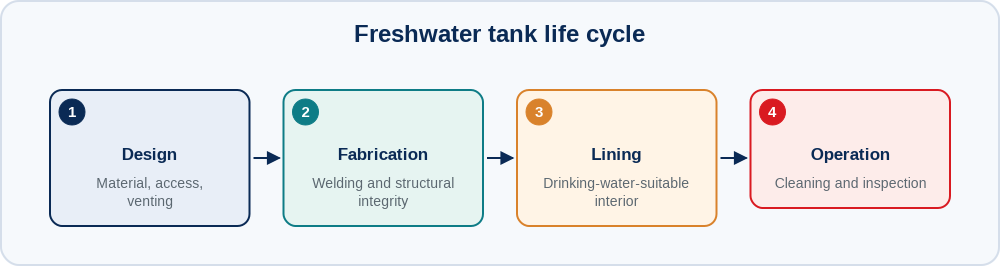
1. Why is a steel freshwater tank a special subject?#
A freshwater tank does two jobs at once: it forms a volume inside the boat’s structure and it holds water people will drink. The second job requires the interior surface to be judged for food and drinking-water safety; the first brings engineering questions such as wall thickness, weld quality and corrosion allowance. This article is a general summary of organisation, magazine, maker and user accounts; it gives no design, thickness, coating product or time for any particular boat. Each source speaks in its own context: a canal organisation describes canal boats, a coating maker describes municipal water tanks, a sailing magazine describes ocean cruising. Shared points and differing points are therefore stated separately, and maker and seller statements are labelled.
2. Tank materials: what do the sources say?#
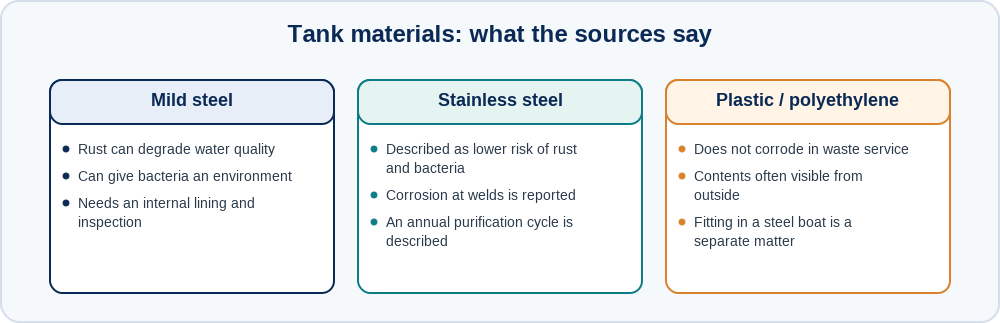
A UK canal organisation writes that leisure boat domestic water tanks are typically plastic, stainless steel or mild steel, each with different maintenance requirements and risks. It says the highest-risk material is mild steel, because it reacts with oxygen to produce rust that drastically depreciates water quality and creates an environment for bacteria, and the lowest-risk is stainless steel, because it offers protection from rusting and bacterial infection and, as it does not retain toxins, avoids persistent foul smells and tastes. That is a user organisation’s general guide written for its own boat types.
| Material | Sources’ general account | Caution |
|---|---|---|
| Mild steel | Rust can degrade water quality; needs lining and inspection | May be integral with the hull wall on a steel boat |
| Stainless steel | Described as lower risk of rust and bacteria | Corrosion at welds has been reported |
| Polyethylene / plastic | Does not corrode in waste service; contents visible | Lingering taste and fitting can be issues |
A boating publication comparing polyethylene with stainless steel writes that polyethylene will not corrode in waste service while stainless steel can show corrosion within a few years, that stainless tanks of reasonable thickness are generally heavier than polyethylene, and that the contents of polyethylene tanks are usually visible from outside. The same publication says baffle spacing in stainless tanks is generally about half a metre. A sailing publication says its order of preference is stainless, fibreglass and rotomoulded tanks, that aluminium tanks tend to pit and corrode and often need replacing; that is a test publication’s experience and may not hold for every boat.
3. Design details of a steel tank#
On steel boats tanks are often integral with the hull, so the hull plating can be one wall of the tank. That design saves space but can make interior access harder and later repair more difficult. A sailing publication describes a previous owner cutting inspection holes of roughly ten inches square into tanks and coating the interior with epoxy, yet the water always tasted of plastic, while removing the tanks would have meant cutting them into small pieces. That is a user experience showing why access and repairability should be thought through at design stage; this article recommends no particular hatch size.
In a technical reader question a sailing magazine writes that corrosion around inspection ports is probably caused by acid in the silicone sealer used to seal them, and that the standard tank coating today is a potable-water-approved epoxy formulation. That is an expert’s guess and not certain for every case, but it is a reminder that hatch gaskets and sealants must suit the tank and the water in it. On the same subject a sailing publication recommends fitting a vent screen of at least 16 mesh and says it is right to empty, clean and dry the freshwater tank for storage because nothing can grow in a clean, dry tank; that is publication experience.
A UK drinking-water regulator’s page on storage tanks says water in a tank deteriorates if there is no lid or if it becomes warm, recommends checking the tank condition and water quality annually and says any change to the tank must not affect water quality; that body speaks for land installations but the principle is meaningful on boats. A local council page says keeping water as cold as possible reduces microbiological growth. That suggests siting tanks away from hot surfaces such as engine rooms and exhausts; exact distances belong to a qualified designer.
4. Internal lining: what does “drinking-water-suitable” mean?#
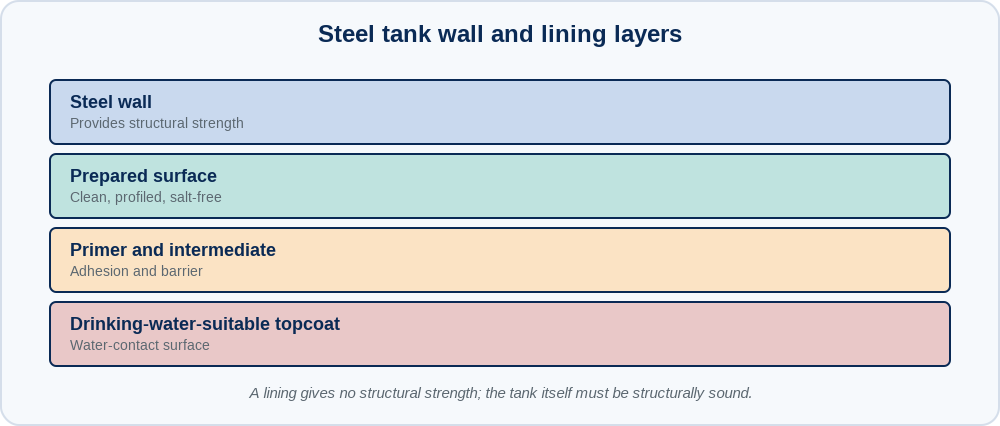
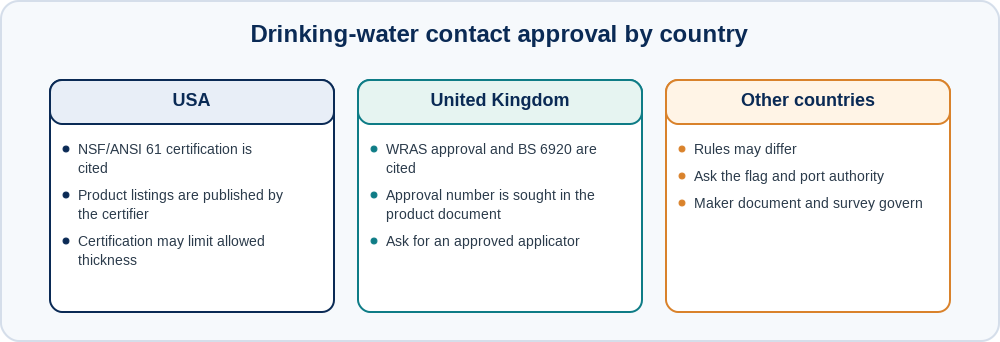
A corrosion body’s article on coatings for different ship areas says coatings in freshwater tanks must protect steel and not impart off-tastes to potable water, that in the US potable water tanks must comply with NSF/ANSI Standard 61, that other countries may have different rules, and that typically two- or three-coat epoxy polyamide or epoxy polyamine systems meet these standards. A UK coating maker’s case study says it relined a drinking-water tank with a WRAS-approved system meeting BS 6920:2000; that is a maker account and the approval number should be verified in the product document.
A coating maker’s potable-water product page says the product is certified to NSF/ANSI/CAN 61 and the extraction requirements of NSF/ANSI/CAN 600, notes that the certification listing states a maximum allowable dry film thickness and says number of coats and thickness vary with substrate, application method and exposure. This is an important detail: a certification may carry a thickness limit, and applying above it may take the work outside the certification’s scope. An industry association’s blog describes a municipal water tank recoat using a zinc-rich urethane primer, a brush-applied epoxy seam coat on all weld seams and edges and a ceramic epoxy topcoat, every layer NSF/ANSI 61 certified; that is an industrial example and not a template for yacht tanks.
A limit exists: a coating maker’s tank-lining guide says the tank must be structurally sound, that lining is meant to mitigate corrosion, prevent product contamination and give assurance against leakage, and that no tank lining, including fibreglass systems, affords structural strength. Where wall loss is serious, structural repair or plate replacement rather than coating may be needed; that decision belongs to a qualified specialist.
| Topic | Sources’ general account | Document to ask for |
|---|---|---|
| USA | NSF/ANSI 61 and extraction (600) are cited | Certification listing and maximum thickness |
| United Kingdom | WRAS approval and BS 6920 are cited | Approval number and product document |
| Other countries | Rules may differ | Port and flag authority, maker |
Taste and odour are a separate matter. In a sailing publication’s example the tank interiors had been coated with epoxy yet the water always tasted of plastic; the author later tried recoating with the type of potable-water epoxy used in municipal water towers and notes that getting a coating to adhere inside a tank can be hard, so the coating needs regular inspection. A forum user writes that clear epoxy resin from a builders’ merchant, once cured, is basically food grade and used it inside an aluminium tank; that is an unverified user view and should not be taken as grounds for using a product without drinking-water approval in a drinking-water tank.
Maker and seller statements need caution here too: a product certified for municipal tanks is not automatically suitable for the small volumes, tight access and moving structure of a yacht tank. A certification covers a particular formulation and application, not the whole product line; this article states a general principle and the product’s certification document should be consulted for detail.
5. Hygiene and cleaning: how do the sources describe it?#
A sailing magazine recommends sanitising the tank once a year and whenever the water turns skunky, referring to a standardised shock-and-rinse procedure (ANSI A119.2), and says solids should be kept out of the tank and that bladders and flexible tanks have no vent. A US publication says most boat owners use hydrogen peroxide, a bleach-water solution or a bleach-detergent-water solution; another says some fear bleach in aluminium tanks because chlorine is corrosive in large amounts but its effects are cumulative so occasional use should be fine. The canal organisation describes an annual purification cycle for stainless tanks using a purifying tablet. These are different methods in different contexts: dose, contact time and rinsing differ between sources (accounts range from half an hour to twenty-four hours) and this article recommends no dose or time; the maker’s and a qualified yard’s instructions govern.
A realistic view is that designing and coating the tank is only the first half of its life. The second half is daily use, the filling point, filters, hoses, the vent and winter preparation. A sailing publication notes that using the dockside connection bypasses the tank, that using tank water first keeps it fresh and that a system used regularly gives fewer problems; chlorine level can be checked with test strips. These practical accounts suggest a coating alone guarantees nothing and that operating habits also decide water quality.
6. A practical frame before deciding#
- Have the tank’s present condition, wall thickness and interior established by a qualified survey; a lining does not solve a structural problem.
- Decide the tank material (mild steel, stainless, plastic) with a surveyor and designer according to boat type, access and your maintenance discipline.
- Check access and sealing of the hatch, vent, filler and outlet connections and the compatibility of sealant materials.
- Verify the lining product’s drinking-water contact approval (NSF/ANSI 61, WRAS or the flag country’s equivalent) in the maker’s document.
- Make sure the maximum thickness and application conditions in the certification are observed.
- Ask the applicator about competence and references, and keep records and batch details.
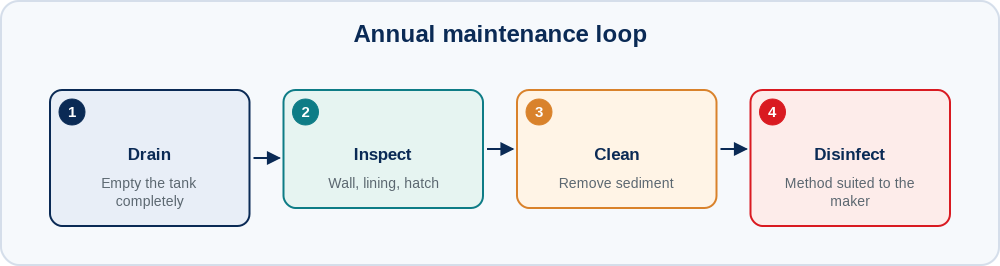
- Plan an annual tank inspection, cleaning and disinfection routine and keep records.
5. Limits#
Sources overlap that mild steel is riskier and stainless steel lower-risk for drinking-water tanks, that steel tanks need a drinking-water-suitable internal lining and that a lining gives no structural strength. They differ on which material is “best”, which lining suits yacht tanks, disinfection dose and contact time, and chlorine’s effect on aluminium. Organisation and maker accounts are specific to their contexts (municipal tanks, canal boats, ocean cruising). So there is no single right answer; a qualified survey and the maker’s document govern. This article is not engineering, legal or drinking-water-safety advice.
5b. Where sources differ#
A canal organisation calls mild steel the riskiest material; a magazine says the standard tank coating is a potable-water-approved epoxy; a sailing publication prefers stainless but admits weld corrosion can occur; a coating maker says no coating provides structural strength; a user says builders’ merchant epoxy may be food grade. These are sources speaking in different contexts and with different interests. The difference means applying to a qualified survey and to the maker’s document confirming drinking-water approval for your own boat.
This article is general information; it recommends no product, method, ratio, number of coats or time. The maker’s data sheet and a qualified yard govern.
5c. A practical frame for reading the sources#
The sources are magazines, makers, sellers and forums; each writes in its own context. None knows the tank’s wall condition, the lining product or the drinking-water approval of your boat. So taking the shared message and consulting the maker and a qualified yard for detail is reasonable.
Working inside a tank carries confined-space risk: low oxygen, solvent vapour, dust and entrapment. Epoxy coatings and cleaning chemicals can irritate skin, eyes and airways; this article describes no personal protection or method. Read the products’ safety data sheets, follow confined-space rules and consult a qualified specialist. For safety-critical matters such as drinking-water safety and hull integrity the opinion of a qualified specialist governs.
Seller and maker statements are the firm’s own account of its product and have not been independently verified. A product’s compatibility with another coating should always be checked in the product’s technical document; where a document and a guide conflict, the maker’s document and a qualified yard’s assessment should be used. Recording decisions and product details helps later maintenance.
6. Common mistakes#
- Assuming a lining will fix a structural problem in the tank.
- Using a product without drinking-water approval in the tank.
- Overlooking the maximum thickness and application conditions in the certification.
- Ignoring the material suitability of hatch gaskets and sealants.
- Not considering tank access and later repair at design stage.
- Choosing a disinfection dose and time at random or skipping the rinse.
- Keeping no maintenance and inspection records.
7. Checklist#
8. Conclusion#
A steel boat’s freshwater tank is described in sources in three parts: material, design details and a drinking-water-suitable internal lining; a lining gives no structural strength and operating habits decide water quality. This article is general information; it is not engineering, legal or drinking-water-safety advice and recommends no product, thickness or time.
Frequently asked questions#
Can a steel freshwater tank be used?
Sources describe mild steel as the riskiest material but also describe steel tanks used with a drinking-water-suitable lining and regular inspection; the decision belongs to a survey and a qualified applicator.
What paint goes inside the tank?
A sailing magazine writes the standard coating is a potable-water-approved epoxy; consult the maker’s approval document and a qualified applicator for product choice.
Does a lining strengthen the tank?
A coating maker’s tank-lining guide says no tank lining gives structural strength and the tank must be structurally sound.
Is stainless steel always better?
Sources describe stainless as lower risk, but a boating publication reports corrosion at welds can occur, so it also depends on conditions.
How often should the tank be cleaned?
A sailing magazine suggests sanitising once a year and when the water turns “skunky”; sources differ on method, and the maker’s instructions and a qualified yard govern.
Was this guide helpful?
Thank you! Your feedback has been saved.
Guide content is for general information; in practice, the current technical data sheet of the product applies.
Keep reading
Related guides
Blasting Inside Tanks: Surface Preparation Standards and Good Practice
How blasting is described for the interior surface preparation of steel tanks: Sa grades, profile, salt and humidity limits and confined-space safety, summarised from standards and maker accounts.
14 min read Refit and MaintenanceDrinking-Water Tank Epoxy Lining: Selection, Stripe Coat, Cure and Disinfection
Product documents, stripe coat, cure, flushing and disinfection steps in epoxy lining of drinking-water tanks, summarised from source accounts with their limits.
11 min read Refit and MaintenanceGrey Water, Black Water and Shower Tanks: Corrosion, Lining and Design
Why grey, black and shower tanks on steel boats corrode, what an internal lining does and design details, summarised from source accounts.
11 min read