
Paint and Coatings
Causes of Mussel and Algae Growth on a Boat Hull
Algae and mussels building up on a hull are not random; they are a combination of environment, boat and use factors. This article summarises how fouling begins and what influences it, using general sources.
Short answer
Biofouling begins with a conditioning film forming shortly after a surface enters the water, generally within a day; micro and macro organisms follow. According to EVAC temperature is a key driver and a seasonal succession occurs; the factors are the marine environment, hull design and maintenance and operating profile. NC Sea Grant lists temperature, salinity, current, light, depth and nearby larval abundance. Idle boats can accumulate more growth; some paints may lose efficacy if dried out (forum and vendor claims). This article is general information; for fouling intensity in a given region see local data.
Key points
- Fouling begins within hours with a conditioning film; micro and macro organisms then settle (EVAC).
- Temperature, salinity, nutrients, light, current and depth matter; a seasonal succession occurs.
- Hull design, paint condition, maintenance and operating profile are also factors.
- Idle boats may accumulate more growth (forum views).
- Some hard paints may lose efficacy after long time out of water (vendor claim); see the data sheet.
1. How does fouling begin?#
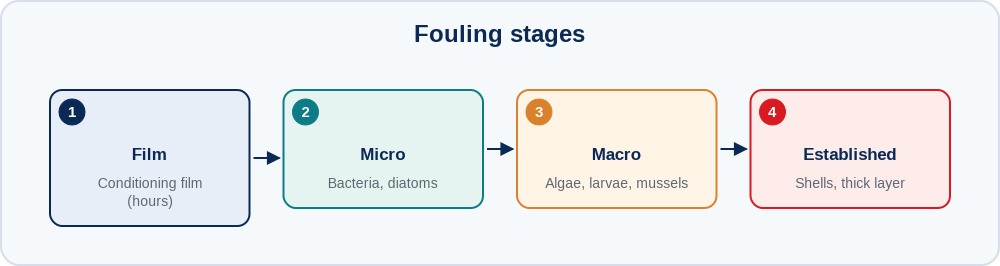
According to EVAC’s summary biofouling begins shortly after a surface enters the water, generally within a day, with a conditioning film of organic molecules and bacteria. Microfouling (single-celled organisms such as bacteria and diatoms) follows, then macrofouling (algae, larvae, mussels and other shelled animals). This article is a general summary; it makes no judgement on fouling intensity in a given region or the success of a given paint.
This sequence is a chain: the first film and micro layer can make it easier for later larvae to settle. So fouling is not only a mussel sticking on but a process that begins in hours and proceeds over weeks.
2. Marine environment: temperature, salinity, nutrients and light#
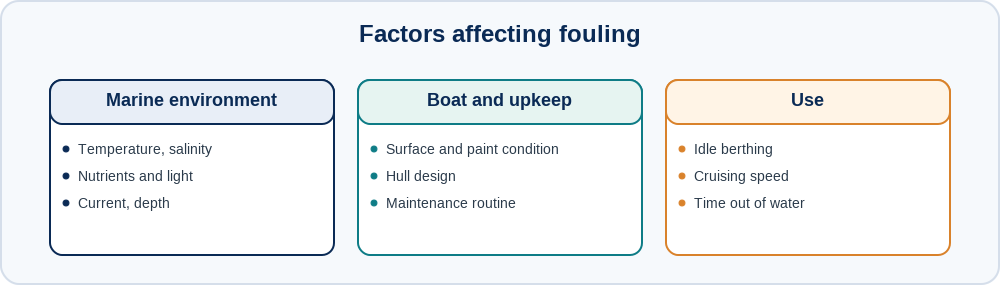
EVAC notes temperature is a key driver of fouling and a seasonal succession is seen. NC Sea Grant lists temperature, salinity, current, light, depth and the abundance of nearby larvae as factors. The table of contents of a Strathclyde thesis likewise names temperature, salinity, pH, depth, nutrients, light, currents and the surface. A forum user writes that phytoplankton blooms follow nutrients and sun; that is a single-user view.
The weight of these factors varies by region. What kind of fouling is expected in which season and region depends on local data; this article gives no regional intensity value (see the relevant article).
| Factor group | Examples | Note |
|---|---|---|
| Marine environment | Temperature, salinity, nutrients, light, current, depth | Varies by region |
| Boat and upkeep | Hull design, surface condition, paint condition | EVAC |
| Use | Idle berthing, cruising speed, time out of water | Forum and vendor views |
| Larval abundance | Larval density nearby | NC Sea Grant |
3. Boat and upkeep factors#
EVAC lists, alongside the marine environment, hull design and maintenance and the operating profile among the factors. Rough or damaged surfaces, aged paint and unprotected areas (propeller, rudder, anode area, intake grilles) can make settlement easier; that is a general observation and carries no numeric value from a specific source. The type and condition of the paint system matter; for selection see the related articles and the product data sheet.
A compatible coat plan, adequate thickness and correct timing are fundamental to paint performance; these are covered in related articles. This article recommends no paint.
4. Use: idle berthing and time out of water#
On the Sailboat Owners forum users describe an idle boat accumulating more growth and some paints losing efficacy once dried out; these are single-user experiences and should not be generalised. TotalBoat (a vendor) says hard paints lose copper faster if out of the water for a long time. International also says leaching from a hard type declines over its life. These are vendor claims and product-specific; for your own product’s out-of-water and relaunch limits see the data sheet.
Regular sailing may make settlement harder because of water flow; but it does not replace a paint system. Plan inspection and cleaning for idle periods.
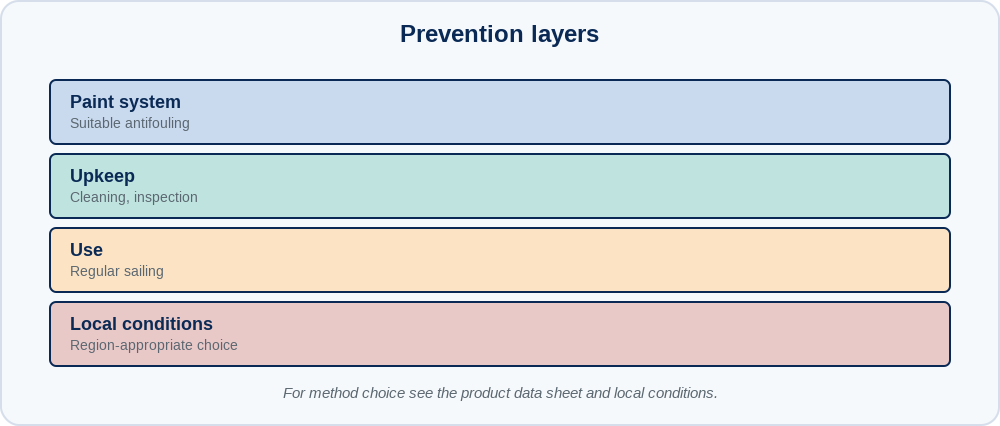
- Learn local conditions: season, temperature, nutrients and larval density.
- Choose the paint system from the data sheet for region and usage profile.
- Inspect the hull surface and paint condition regularly.
- Check propeller, rudder, anode and intake areas in particular.
- Plan cleaning and inspection for idle periods.
- Check the data sheet for out-of-water and relaunch limits.
- Record observations by season.
5. Observation, records and realistic expectations#
The practical benefit of understanding causes is setting expectations correctly. The same paint can give different results in different regions and seasons; so recording last season’s observation (which region, which month, what kind of growth) is valuable for next season’s plan. The experience of neighbouring boats in the marina is a useful indicator too, but individual accounts are not firm evidence.
In a high-fouling region and with an idle boat the paint system alone may not be enough; regular inspection and cleaning may be needed. For cleaning method and waste see the relevant articles and local rules.
5b. Larval settlement, surface and the seasonal cycle#
Many macrofouling organisms spread through a free-swimming larval stage; when larvae find a suitable surface they attach and develop into the adult form. So local larval abundance, seasonal breeding periods and water flow affect when and how much settlement happens. This is why even in the same marina no growth may be seen for a month and rapid build-up the next; that is a general observation and not a numeric forecast for any region.
Surface also plays a part: rough, scratched or damaged areas can make it easier for larvae and microorganisms to attach, while a smooth, sound paint film has an advantage here. But smoothness alone does not protect; the paint system’s design and upkeep are judged together. In winter when water is cold growth may slow and in spring and summer speed up; local conditions still differ and this article proposes no calendar.
6. Common mistakes#
- Treating fouling solely as a result of “bad paint”.
- Not accounting for local conditions and season.
- Not inspecting during idle periods.
- Skipping propeller, rudder and anode areas.
- Not knowing the paint’s out-of-water limit.
- Treating a single-user account as a general rule.
- Not recording observations.
7. Checklist#
8. Conclusion#
Fouling begins within hours with a conditioning film and proceeds through environment, boat and use factors. Temperature, salinity, nutrients, light, current and larval abundance make up the environment; hull design, surface and paint condition the boat; idle berthing and time out of water the use. This article is general information; for a specific region or product, local data and the product data sheet govern.
Frequently asked questions#
How soon does fouling start?
According to EVAC biofouling begins with a conditioning film within a day of a surface entering the water; micro and macro organisms follow.
Does warm water mean more fouling?
Temperature is a key factor and a seasonal succession occurs (EVAC); but salinity, nutrients and light also play a part.
Why does an idle boat foul more?
Forum users describe growth accumulating more on a stationary boat (single-user views); water flow when sailing may make settlement harder.
Does paint lose effect when out of water?
For some products vendors mention such a limit; TotalBoat says hard paints lose copper faster if out of water for a long time (vendor claim). See the data sheet.
Can I prevent fouling entirely?
No; paint system, upkeep and usage reduce it but it varies by region. For local conditions ask yards and users in your area.
Was this guide helpful?
Thank you! Your feedback has been saved.
Guide content is for general information; in practice, the current technical data sheet of the product applies.
Keep reading
Related guides
Boat Colour Selection and Solar Reflectance: Effect of Heat Absorption on Surfaces
A study of the effect of boat paint colour on solar reflectance and surface temperature.
2 min read Paint and CoatingsCauses and Diagnosis of Paint Blistering
A study of the sources, types and diagnostic approach to blistering on boat paints.
2 min read Paint and CoatingsNumber of Coats in Epoxy Coating Systems
A study of the effect of the number of coats in epoxy coating systems on protective performance and thickness.
2 min read