
Paint and Coatings
Protection from Toxic Dust When Sanding Antifouling
Sanding antifouling is not just a preparation step; it produces dust that contains biocide. This article summarises why dry sanding is not advised, the wet and vacuum methods and personal protection, using general sources. It is general information, not safety or legal advice.
Short answer
Dust from sanding antifouling contains biocide; BoatTest advises never to dry-sand antifouling. Field studies relayed by Practical Sailor note that workers wearing fabric clothing were more exposed and suggest vacuum sanding in open air or working in a tent. A PBO expert account mentions P3 filters for wet sanding and an ABEK1+P3 combination for chemical stripping plus wet sanding; a full-face mask has a higher protection factor than a half mask. This article is general information; it is not safety, legal or medical advice. For the mask, filter and method see the product safety data sheet (SDS), the maker’s instruction and local regulation.
Key points
- Do not dry-sand antifouling; the dust contains biocide (BoatTest).
- Wet methods and vacuum sanding reduce dust; vacuum sander capture rates have been reported as high in auto-body and construction contexts.
- Fabric clothing holds dust; consider a disposable coverall and washing separately (Practical Sailor field studies).
- Respiratory protection depends on filter type; see the SDS and local regulation for choice.
- Dust and waste must be collected and disposed of under local rules; this article is not safety advice.
1. Why is there a toxic dust problem?#
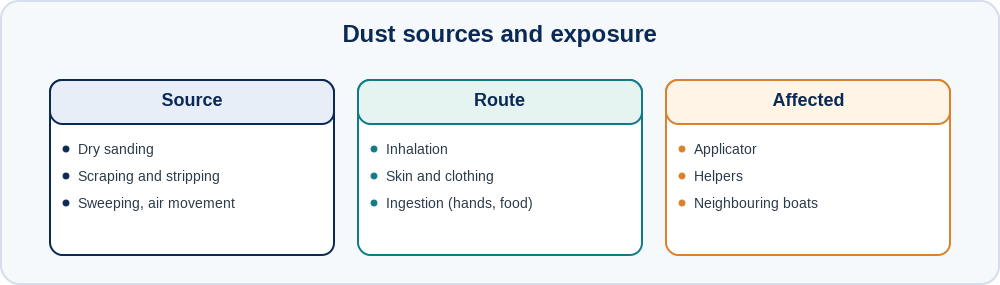
Antifouling contains biocide to stop marine organisms attaching; when sanded, scraped or stripped this film becomes dust. The dust can affect the applicator, people nearby, the ground and the water. This article is a general summary; it is not safety, legal or medical advice and gives no exposure limit. For mask, filter and method choice see the product safety data sheet (SDS), the maker’s instruction and local regulation.
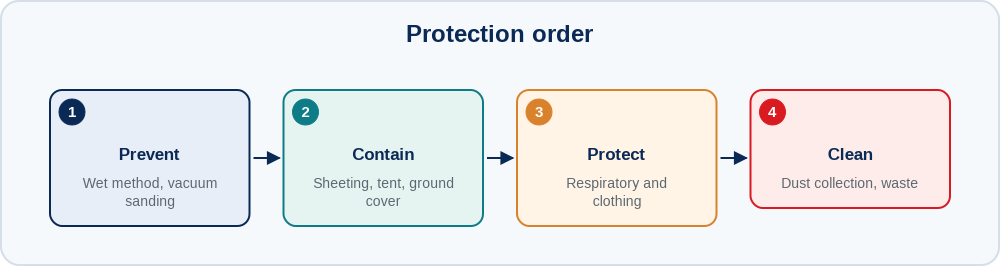
BoatTest advises never to dry-sand antifouling. That is a common principle in trade sources, because dry sanding produces fine dust that hangs in the air. Wet methods and dust collection aim to reduce this risk but do not eliminate it.
2. Exposure routes and field studies#
Practical Sailor, citing field studies of yard workers and people working on boats, relays that workers wearing fabric clothing were more exposed; the same roundup mentions studies recommending vacuum sanding in open air or working in a tent and finding an N95-type mask sufficient for assistants in open air. That is a magazine relay; results depend on specific conditions and are not safety advice for your situation.
Exposure is not only by inhalation: dusty hands can carry it to the mouth through eating and smoking, and clothes and shoes can carry dust home. So clothing, hand and work-area hygiene are part of the protection plan too.
| Method | Effect on dust | Note |
|---|---|---|
| Dry sanding | High dust | Not advised (BoatTest) |
| Wet sanding | Dust reduced, slurry produced | Collect waste |
| Vacuum sanding | Dust collected at source | May be marina rule |
| Chemical stripping | Dust reduced, chemical risk up | SDS and filter type |
| Tent / sheeting | Limits dust spread | Plan for wind and ground |
3. Vacuum sanding#
Vacuum sanders draw dust at the source. EPA reports vacuum sanders are 93-98 percent effective at controlling dust in auto-body paint work; a Mass.gov page gives a rate above 90 percent; a NIOSH study in a drywall context reports a range of 80-97 percent. These figures were not measured for antifouling or boats; they only show the dust-capture potential of vacuum systems, and the same result is not guaranteed on a boat.
A YBW forum user writes that marinas in the US often require vacuum sanding; that is a single-user account. Ask your marina and region for their rules in advance. For the filter class of vacuum systems and the use of collected waste see the maker’s instruction.
4. Respirators and filter types#
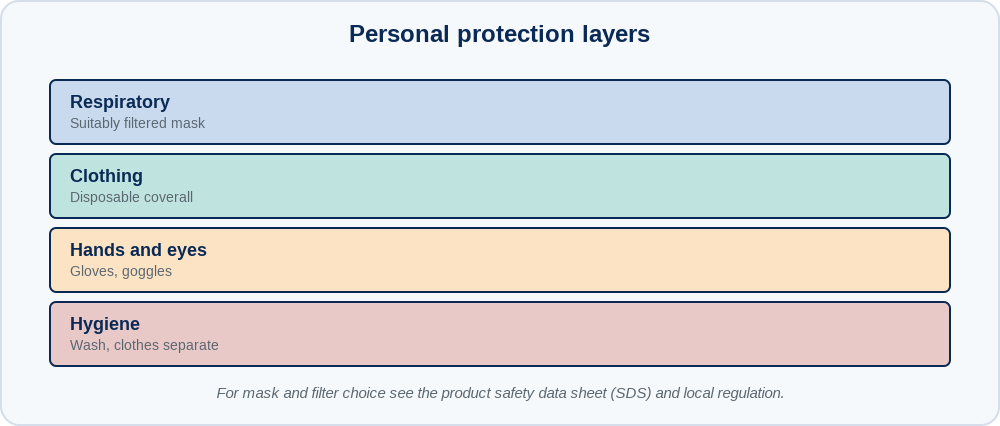
In R. Jerram’s account in PBO, a mask with P3 filters is mentioned for wet sanding and ABEK1+P3 filters for chemical stripping plus wet sanding; it also says a full-face mask has an assigned protection factor (APF) of around 40 and a half mask around 20. That is an expert account; it is not a choice made for you. Which mask suits which job is stated in the SDS, the maker’s instruction and local regulation. The mask must fit properly and filter life and change instructions must be followed.
This article gives no exposure limit and does not say “this mask is enough”. If you have health conditions or doubts, consult an occupational health professional.
- Choose the method: wet, vacuum, tented; do not choose dry sanding.
- Read the SDS; take the mask and filter information from it.
- Cover the ground and surroundings; consider wind direction.
- Use a disposable coverall, gloves and goggles.
- Do not eat, drink or smoke while working.
- When done, collect dust; dispose of waste under local rules.
- Wash clothes separately; wash hands and face.
5. Clothing, hygiene and environment#
Fabric clothing holds dust; a disposable coverall or a separate washable work outfit is advised. Do not mix work clothes with household laundry. Keep children and pets away from the dust. Cover the work area and collect dust and slurry when finished; waste containing biocide is disposed of under local rules (see the regulation article).
Remember that helpers and neighbouring boats can also be affected. In wind dust spreads to nearby boats and the ground, so a tent, sheeting and dust-collection plan matters not only for your protection but for the environment.
5b. Planning, records and when to ask an expert#
When planning sanding and stripping work it helps to write down who will work, where and by which method: method, protective equipment, dust collection, waste container and cleaning sequence. The marina or yard may have its own rules; some places require or ban particular methods. If a professional does the job, ask in advance about their method and waste disposal arrangements; this article makes no judgement on any contractor’s competence.
Keeping records also helps: which product was sanded, on what date, by what method and where the waste was delivered. If a health complaint arises or an environmental inspection occurs these records are useful. For matters such as health conditions, pregnancy or pre-existing respiratory problems consult an occupational health professional or doctor; this article is not medical advice.
6. Common mistakes#
- Dry-sanding antifouling.
- Treating a simple dust mask as sufficient.
- Poorly fitted mask or filters not changed.
- Working in fabric clothing and going home in it.
- Not covering the work area and sweeping dust.
- Not disposing of waste under local rules.
- Starting work without reading the SDS.
7. Checklist#
8. Conclusion#
Sanding antifouling produces biocide-containing dust; dry sanding is not advised. Wet methods, vacuum sanding and tented working aim to reduce dust; respiratory, clothing and hygiene measures complement them. This article is general information; it is not safety, legal or medical advice. For the mask, filter and method the SDS, the maker’s instruction and local regulation govern.
Frequently asked questions#
Can I dry-sand antifouling?
BoatTest advises never to dry-sand antifouling. For method and protection see the SDS, the maker’s instruction and local regulation.
Why is vacuum sanding recommended?
Dust is collected at the source so less gets into the air. Sources such as EPA and Mass.gov report vacuum sanders capture most dust (auto-body context); results on a boat may differ.
Which mask is enough?
There is no single answer. A PBO expert account mentions P3 for wet sanding and ABEK1+P3 for chemical stripping; for your case see the SDS and local regulation.
Can my work clothes carry toxic dust?
Field studies relayed by Practical Sailor note workers in fabric clothing were more exposed; a disposable coverall and washing clothes separately are options.
Do marinas require vacuum sanding?
A YBW forum user writes that US marinas often require vacuum sanding (single-user view). Check the rules of your marina and region.
Was this guide helpful?
Thank you! Your feedback has been saved.
Guide content is for general information; in practice, the current technical data sheet of the product applies.
Keep reading
Related guides
Boat Colour Selection and Solar Reflectance: Effect of Heat Absorption on Surfaces
A study of the effect of boat paint colour on solar reflectance and surface temperature.
2 min read Paint and CoatingsCauses and Diagnosis of Paint Blistering
A study of the sources, types and diagnostic approach to blistering on boat paints.
2 min read Paint and CoatingsNumber of Coats in Epoxy Coating Systems
A study of the effect of the number of coats in epoxy coating systems on protective performance and thickness.
2 min read