
Paint and Coatings
Choosing an Epoxy Primer for Aluminium Hulls
Which epoxy primer goes on an aluminium hull depends on the surface condition, the old coating and the chosen finish system. This article summarises seller, maker and forum accounts with their limits; it is not a product, coat-count or time recommendation.
Short answer
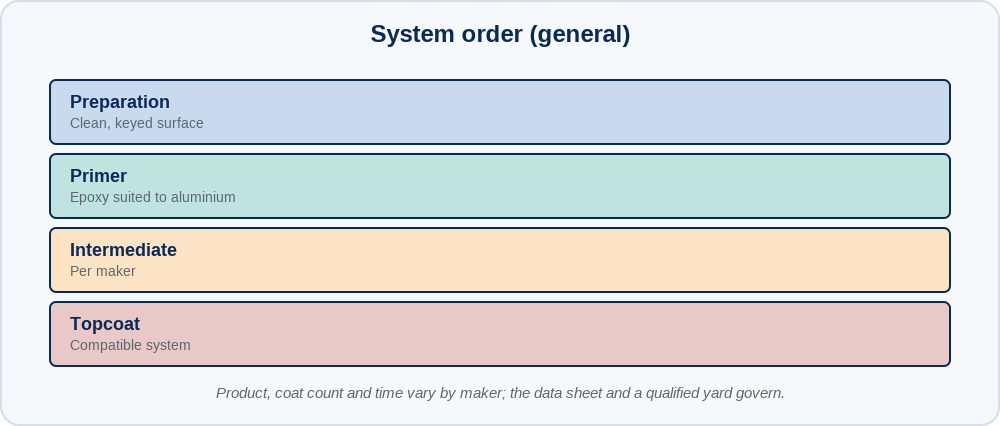
Fisheries Supply (seller) describes a manufacturer-approved metal or epoxy primer for an aluminium hull, listing aluminium compatibility, corrosion control and correct surface preparation as selection priorities, and writes that the next coat must go on within the stated recoat window. BetterBoat describes a two-part epoxy-based primer as the best foundation for painting aluminium. Pettit (maker) uses an aluminium epoxy primer followed by a high-build epoxy primer in a pontoon process; a product description for an aluminium epoxy primer mentions strontium chromate. TotalBoat (seller) describes an etch wash and barrier primer for bare aluminium. This article is general information; product, coat count and time vary by maker.
Key points
- Primer choice depends on the surface, the old coating and the maker’s system (Fisheries Supply, seller).
- Sources describe a two-part epoxy-based primer as the foundation for aluminium (BetterBoat, Pettit).
- Some aluminium epoxy primers contain a chromate compound; that is a maker description, check the data sheet.
- The recoat window must be respected; times depend on the maker.
- The maker’s system, compatibility chart and a qualified yard govern.
1. Why does primer choice matter?#
On an aluminium hull the primer is the foundation layer that provides both paint adhesion and corrosion protection. BetterBoat writes that the best foundation for painting an aluminium boat is an epoxy-based, two-part primer and explains that although aluminium boats do not rust like steel, different metals such as stainless screws or a bronze fitting can form a galvanic battery in salt water. This article is a general summary; it gives no product, coat count, thickness or waiting time and is not application advice. Some sources are seller, maker or forum accounts and are labelled as such.
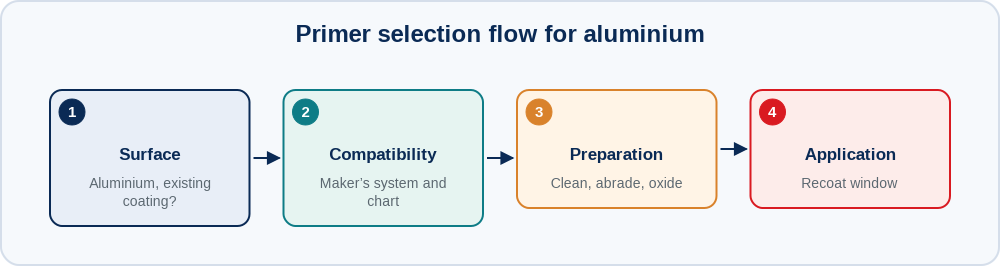
Fisheries Supply (seller) describes a manufacturer-approved metal or epoxy primer for an aluminium hull or component and lists aluminium compatibility, corrosion control and correct surface preparation as selection priorities. This shows one should think of a system rather than a single product.
2. Primer types: what sources describe#
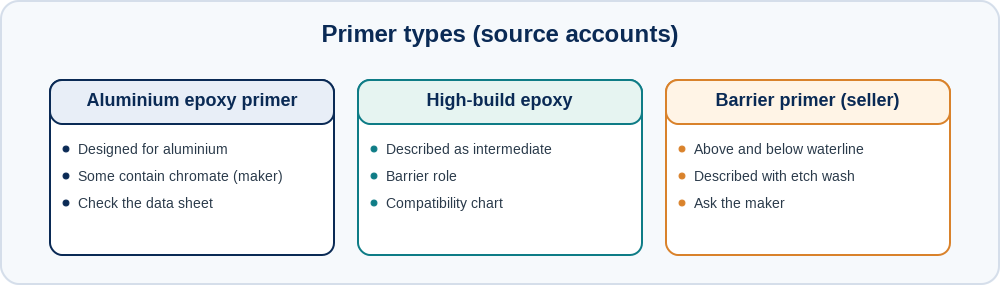
Pettit (maker) describes in a pontoon antifouling process two coats of an aluminium epoxy primer followed by two coats of a high-build epoxy primer; this is a specific product process and cannot be applied directly to your boat. A product description says the aluminium epoxy primer contains strontium chromate for corrosion control; that is a maker description and the product’s safety information and data sheet should be read. TotalBoat (seller) presents its aluminium barrier primer as a two-part high-build epoxy usable above and below the waterline with a 3-to-1 mix; that is a seller claim.
Fisheries Supply writes that epoxy primers give strong adhesion and a moisture barrier, but the next coat must go on within the stated recoat window. This article gives no window; the maker’s data sheet governs.
| Type | Sources’ general account | Caution |
|---|---|---|
| Aluminium epoxy primer | Designed for aluminium; some contain a chromate compound (maker) | Safety information and data sheet |
| High-build epoxy | Described as intermediate and barrier (Pettit) | Compatibility chart |
| Barrier primer | Above and below waterline; with etch wash (seller) | Ask the maker |
3. Surface and existing coating#
The choice varies with whether the surface is bare or previously painted. Pettit says on previously painted hulls to check the compatibility chart if the previous coating is compatible. TotalBoat describes an etch wash as a pre-coat for bare aluminium and a separate rust converter for steel; after abrading, the surface is wiped with a clean rag and left to dry completely. These are a seller’s accounts of its own products.
A forum user relays that a local dealer described, for a copper antifouling, sanding and cleaning the aluminium first, then a vinyl wash primer, then a two-part epoxy primer and finally the antifouling. That is a user relay and unverified; for the risk of copper paint on aluminium see the aluminium painting guide article.
4. A practical frame#
- Establish whether the hull is bare or previously painted.
- Find out the system the maker approves for aluminium.
- Check the compatibility chart.
- Clean and prepare the surface by the maker’s method.
- Respect the recoat window (data sheet).
- Mask the anodes and leave them bare.
- Read the safety information sheet and consult a qualified yard if needed.
5. Limits#
Sources agree an epoxy primer is the foundation for aluminium; differences appear in product and system choice. A seller presents its own barrier primer as compatible with everything; a maker is tied to a specific process. So there is no single right product; the maker’s system and a qualified yard’s assessment govern. This article is not application or engineering advice.
5b. Where sources differ#
Pettit (maker) describes two separate epoxy primers in sequence in its process; TotalBoat (seller) says a single barrier primer can be used above and below the waterline; Fisheries Supply (seller) says generally a “manufacturer-approved” primer. These sources speak for different product families and have different interests. The difference means looking at the maker’s full system recommendation for each boat; one source’s product cannot be added to another’s system.
This article summarises the sources’ general accounts; it may not hold for a particular boat. For product, coat count and time the maker’s data sheet and a qualified yard govern.
5c. A practical frame for reading the sources#
The sources are sellers, makers and a forum; each writes in its own context. Sellers describe their range, makers their systems and forum users personal experience. None knows your hull’s history, the existing coating or your berthing conditions. So taking the shared message, that a primer is a foundation for aluminium and that surface preparation and the compatibility chart matter, and consulting the maker for detail, is reasonable.
If the type of existing coating is unknown, applying an incompatible system over it can be risky. This article proposes no test or method for that; consult the maker and a qualified yard on compatibility. Some primers may also need special precautions for health and safety; read the product’s safety information sheet and consult a qualified yard.
Finally, a primer alone is not a corrosion solution; the anode system, electrical isolation, isolation of dissimilar metals and regular inspection should be considered together. If you see blistering or pitting consult a specialist. Recording decisions and keeping the maker’s instruction helps later maintenance.
In addition, seller and maker statements are the firm’s own account of its product and have not been independently verified. A primer’s compatibility with another paint should always be checked in the product’s technical document; where a document and a guide conflict, the maker’s document and a qualified yard’s assessment should be used.
6. Common mistakes#
- Choosing a primer without checking the maker’s system.
- Skipping the compatibility chart.
- Missing the recoat window.
- Cutting surface preparation short.
- Painting the anodes.
- Not reading the safety information sheet.
- Keeping no records.
7. Checklist#
8. Conclusion#
Primer choice on an aluminium hull depends on the surface, the existing coating and the maker’s system; sources describe a two-part epoxy-based primer as the foundation. This article is general information; it gives no product, coat count or time, and the maker’s data sheet and a qualified yard govern.
Frequently asked questions#
Which primer goes on an aluminium hull?
Fisheries Supply (seller) describes a manufacturer-approved metal or epoxy primer; BetterBoat writes a two-part epoxy-based primer is the best foundation. Which product suits is set by the maker’s system.
What matters in choosing a primer?
Fisheries Supply lists aluminium compatibility, corrosion control and correct surface preparation as priorities. Ask the maker for your own boat.
Is an etch wash needed on bare aluminium?
TotalBoat (seller) describes its own etch wash for bare aluminium; that is a seller account and may not apply to every system. See the maker’s instruction.
What about a previously painted hull?
Pettit (maker) says to check its compatibility chart if the previous coating is compatible. If unsure ask the maker.
Must one wait between coats?
Fisheries Supply writes the next coat must be applied within the stated recoat window; TotalBoat describes a thumbprint-tacky stage for its own product. Times depend on the product.
Was this guide helpful?
Thank you! Your feedback has been saved.
Guide content is for general information; in practice, the current technical data sheet of the product applies.
Keep reading
Related guides
Boat Colour Selection and Solar Reflectance: Effect of Heat Absorption on Surfaces
A study of the effect of boat paint colour on solar reflectance and surface temperature.
2 min read Paint and CoatingsCauses and Diagnosis of Paint Blistering
A study of the sources, types and diagnostic approach to blistering on boat paints.
2 min read Paint and CoatingsNumber of Coats in Epoxy Coating Systems
A study of the effect of the number of coats in epoxy coating systems on protective performance and thickness.
2 min read