
Paint and Coatings
Steel Hull Interior Corrosion and Care Under Tanks
The outside of a steel boat is watched by eye; but the interior, the bilge and the area under tanks are usually out of sight. This article summarises where and why interior corrosion forms and tank-underside care from source accounts; it is not engineering or safety advice.
Short answer
Passagemaker writes that a tank should rest on a material that holds no moisture and allows airflow under it, that strips under the tank ends and baffles raise the bottom off the tank bed, and that ABYC standards call for a minimum air space between tank and mounting surface. Boating New Zealand explains that crevice corrosion occurs where a gap traps salt water, along seams and welds, in joints, where fittings are installed, under coatings and under carpets and decking. A service company’s presentation reports pin holes and rotted subflooring beneath a bilge-exposed fuel tank, with the tank replaced and drainage and ventilation improved. In a Sail magazine reader question, welded steel water tanks painted inside and sound after 18 years are advised to be left undisturbed. This article is general information; consult a qualified specialist and the maker for tanks and internal structure.
Key points
- A tank should rest on a base that holds no moisture and allows airflow; ABYC standards call for a minimum air space (Passagemaker).
- Crevice corrosion can form at seams, welds, fittings and under carpets or decking (Boating NZ).
- Beneath tanks exposed to a wet bilge pin holes and rotted sole can be found; drainage and ventilation improvements are described (service company presentation).
- A water tank with sound interior paint is advised to be left alone; light entering through inspection plates can encourage algae (Sail).
- Tanks and internal structure are safety-critical; a qualified specialist and the maker are needed.
1. Why does interior corrosion go unnoticed?#
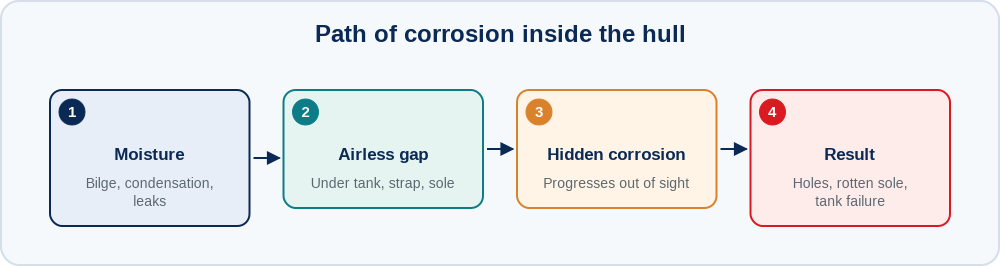
On a steel boat the outer hull is watched by eye and protected with touch-up paint; the interior, the bilge and the area under tanks are often out of sight. BoatUS writes that corrosion is not only about underwater anodes but an issue throughout the boat and that dim recesses should be checked; the same source recalls that stainless steel cannot keep its protective oxide layer without oxygen and that some connections are bolted to interior sections. This article is a general summary; it gives no product, method, thickness or time and is not engineering or safety advice. Some sources are service company, seller or forum accounts and are labelled as such.
Boating New Zealand writes that crevice corrosion occurs where a gap or crack allows salt water to become trapped and can be found along seams and welds, in joints, where fittings are installed, under coatings and under carpets and decking. Because the interior has many such narrow damp places, inspection should be planned deliberately.
2. Under the tank: airflow and drainage#
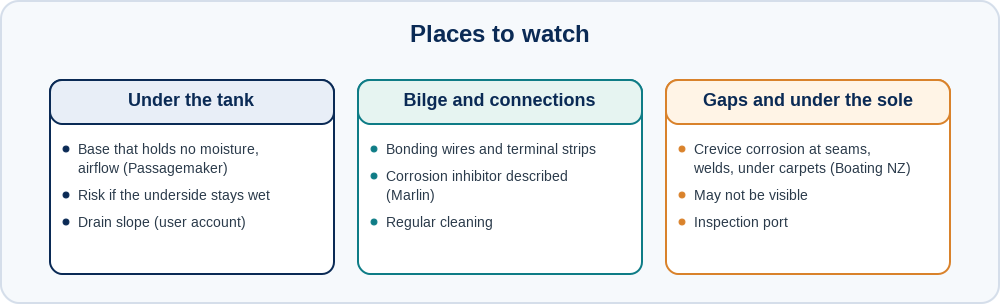
Passagemaker writes that cruising powerboat fuel tanks are generally aluminium, composite or steel and that with proper maintenance any of them will provide decades of service; it adds that the tank should rest on a material that holds no moisture and allows airflow, that strips under the tank ends and baffles raise the bottom off the tank bed, and that ABYC standards call for a minimum air space between the tank and the flat mounting surface. For the dimension see the relevant standard and the tank maker; this article gives no value.
A service company’s presentation describes a boat owner who found pin holes and rotted subflooring beneath a fuel tank exposed to a wet bilge; the tank was replaced and drainage and ventilation improvements installed to prevent future corrosion. The same presentation says small corrosion pock marks can be seen even through the black bacterial slime and residual fuel inside a tank. That is a company account and cannot be generalised.
In a forum thread one user writes that the original steel fuel tanks on his 40-year-old boat show no rust to speak of; another reports cleaning light surface pitting on 33-year-old tanks with a pad, wire brush and fine paper and planning to use a borescope to check the bottom; another writes that on a boat where the steel hull formed one side of the tanks, water from the galley rusted through the top and then the bottom; another says he mounted new tanks on tapered plastic strips for ventilation and slope to the drain. These are user accounts and have not been independently verified.
| Place | Sources’ general account | Caution |
|---|---|---|
| Under the tank | Base that holds no moisture and airflow (Passagemaker) | Risk if the underside stays wet |
| Bilge connections | Corrosion inhibitor described (Marlin) | Regular cleaning |
| Gaps | Seams, welds, under carpets and decking (Boating NZ) | May not be visible |
3. Bilge, connections and water tanks#
Marlin magazine writes that many bonding connections are in or near the bilge, an inhospitable environment, that they should be coated with a corrosion inhibitor and terminal strips wiped with a corrosion blocker and that bonding wires should be clean and sound. A clean bilge is described as often the telltale sign a boat is in good condition. That is a magazine account and electrical systems carry their own safety requirements; consult a qualified electrician for electrical work.
In a Sail magazine reader question, welded steel water tanks were painted inside with a blue, high-gloss, rubber-like paint; the answer advises leaving the paint undisturbed if it has protected the metal for 18 years and the tanks are intact except around the edges of the inspection plates. It adds that light entering through the plates encourages algae and that the plates can be painted opaque on the outside. That is a magazine column answer; for your own tank consult the maker and a qualified yard.
4. A practical frame#
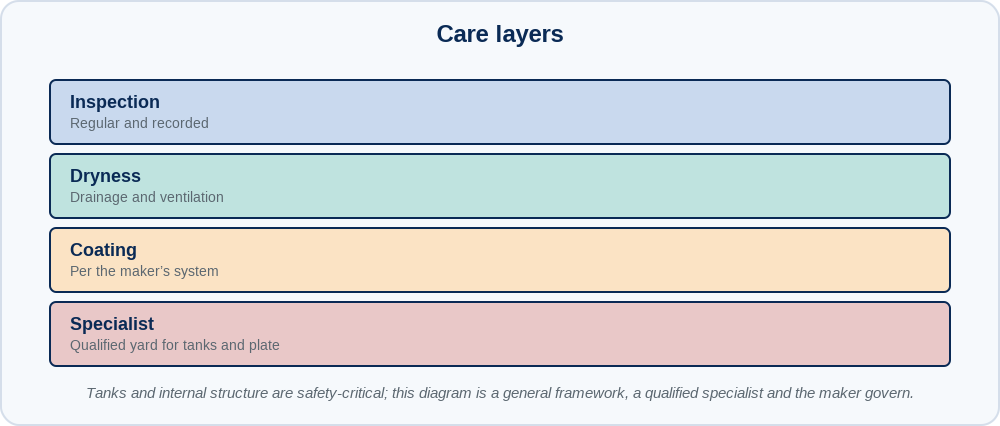
- Inspect under tanks, in the bilge and under the sole regularly, using inspection ports.
- Check the tank sits on a base that holds no moisture and allows airflow.
- Assess the source of bilge water and drainage.
- Keep bonding connections clean and sound.
- Remove surface rust by the maker’s method and renew the system.
- If there are pin holes, a wet sole or rust bleeding consult a qualified specialist.
- Record inspections and repairs.
5. Limits#
Sources agree on the importance of dryness and airflow inside; they differ on when to replace a tank and whether to keep interior paint. A reader answer advises leaving sound interior paint alone while a service company replaces a tank on finding pin holes. So there is no single right answer; the maker’s system and a qualified yard’s assessment govern. This article is not diagnosis or engineering advice.
5b. Where sources differ#
The Sail answer advises leaving sound interior paint alone; Passagemaker stresses airflow under the tank and a moisture-free base; a service company describes replacing a tank on finding pin holes and improving drainage and ventilation; forum users relay experiences from 33-40-year-old tanks ranging from light surface pitting to none at all. These are sources speaking in different contexts and with different interests. The difference means consulting the maker and a qualified yard for each tank.
This article summarises the sources’ general accounts; it may not hold for a particular boat. For product, method and time the maker and a qualified yard govern.
5c. A practical frame for reading the sources#
The sources are magazines, a service company, an insurer’s publication and forums; each writes in its own context. None knows your boat’s tank material, bilge conditions or plate thickness. So taking the shared message, that moisture and airflow decide interior corrosion and that the area under tanks should be inspected regularly, and consulting the maker and a qualified yard for detail, is reasonable.
Fuel and water tanks are critical components for safety and the environment; inspecting inside a tank, emptying it and repairing it can carry fuel vapour, confined-space and hot-work risks. This article does not describe those operations; consult a qualified yard and follow the relevant safety rules. If you see rust bleeding, pin holes or a wet sole apply to a qualified specialist for inspection.
Finally, the source of interior corrosion is often a leak or condensation; repairing only the surface does not solve it. Finding the leak, improving ventilation and regular inspection should be considered together. Recording decisions and keeping the maker’s instruction helps later maintenance.
In addition, seller and maker statements are the firm’s own account of its product and have not been independently verified. A product’s compatibility with another paint should always be checked in the product’s technical document; where a document and a guide conflict, the maker’s document and a qualified yard’s assessment should be used.
6. Common mistakes#
- Not inspecting under the tank.
- Seating a tank on a base that holds moisture.
- Not looking for the source of bilge water.
- Covering surface rust without checking beneath.
- Treating a forum account as a firm diagnosis.
- Leaving tank work to unqualified people.
- Keeping no records.
7. Checklist#
8. Conclusion#
Interior and under-tank corrosion on a steel boat often progresses out of sight; sources stress dryness, airflow, drainage and regular inspection. This article is general information; it is not engineering or safety advice, and for tanks and internal structure a qualified specialist and the maker govern.
Frequently asked questions#
Why is the area under a tank risky?
Passagemaker writes that a tank should rest on a material that holds no moisture and allows airflow. A service company reports pin holes and rotted subflooring beneath a fuel tank exposed to a wet bilge.
Where does crevice corrosion occur inside the boat?
Boating New Zealand writes it can occur along seams, welds, in joints, where fittings are installed, under coatings and under carpets and decking.
What is done about bilge connections?
Marlin magazine writes bonding connections sit in a hostile bilge environment, can be coated with a corrosion inhibitor and bonding wires should be clean and sound.
Should a painted water tank be repainted?
A Sail magazine answer advises leaving the paint undisturbed if sound after 18 years, with the edges of inspection plates examined separately. Ask a specialist for your own tank.
When should a tank be shown to a specialist?
If there is rust bleeding, pin holes, a wet sole or a suspect smell consult a qualified specialist; this article does not diagnose.
Was this guide helpful?
Thank you! Your feedback has been saved.
Guide content is for general information; in practice, the current technical data sheet of the product applies.
Keep reading
Related guides
Boat Colour Selection and Solar Reflectance: Effect of Heat Absorption on Surfaces
A study of the effect of boat paint colour on solar reflectance and surface temperature.
2 min read Paint and CoatingsCauses and Diagnosis of Paint Blistering
A study of the sources, types and diagnostic approach to blistering on boat paints.
2 min read Paint and CoatingsNumber of Coats in Epoxy Coating Systems
A study of the effect of the number of coats in epoxy coating systems on protective performance and thickness.
2 min read