
Paint and Coatings
Post-Weld Paint Preparation on Steel Boats
Post-weld paint preparation on a steel boat is one of the steps that decide coating life, because welds, edges and spatter are where coatings fail first. This article summarises source accounts with their limits; it is not a product, method or time recommendation.
Short answer
A coating supplier’s surface preparation document writes that weld spatter is almost impossible to coat evenly and is often loosely adherent, making it a common cause of premature coating failure. Graco’s account of ISO 8501-3 sorts surface defects into welds, edges and general steel surfaces, says some protrusions such as spatter can be abrasively blasted while others need grinding, that grinding must not leave surfaces rough, with burrs or burnished, and that agreeing prep grades with the parties saves time. A US military manual describes removing weld spatter and flux compounds by grinding or chipping and removing oil before mechanical preparation. This article is general information; method, product and time vary by maker and specification.
Key points
- Weld spatter is hard to coat evenly and often loosely adherent; it is described as a common cause of premature coating failure (coating supplier document).
- ISO 8501-3 sorts defects into welds, edges and general surface; prep grades are agreed between parties (Graco account).
- Weld spatter and flux compounds are removed by grinding or chipping; oil is removed before mechanical preparation (military manual).
- Coatings fail first on sharp edges, burrs, welds and spatter (coating shop account).
- For method, product and time the maker and a qualified yard govern.
1. Why are weld areas critical?#
On a steel boat welds, edges and weld spatter are where coatings are most stressed. A coating shop account writes that coatings fail first on prominences such as sharp edges, burrs, welds and weld spatter. A coating supplier’s surface preparation document says weld spatter is almost impossible to coat evenly and is often loosely adherent, so it is a common cause of premature coating failure. This article is a general summary; it gives no product, method, thickness or time and is not application advice. Some sources are supplier, military or forum accounts and are labelled as such.
Cruising World writes that during fabrication mild steel develops scale and rust that must be removed to protect the steel. Post-weld preparation is an extension of this general surface preparation specific to weld areas.
2. ISO 8501-3 and prep grades#
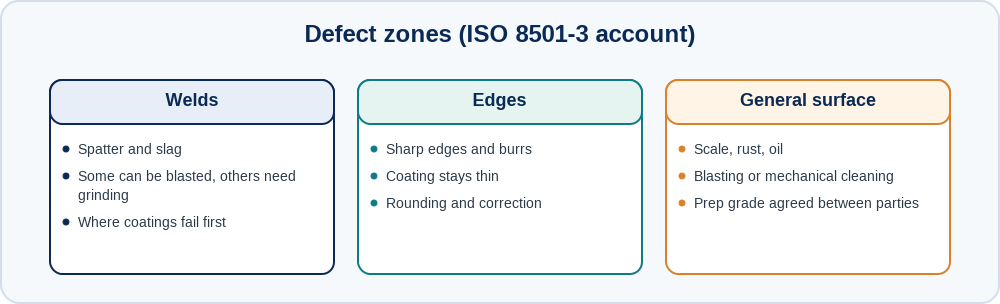
According to Graco’s account ISO 8501-3 sorts defects in preparing steel before painting into three categories: welds, edges and general steel surfaces. The same account says some protrusions, such as weld spatter, can be abrasively blasted, others need grinding and that when grinding with power tools it is crucial not to leave surfaces rough, with burrs or burnished. It describes three prep grades for visible imperfections, the first, light preparation, needing no or only minimum preparation before painting, and says agreeing prep grades and specific imperfections between the relevant parties before starting can save time and effort. That is a commercial firm’s summary of the standard; for detail see the standard itself and the maker’s specification.
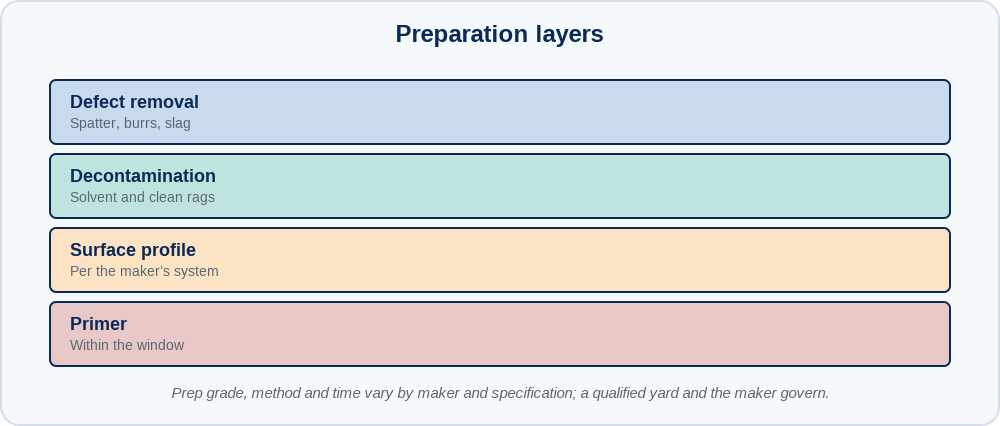
A US military manual describes removing oil and grease before mechanical or abrasive-blast preparation, freshwater rinsing rusted surfaces where practicable to remove water-soluble contaminants, and removing weld spatters and flux compounds by grinding or chipping. A coating document writes the most common method of removing oil is solvent washing followed by wiping dry with clean rags and that the wiping is critical. These documents were written for an industrial context; for a yacht the maker’s system governs.
| Zone | Sources’ general account | Caution |
|---|---|---|
| Welds | Spatter and slag cannot be coated evenly and are loosely adherent (supplier document) | Blasting or grinding |
| Edges | Coating fails first on sharp edges and burrs (shop account) | Correction |
| General surface | Scale, rust, oil; prep grade agreed between parties (Graco) | Standard and specification |
3. Post-weld residues and primed steel#
A structural steel body’s FAQ page writes that slag, chemical residue and spatter compounds determined to be incompatible with the coating system should be removed or neutralised, while compatible residue and spattered weld metal that cannot be removed by hand scraping need not be removed provided it is not detrimental to the structure or paint system. That is an approach in a structural steel context; marine immersion conditions differ and for a yacht the maker’s system governs. A supplier document describes using a blast cleaner or power tool to remove weld flux slugs, weld metal spatters and flux fume deposits.
For welding primer-coated steel an article from a welding-materials publication says flux-cored wire is often an ideal option but that the filler metal maker should be consulted for the best recommendation; another welding-wire maker article says removing the primer is rarely viable from a productivity standpoint. A forum user writes that a weldable rust-retardant primer can be used before welding, then a final blast and an organic zinc. These are different contexts and are not offered here as a method; the maker and a welding specialist govern.
4. A practical frame#
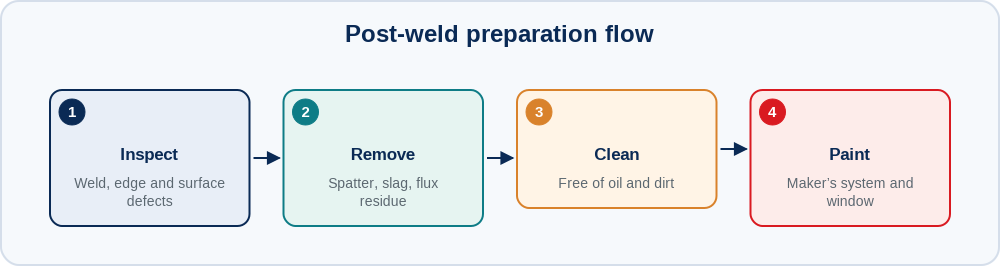
- Inspect welds, edges and the general surface for defects.
- Remove spatter, slag and flux residue by the maker’s and specification’s method (blasting or grinding).
- Correct sharp edges and burrs; do not leave the surface rough or burnished.
- Free the surface of oil and dirt; if using solvent, wipe dry with clean rags.
- Agree the prep grade with the relevant parties beforehand.
- Apply the primer within the window in the maker’s data sheet.
- Keep records; read the safety information sheet.
5. Limits#
Sources agree weld areas are critical for coatings and that spatter should be dealt with; they differ on which residue must be removed. A structural steel body says compatible residue need not be removed while a coating supplier writes that spatter is a common cause of early failure. So there is no single right answer; the maker’s system and a qualified yard’s assessment govern. This article is not application or engineering advice.
5b. Where sources differ#
The structural steel body (AISC) says compatible residue and spatter that cannot be removed by hand scraping may stay if not detrimental; the coating supplier writes spatter is a common cause of early failure; the military manual describes removing spatter and flux compounds by grinding or chipping; the welding-materials makers address welding primer-coated steel. These sources speak in different contexts and with different interests. The difference means looking at the maker’s full system recommendation for a yacht; a structural or military practice cannot be transferred directly to a yacht.
This article summarises the sources’ general accounts; it may not hold for a particular boat. For method, product and time the maker’s data sheet and a qualified yard govern.
5c. A practical frame for reading the sources#
The sources are a coating supplier, an equipment maker, a structural steel body, a military manual, welding-materials publications and forums; each writes in its own context. None knows your boat’s plate thickness, weld type or the coating system you choose. So taking the shared message, that spatter, edges and oil should be dealt with before paint, and consulting the maker and a qualified yard for detail, is reasonable.
Welding, grinding and blasting produce sparks, dust, fumes and noise; welding some primer-coated steels may need special fume precautions. This article describes no personal protection or welding method; consult a qualified yard and follow the relevant safety rules. For weld quality or structural concerns apply to a qualified welding specialist.
Finally, post-weld preparation is not only a paint matter; the quality, tightness and structural soundness of the weld itself must be assessed separately. Recording decisions and keeping the maker’s instruction helps later maintenance.
In addition, seller and maker statements are the firm’s own account of its product and have not been independently verified. A product’s compatibility with another paint should always be checked in the product’s technical document; where a document and a guide conflict, the maker’s document and a qualified yard’s assessment should be used.
6. Common mistakes#
- Painting over weld spatter.
- Not correcting sharp edges and burrs.
- Leaving the surface rough or burnished after grinding.
- Not removing oil before mechanical preparation.
- Not agreeing the prep grade beforehand.
- Missing the primer window.
- Keeping no records.
7. Checklist#
8. Conclusion#
Post-weld paint preparation on a steel boat targets where coatings fail first, namely welds, edges and spatter; sources stress defect removal, degreasing and agreeing the prep grade beforehand. This article is general information; it gives no method, product or time, and the maker and a qualified yard govern.
Frequently asked questions#
Why does weld spatter cause trouble?
A coating supplier’s document writes that weld spatter is almost impossible to coat evenly and is often loosely adherent, making it a common cause of premature coating failure.
What is ISO 8501-3?
According to Graco’s account it is a standard for preparing steel before painting; it sorts defects into welds, edges and general surfaces and defines prep grades. See the standard itself for detail.
How is spatter removed?
Graco’s account says some protrusions can be blasted while others need grinding; a US military manual writes weld spatter and flux compounds are removed by grinding or chipping.
When is oil removed?
The same military manual describes removing oil before mechanical cleaning or blasting; a coating document says solvent wiping followed by wiping dry with clean rags is critical.
Is primer applied before welding?
A forum user relays that a weldable rust-retardant primer can be used before welding; a welding-wire maker’s article recommends flux-cored wire for welding primer-coated steel. These are different contexts; ask the maker.
Was this guide helpful?
Thank you! Your feedback has been saved.
Guide content is for general information; in practice, the current technical data sheet of the product applies.
Keep reading
Related guides
Boat Colour Selection and Solar Reflectance: Effect of Heat Absorption on Surfaces
A study of the effect of boat paint colour on solar reflectance and surface temperature.
2 min read Paint and CoatingsCauses and Diagnosis of Paint Blistering
A study of the sources, types and diagnostic approach to blistering on boat paints.
2 min read Paint and CoatingsNumber of Coats in Epoxy Coating Systems
A study of the effect of the number of coats in epoxy coating systems on protective performance and thickness.
2 min read