
Underwater
Choosing Antifouling in Freshwater, Brackish Water and the Salt Sea: A Salinity Guide
The water a boat lives in is the first question deciding paint choice. Fresh, brackish and salt water bring different organisms, different pressure and different rules. This article explains the logic of choosing by salinity.
Short answer
Salinity affects an antifouling’s biocide release, the organisms in the area and the rules in force. A Swedish study reported that copper release from paints increases with salinity; in Sweden, paints with higher copper content are allowed on the high-salinity west coast while the east coast has a lower limit, and copper is banned in the Bothnian Bay and in freshwater. The choice is therefore made together with the type of water, the regional rule, temperature and the salinity warning in the product data sheet.
Key points
- Salinity affects biocide release, the organisms present and the rules.
- A Swedish study reported that copper release rises with salinity.
- Sweden has a higher copper limit on the west coast and a lower one on the east coast; copper is banned in the Bothnian Bay and in freshwater.
- Makers of some products give a low-salinity warning; the data sheet must be read.
- When the water type changes (sea to freshwater) the old system’s suitability is confirmed again.
1. Why is “which water?” the first question?#
When choosing antifouling, a yacht owner usually talks about brand, colour and price. Yet the water the paint will work in is the first and most decisive input to the decision. Organisms living in freshwater differ from those in the warm, salty water of the Mediterranean, and the same biocide can be released at a different rate in a different salinity. Add regional rules and it becomes clear that there is no single “best paint” answer.
This article deals with the effects of salinity on antifouling and how choice differs in three environments. The text is not rule or product advice; local legislation and the product data sheet are decisive.
2. What does salinity change?#
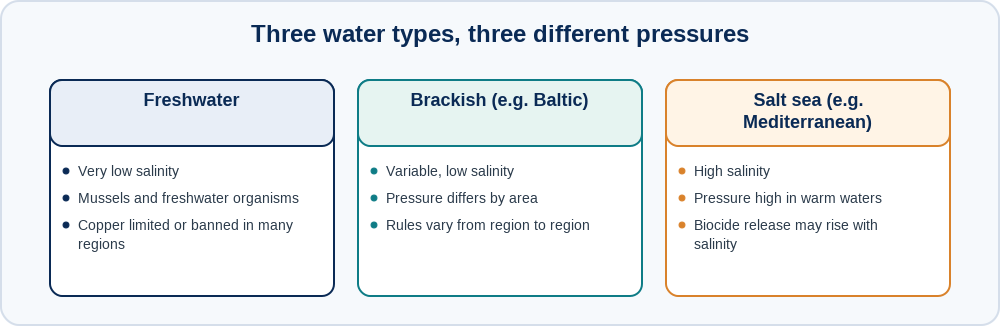
The first effect is biocide release. A research group from Sweden published a study reporting that antifouling paints leach copper in excess and that the copper release rate rises with salinity. This finding suggests that the same paint may release more slowly in a low-salinity area and faster in a high-salinity area.
The second effect is the organisms. In freshwater and low-salinity water the pressure comes from different organisms; in high salinity marine organisms dominate. The third effect is the rules: some regions set different limits based on salinity.
3. Freshwater#
In freshwater the pressure differs from the marine environment; organisms such as mussels can be a problem. A marine retailer’s guide notes that hauling a boat out after every use, or not keeping it in the water, can remove the need for antifouling in freshwater. In a boating magazine’s freshwater test, the best-performing paints contained copper, but it was reported that this may be more than seasonal boaters need.
From a regulatory view, copper is banned in freshwater in some regions; in Sweden, for example, copper cannot be used in the north of the Bothnian Bay or in freshwater. For a freshwater boat the choice therefore starts with the rule.
4. Brackish water: the Baltic example#
In brackish water salinity is low and variable. A field study in Sweden reported no clear difference in the amount of biofouling between boats painted with copper- or zinc-containing paints and unpainted boats in low-salinity areas, suggesting biocidal paints may not be necessary at low salinity. A boating magazine, in a test in a brackish arm of Chesapeake Bay where salinity swung between roughly 14 and 30 percent of seawater, reported that the effect of some products may fall at low salinity and that one maker gives a warning for low salinity.
| Area | Summary of the rule |
|---|---|
| West coast (high salinity) | Higher copper content and release limit |
| East coast | Lower copper content and release limit |
| North of the Bothnian Bay and freshwater | Copper not permitted |
5. The salt sea: the Mediterranean example#
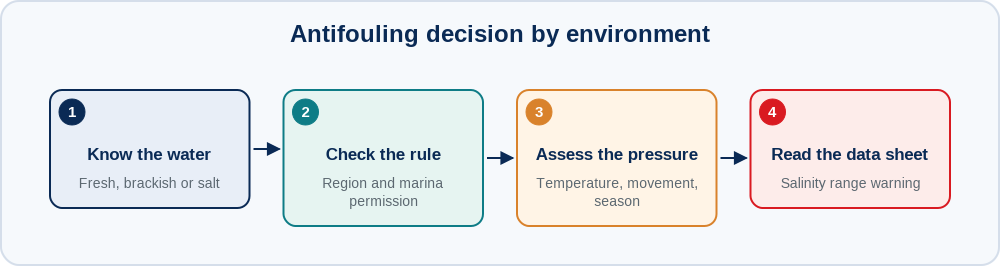
In high-salinity, warm seas such as the Mediterranean the biofouling pressure is high. In these environments paint choice is made together with factors such as temperature, boat movement and season length. Given the research reporting that copper release rises with salinity, a product’s release characteristic and thickness gain importance. But this should not be read as a simple rule such as “high salinity = more biocide”; each product’s data sheet and the region’s rule are decisive.
6. When the water type changes#
When a boat moves from sea to freshwater or from freshwater to sea, the paint choice should be reassessed. One source notes that for boats moving from the sea to inland waters, the need for protection against different organisms changes. The suitability of the old system for the new environment should be confirmed with the manufacturer.
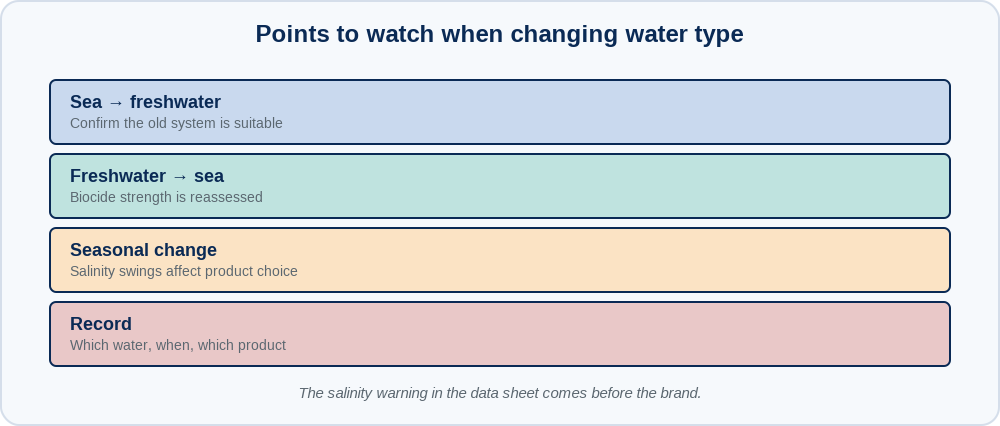
- Know the water: fresh, brackish or salt; learn the seasonal salinity range.
- Check the rule: region and marina permissions.
- Assess the pressure: temperature, movement and season length.
- Read the product data sheet: salinity warning and application range.
- Record: which water, when, which product.
7. A short case: the same boat, three environments#
Take an 11-metre yacht. Used through summer in the Mediterranean, the pressure is high because of high salinity and temperature. Used for a season in a low-salinity area of the Baltic, both pressure and rule are different. Third, if it is to be used on an inland lake, whether copper is permitted should be checked first.
Choosing the same product in all three cases either loads unnecessary burden or falls short. The right approach is to choose the product by environment and to run the decision process again at each change of environment.
8. Checklist#
9. Common mistakes#
- Using the same product in every water.
- Not reading the salinity warning in the data sheet.
- Thinking high biocide strength is “safer” at low salinity.
- Not confirming the old system’s suitability when the water environment changes.
- Treating the regional rule as a detail independent of salinity.
10. Season plan: a maintenance calendar by water#
The water environment determines not only product choice but also the maintenance calendar. In regions where salinity and temperature swing with the seasons, the period of highest pressure may coincide with the period in which the boat moves least. That overlap is when the paint is most stressed and should be planned for in advance.
- In spring: measure film condition at haul-out and confirm the application window in the data sheet before the season starts.
- In summer: in the months of highest pressure, if the boat will stay idle for long, obtain the manufacturer’s advice beforehand.
- In autumn: check the hull when salinity or temperature changes and assess the need for cleaning.
- In winter: for a boat waiting ashore, follow the manufacturer’s instruction on film drying and the launch interval.
This calendar is not the same for every environment; it differs for a boat waiting on dry land in freshwater and for a boat staying in the water all year in a salt marina. What matters is to write the calendar once and review it at the end of every season.
11. Conclusion#
Antifouling choice starts with the water. Salinity affects biocide release, the type of pressure and the rules. Fresh, brackish and salt water each need a different decision process. Know the water, check the rule, look at the salinity warning in the data sheet and run the process again when the environment changes.
Frequently asked questions#
How does salinity affect antifouling?
Research reports that copper release rises with salinity. The organisms and the rules also change with the water, so the choice is made by water.
Is antifouling essential in freshwater?
Not always. Where the boat does not stay in the water continuously and is hauled out after each use, paint may not be needed; but in waters with problem species such as mussels, protection is considered.
Does paint lose effect at low salinity?
The makers of some products warn that effect may fall at low salinity. The salinity range in the product data sheet should therefore be checked.
What should I do if I move from sea to freshwater?
Confirm with the manufacturer that the old system suits the new environment and check the biocide rule in the area.
What are the rules in the Baltic?
In Sweden the Baltic coast is divided by area: the west has a higher and the east a lower copper limit, and copper is banned in the far north. For the current rule, check with local authorities.
Was this guide helpful?
Thank you! Your feedback has been saved.
Guide content is for general information; in practice, the current technical data sheet of the product applies.
Keep reading
Related guides
Choosing Antifouling: A Decision Based on Usage Profile
A decision-focused study explaining how the type of antifouling should be chosen according to the frequency of use and water conditions.
2 min read UnderwaterChemical Principles of Antifouling Systems
A study of the mechanisms of action and chemical foundations of antifouling systems that prevent marine organisms from attaching to the hull.
2 min read UnderwaterFormation of Algae and Biofilm on the Hull
A study of how algae and biofilm form on the hull, the methods of protection and their effect on the surface.
2 min read