
Paint and Coatings
Yacht Paint for Hot Seas and Tropical Climates: UV, Heat and Colour Choice
A Mediterranean summer or a tropical route is a separate test for a paint system. Sun, heat and warm water work together. This article explains why yacht paint must be thought about differently in hot climates and what to watch.
Short answer
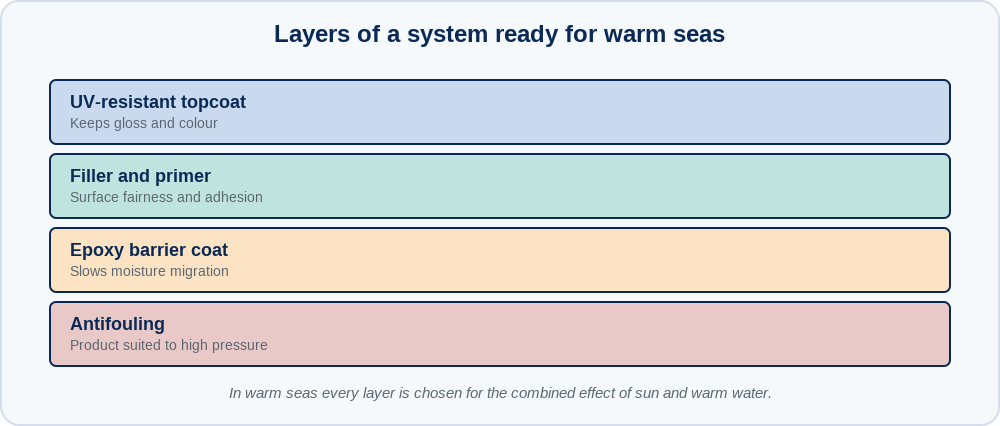
In hot climates a paint system is stressed by three factors: UV, heat and warm water. A dark hull can be 30 to 50 °F (roughly 17 to 28 °C) hotter than a white one in the same sun, according to one marine retailer’s guide, which can speed paint ageing. In warm water osmotic blistering on a fibreglass hull can also accelerate and fouling pressure rises. A UV-resistant topcoat, an epoxy barrier coat and an antifouling suited to the region should therefore be planned together, and if a dark colour is chosen the manufacturer’s approval should be obtained.
Key points
- In hot climates UV, heat and warm water stress the paint system together.
- A dark hull can be markedly hotter than a white one.
- In warm water osmotic blistering on a fibreglass hull can accelerate.
- An epoxy barrier coat is used to slow moisture migration.
- For a dark colour the manufacturer’s product and thickness approval should be obtained.
1. Why is a hot climate a separate test?#
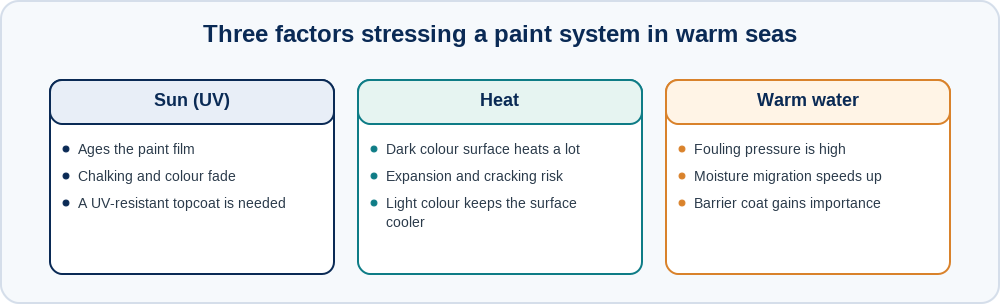
The same paint system does not behave the same way in Scandinavian waters and in the August sun of the Mediterranean. In a hot climate pressure on the paint comes from three directions: UV rays from the sun, solar energy that heats the surface and warm water that speeds biological and chemical processes. These three factors produce different results above and below the waterline.
This article offers a practical framework for yacht paint in a hot climate. The text is not product or application advice; the manufacturer’s data sheet and the applicator’s assessment are decisive.
2. UV: the main cause of ageing#
The sun’s ultraviolet rays gradually degrade the surface of the paint film: gloss disappears, the surface chalks and colour fades. Topcoats used on the upper surfaces are therefore chosen for UV resistance. A paint-industry article explains that modern marine topcoats are resistant to UV and that systems such as polyurethane and acrylic-modified polyurethane were developed for this purpose. Another marine magazine piece notes that, thanks to advances in UV-protection technology, a thin coat of exterior paint can last more than five years with strong colour stability.
Even so, “UV-resistant” is not a guarantee. In intense sun, colour, thickness and application quality together decide the result. Following the number of coats and thickness in the manufacturer’s data sheet is the most practical assurance of UV resistance.
3. Heat: the hidden cost of colour choice#
Dark colours absorb far more solar energy than light colours. A marine retailer’s guide reports that on a fibreglass boat in direct sun a dark hull can reach a surface temperature 30 to 50 °F (roughly 17 to 28 °C) hotter than a white hull in the same conditions, and says this can speed UV ageing of the paint, in extreme cases cause crazing of the gelcoat and warm the cabin. A boat-painting specialist reports a summer measurement in which a light-grey hull read about 90 °F while black and dark blue hulls read about 130 °F, and explains that when changing to a dark colour the resin can cure further and shrink slightly, producing a visible mark known as print-through.
These findings do not mean dark colour is forbidden; they show that it brings an additional heat load and that product and application quality must be chosen for it. On commercial ships, coatings aiming to reduce heating with reflective pigments are used; one manufacturer reported that on a tested deck the surface temperature measured 70 °C on conventional coating and 42 °C on the reflective coating. This is a manufacturer’s claim made for ships and cannot be transferred directly to yachts.
| Property | Light / white | Dark |
|---|---|---|
| Sunlight reflection | High | Low; absorbs more heat |
| Surface temperature | Cooler | May be markedly hotter |
| Paint ageing | Slower | May speed up with heat load |
| Effect on substrate | Low | Resin post-cure and print-through risk |
| Maintenance | Shows dirt | May show dust and scratches more |
4. Warm water: osmosis and moisture migration#
Warm water speeds not only organisms but also chemical processes. A marine retailer’s guide says the osmotic blistering process on a fibreglass hull accelerates in warm water and on boats kept in the water all year, and that an epoxy barrier coat applied below the waterline significantly slows this moisture migration. The same guide stresses that painting over active blisters traps moisture and the problem will return.
For a fibreglass yacht that will stay in a hot region, a barrier coat is therefore a step to be planned before the antifouling. If blistering has already been found, no paint should be applied before the surface has been dried and repaired. For more detail on osmosis, see the osmosis articles on our site.
5. Antifouling in warm water#
In warm, nutrient-rich water fouling pressure is high. An antifouling maker says that in tropical waters growth on an untreated hull can increase drag, fuel consumption and haul-out frequency, and describes a boat prepared for long tropical cruising that used a full system including a primer, a multi-season copolymer antifouling and the suitable thinner. This is a case narrative, not a product recommendation.
Another manufacturer separates “high activity” and “low activity” options in its range and notes that some are more suitable for long idle periods or for switching from warm to cold water. This also shows that product choice depends on use profile, idle time and route.
6. Practical steps in a hot climate#
- Write down your route and season: how long in the hot region, how long the boat will sit idle.
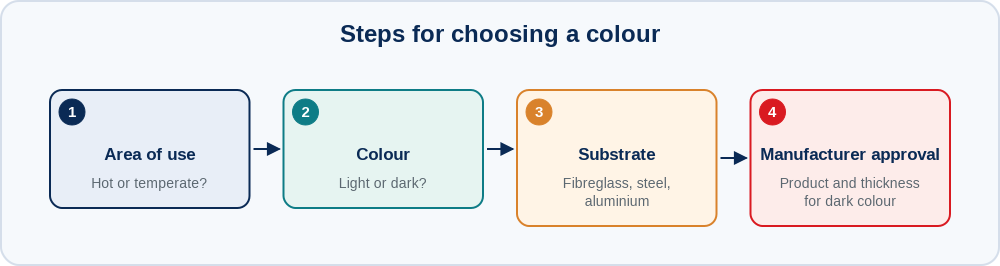
- Choose colour deliberately: if you want a dark colour, obtain the manufacturer’s product and thickness approval.
- Plan the barrier coat: to slow moisture migration on a fibreglass hull.
- Choose a UV-resistant topcoat and apply the number of coats in the data sheet.
- Choose the antifouling by the region’s pressure and your idle time; do not forget the rule check.
- At season end record film, gloss and blistering condition.
7. A short case: the same boat, two climates#
Take a 13-metre fibreglass yacht with a dark blue hull. For a yacht spending a short season in a northern sea, the dark colour may not create a big heat problem. If the same yacht will sit in the sun all summer in a hot sea, surface temperature, paint ageing and resin movement in the substrate come into play; it is necessary to consult the manufacturer and perhaps consider a lighter colour.
If the same yacht stays in the water all year in a hot sea, the barrier coat and antifouling plan matter even more. The decision comes from the combination of boat and climate rather than from the boat alone.
8. Checklist#
9. Common mistakes#
- Choosing colour for looks alone and ignoring heat load.
- Painting over active blisters.
- Skipping the barrier coat and applying antifouling directly.
- Reducing coat thickness “to save” in a hot climate.
- Buying a “general” product without stating the route.
10. Conclusion#
A hot climate stresses a paint system with UV, heat and warm water together. A light colour gives coolness and slower ageing; a dark colour brings aesthetic advantage but an extra heat load. On a fibreglass hull a barrier coat slows moisture migration; the antifouling must be chosen by route and idle time. Write down your route, consult the manufacturer and record every decision.
Frequently asked questions#
Is a dark hull a problem in a hot sea?
Dark colours absorb more solar heat. A marine retailer’s guide reports that on a fibreglass boat a dark hull can be 30 to 50 °F hotter than a white one, which can speed ageing. The manufacturer’s approval matters.
Does warm water speed up osmosis?
A marine retailer’s guide says the osmotic blistering process accelerates in warm water and on boats kept in the water all year. An epoxy barrier coat is used to slow this migration.
How important is antifouling in the tropics?
Growth is strong in warm water; one manufacturer says that, left untreated, drag, fuel consumption and haul-out need can increase.
Is white always better?
White reflects the most sunlight and so keeps the surface cooler. A dark colour can be chosen, but heat load and product approval must be taken into account.
Which layer matters most against UV?
The topcoat. UV-resistant polyurethane and similar topcoats are used for this; product choice and thickness should follow the manufacturer’s data sheet.
Was this guide helpful?
Thank you! Your feedback has been saved.
Guide content is for general information; in practice, the current technical data sheet of the product applies.
Keep reading
Related guides
Colour Stability and UV Resistance in Yacht Paints
A study of the fading caused by sunlight on paint colours, UV resistance and the components that preserve this property.
2 min read Refit and MaintenanceOsmosis Treatment: Drying, Moisture Readings and Epoxy Barrier
How does osmosis form in a GRP boat, how is moisture measured, and how are drying and an epoxy barrier applied? Step-by-step treatment principles.
6 min read UnderwaterChoosing Antifouling: A Decision Based on Usage Profile
A decision-focused study explaining how the type of antifouling should be chosen according to the frequency of use and water conditions.
2 min read