
Underwater
Removing Old Antifouling: Waste Management, Microparticle Risk and the 2024 IMO Guidance
The antifouling debate usually concerns release into the water, yet the dust and particles produced during removal matter just as much. This article gathers the waste chain and measures that yacht businesses can apply.
Short answer
Removing old antifouling produces biocide-containing dust, paint particles, abrasive and wastewater. In 2024 the IMO issued guidance on best management practices for removing antifouling coatings from ships (AFS.3/Circ.6); it is aimed at ships, but its principles guide yacht yards too: control the source, keep waste on site, separate it and hand it to an authorised facility with paperwork. Uncontrolled removal can let particles reach the sea with rainwater.
Key points
- Removal produces biocide-containing dust, particles, abrasive and wastewater.
- The IMO’s 2024 guidance (AFS.3/Circ.6) is for ships; its principles guide yacht yards too.
- Uncontrolled abrasive blasting and dry sanding can carry particles into the environment.
- Waste is collected, separated and handed to an authorised facility with paperwork.
- The cheapest waste is the waste never produced: planned, targeted removal.
1. Why is removal a separate environmental subject?#
Most of the debate about antifouling focuses on what the paint releases in the water. Yet a paint’s life does not end when it ages and is removed. Old film holds biocide for years; when sanded, scraped or blasted away, that material can enter the environment as dust and particles. A single handful of paint dust left on the yard floor can be carried to the sea by rainwater.
Removal is therefore a job that must be planned as carefully as application. The sections below set out the waste chain and measures that yacht businesses can apply. The text is not legal or engineering advice; the rules and yard permits in your region are decisive.
2. What does the IMO’s 2024 guidance say?#
The IMO first approved guidance on best management practices for removing antifouling from ships in 2009, updated it in later years and in 2024 issued a revised version as AFS.3/Circ.6. The background is the change in the rules on antifouling systems. The guidance deals with managing the waste produced in removal at shipyards and maintenance facilities and stresses that waste-prevention strategies should rest on identifying and controlling the sources.
The guidance is aimed at ships and is a guidance document, not a binding legal text. Its principles nonetheless guide smaller boats too, because yacht yards handle the same material on a smaller scale and often with less oversight.
3. What does the waste consist of?#
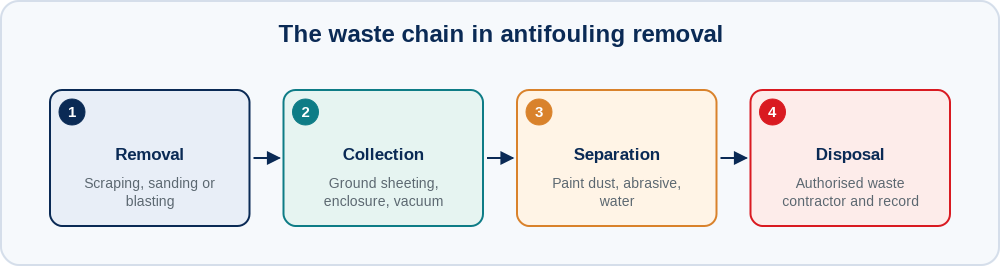
- Paint dust and particles: formed during sanding, scraping and blasting; may carry biocide.
- Spent abrasive: the material used in blasting mixes with paint particles and enlarges the waste volume.
- Wastewater: formed when removal is done with high-pressure water; may need to be collected and treated.
- Ancillary materials: masks, overalls, ground sheeting, tapes and solvent-soaked rags.
A boatyard guide notes that sanding, blasting and pressure washing are often used to remove paint, but that heavy metals such as copper can be released in the process. Another document stresses that abrasive blasting does not remove waste because the sand or similar material commonly used forms a large volume.
4. Risk by method#
| Method | Waste type | Point to watch |
|---|---|---|
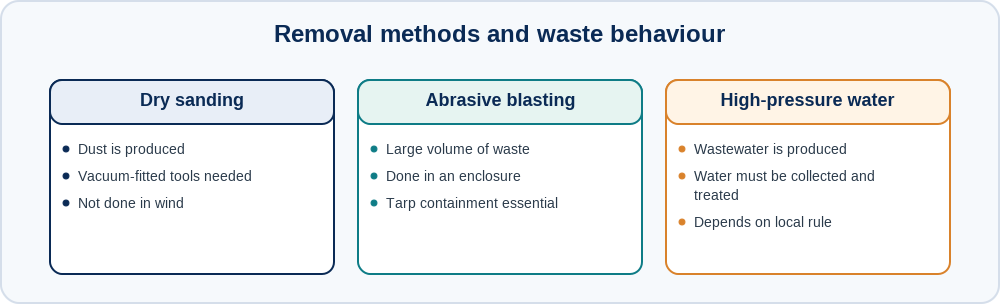
| Dry sanding | Dust | Vacuum-fitted tools; not done in wind |
| Abrasive blasting | High-volume solid waste | Enclosure or tarp containment |
| High-pressure water | Wastewater and paint particles | Collecting the water and disposing under local rules |
| Scraping | Particles and shavings | Ground sheeting and hand sweeping |
A state guide recommends that uncontrolled abrasive blasting not be permitted and that the work be done only in the maintenance area, inside a structure or in an area enclosed with a plastic tarp. It also advises investigating alternatives to traditional blasting such as hydroblasting and mechanical methods.
5. The “microparticle” concern#
Paint particles can be microscopic and long-lived; the “microparticle” concern therefore draws attention to paint residues reaching sediment at yards and marinas. Academic groups are known to have reported paint particles in sediments near yards; but regional and methodological differences exist, so claims of a particular quantity or effect should be avoided. The practical conclusion is this: preventing particles from reaching the water is far more effective than trying to clean up after they arrive.
6. The waste management hierarchy#
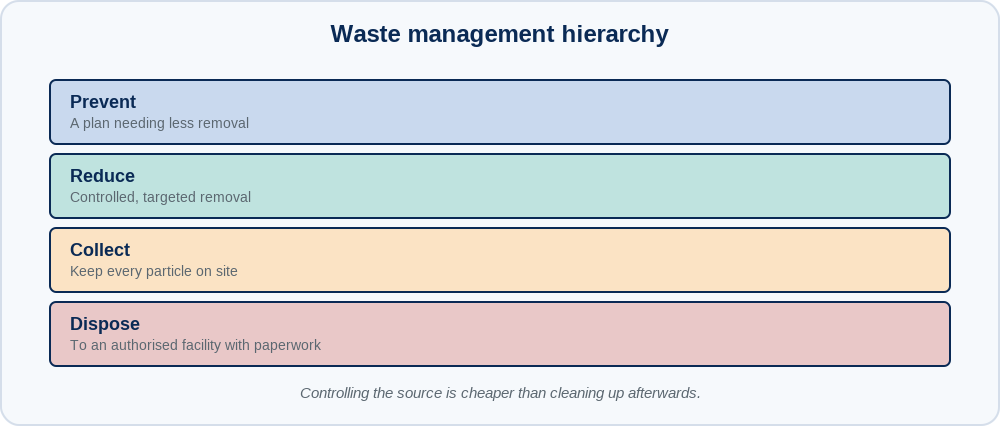
- Prevent: avoid unnecessary removal; plan targeted removal using thickness measurement.
- Reduce: limit removal to the areas that need it and, when rebuilding the system, think of a structure that eases future removal.
- Collect: keep every particle on site with ground sheeting, vacuum-fitted tools and enclosure.
- Dispose: through an authorised waste contractor with paperwork; keep records.
7. Measures yacht businesses can apply#
- Do not sand or blast in windy weather.
- Do removal in an enclosed or tarp-surrounded area; cover the ground.
- Use vacuum-fitted sanding tools; connect to a dust extractor if possible.
- Check local rules before reusing abrasive; manage painted abrasive as waste.
- Sweep the ground after removal; do not hose it toward the sea.
- Provide workers with personal protective equipment; prevent dust inhalation.
8. What should the yacht owner do?#
When choosing who does the removal, the owner should look not only at price but also at the yard’s waste management. It makes sense to ask the yard: what is the removal method? Is the area enclosed? How are dust and waste collected? To which firm is the waste given and can paperwork be provided? These questions are natural for good businesses and may be uncomfortable for weak ones.
9. A short case: two yards, two approaches#
The first yard sands the underwater hull of a 12-metre yacht in the open on a windy day and leaves the dust on the ground. The second works the yacht under a closed roof or in an area enclosed with tarps, uses vacuum-fitted tools, covers the floor and gives the waste to a firm with paperwork. The second yard may look a few hundred euros more expensive; but it gives the owner a waste record, less load on the environment and reassurance in a possible inspection.
The owner should ask “why is there a difference?” A removal that looks cheap may later load the environmental and reputation costs onto the owner.
10. Documentation: how to keep a removal record#
Removal is not just a job done and finished but a process that needs recording. A record protects both the owner and the yard; it makes it easier to show the system’s history in a later resale, in insurance or in an inspection. What the record should contain can be summarised in the list below.
- Date and method of removal and the surface area removed.
- Type of the removed system and its known biocide content, if any.
- A short description of the containment and dust-collection measures.
- Quantity of waste, the firm it was handed to and the disposal certificate number.
- Product, batch number and application date of the new system.
- Photographs: before, during and after removal.
This record can fit on a single page; what matters is that the yard and the owner share the same information and that the document is kept in the yacht’s file. That way, when the next removal is planned, the existing system’s thickness and type are known from records, not guesses.
11. Conclusion#
Removing old antifouling is one of the least discussed but riskiest stages in a paint’s life cycle. The IMO’s 2024 guidance is for ships, but its principles are clear: control the source, keep the waste on site, separate it and dispose with paperwork. As a yacht owner, ask for planned and targeted removal, question the yard’s waste management and keep the documents.
Frequently asked questions#
Is the IMO’s 2024 removal guidance binding for yachts?
The guidance is aimed at ships and is a guidance document; its principles are a guide for yacht businesses. Binding rules come from local legislation.
Which method produces the most waste?
Abrasive blasting generally produces the largest volume of waste; dry sanding produces dust and high-pressure water produces wastewater.
Why does paint dust matter?
Dust can carry antifouling biocides and can be carried to the sea by rainwater. It should therefore be kept on site.
Can I put the waste in the bin?
No. Antifouling waste needs an authorised waste contractor and disposal with paperwork that meets local rules; the situation varies by region.
Which plan reduces waste?
Targeted removal in the areas that need it, and decisions based on thickness measurement rather than stripping the whole system, reduce waste volume.
Was this guide helpful?
Thank you! Your feedback has been saved.
Guide content is for general information; in practice, the current technical data sheet of the product applies.
Keep reading
Related guides
Choosing Antifouling: A Decision Based on Usage Profile
A decision-focused study explaining how the type of antifouling should be chosen according to the frequency of use and water conditions.
2 min read UnderwaterManaging the Waterline Zone with a Paint System
A study of the special conditions around the waterline of a boat and how this zone is managed with a paint system.
2 min read UnderwaterFormation of Algae and Biofilm on the Hull
A study of how algae and biofilm form on the hull, the methods of protection and their effect on the surface.
2 min read