
Paint and Coatings
Deck Non-Skid: Sand, Grit and Ready-Made Sheet Options
For deck non-skid, sand or grit-additive paint, ready-made stick-on sheet and tape options are described; sources differ on grip, upkeep and lifespan. This article summarises the accounts with their limits; it is not a product, method or time recommendation.
Short answer
A boat-test website divides common non-skid renewal options into grit paints, textured paints and mats, and adhesive-mounted coverings; it lists polymer bead aggregates among modern additives. A test publication writes that it left sand and walnut shell out of its tests because they are used less and can be hard on skin; a long-term test article says a faded deck does not always mean lost grip. Another test article writes that untreated teak gave similar traction to two fibreglass textures even when wet, but that on a damp deck the same grip cannot be counted on. A seller says high-quality sheets can last more than ten years; that is a seller claim. This article recommends no product; the maker governs.
Key points
- Non-skid renewal options are described in three groups: grit paints, textured paints and mats, and adhesive-mounted coverings.
- Sand and walnut shell are used less and can be hard on skin (test publication).
- A deck that looks faded does not always mean lost grip (long-term test article).
- Behaviour on a wet or damp deck can differ from a dry one (test publications).
- Lifespan claims are mostly seller accounts; for product and time the maker and a qualified yard govern.
1. Why compare options?#
When the moulded non-skid pattern wears, boat owners meet many options; each has pros and cons in addition to its actual non-skid qualities. An insurer and boating organisation’s guide describes these options as coming by three main routes. This article is a general summary; it gives no product, ratio, number of coats, grit or time and is not application advice. Sources are test publication, magazine, guide and seller accounts and may differ; seller statements are labelled.
2. Grit and additives#
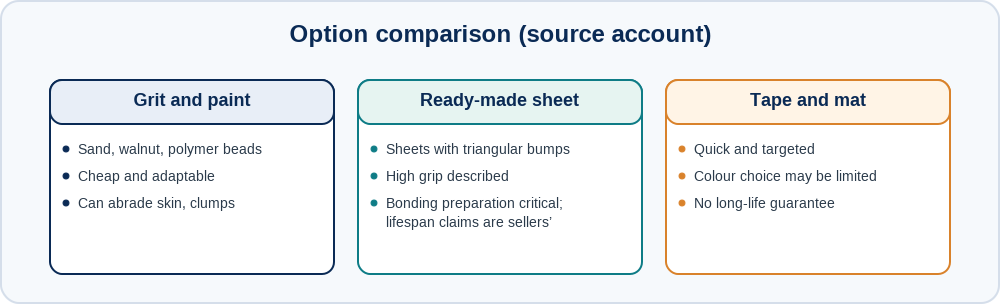
A boat-test website lists among modern non-skid additives a polymer bead aggregate that comes in fine, coarse and extra-coarse grades and a pre-measured polymer-bead compound sold for mixing into paint. The same publication puts these in the category of deck paints with a grit-type traction material added. A test publication says it left sand and crushed walnut shell out of its tests because fewer owners use them as additives, commercial products give better results and they can be very rough on human flesh; it adds that getting a good finish with them can be harder.
| Option | Sources’ general account | Caution |
|---|---|---|
| Sand and walnut shell | Cheap and adaptable; used less | Can abrade skin |
| Polymer beads | Pre-measured compounds described | Mixing and clumping |
| Ready-made sheet | High grip; lifespan claim from seller | Preparation critical |
3. Ready-made sheet, tape and the wet deck#
A 1995 foundation test publication writes it tried seven types, including non-skid paint mixtures, a teak piece and a non-skid sheet with triangular raised bumps that can be cut and applied to almost any deck area; that is an old test and products may have changed. A sailing magazine says stick-on options give a highly non-slip surface but need careful preparation to stick. A retailer writes that high-quality sheets can last more than ten years with maintenance while non-skid paints may need reapplying; that is a seller claim.
A boating magazine article from 2015 writes that non-slip tape can be a quick fix but comes in only a few colours and stands out on the deck. A long-term test article says faded decks do not always mean lost grip, some finishes losing looks while keeping traction; that applies to a publication’s own test panel and cannot be generalised.
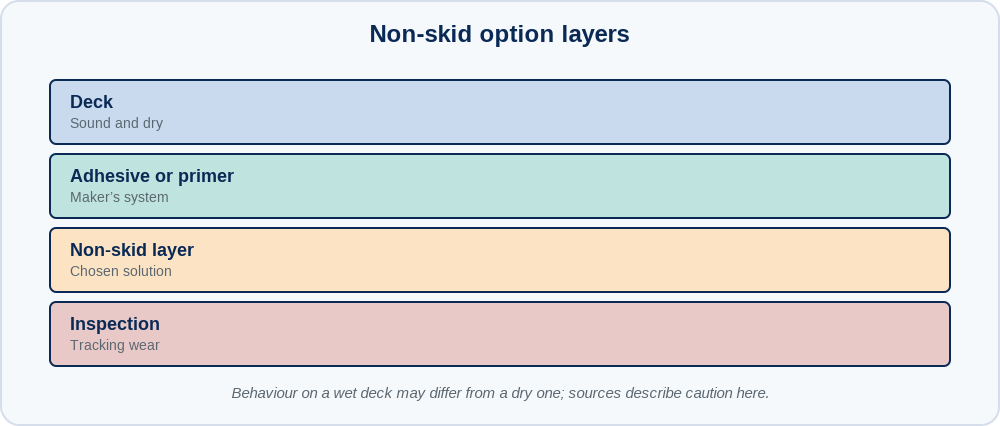
A test article describes untreated teak giving similar traction to two fibreglass non-skid textures even when wet, but says one cannot count on the same grip on a damp deck; it also writes that a diamond-pattern fibreglass sole gave good traction when dry and lost a little when wet. These results belong to specific test conditions and cannot be taken as firm results for your deck.
Cleaning matters too: an older publication’s author describes harsh cleaners leaving stains on non-skid over time and a measured approach being better; that is a user observation. Build-up of dirt, oil and algae on the deck can reduce grip; compatibility of cleaning products should be confirmed from the maker’s instruction.
The choice should not be made on grip alone: comfort underfoot, look, weight, ease of repair and later replacement cost are also mentioned in sources. This article gives no price or cost estimate; comparing written quotes is the basis.
4. A practical frame#
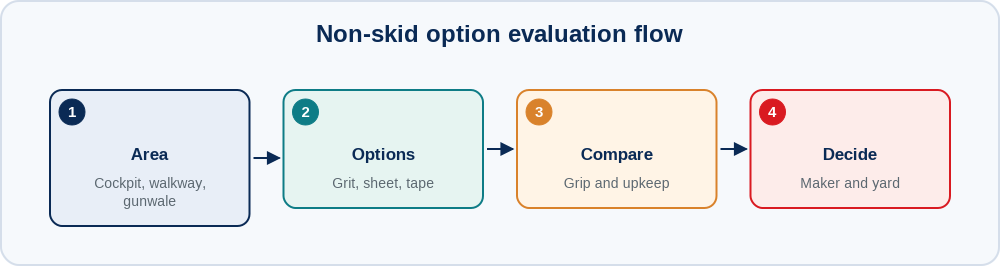
- Establish the area: cockpit, walkway, gunwale or bathing platform have different requirements.
- Inspect the existing surface; a faded look and real loss of grip are separate matters.
- Compare options through test and user accounts separately from seller claims.
- Ask the maker about behaviour in wet and damp conditions.
- Plan preparation and application per the maker’s data sheet.
- Plan regular inspection and cleaning.
- Keep records; read the safety data sheet.
5. Limits#
Sources overlap that options carry different pros and cons, that preparation matters and that wet conditions need care; they differ on which option is better and on lifespan. Test articles apply to their own panels; sellers make lifespan claims for their own products. So there is no single right answer; deck, use and the maker’s instruction govern. This article is not application advice.
5b. Where sources differ#
Test publications find sand and walnut shell hard on skin; a magazine finds tape colour choice limited; a seller claims ready-made sheet can last more than ten years; the long-term test article says a faded deck does not mean lost grip. These are sources speaking in different contexts and with different interests. The difference means consulting the maker and a qualified yard for your own deck.
This article is general information; it recommends no product, method, ratio, number of coats or time. The maker’s data sheet and a qualified yard govern.
5c. A practical frame for reading the sources#
The sources are magazines, makers, sellers and forums; each writes in its own context. None knows the deck surface, its use or its climate of your boat. So taking the shared message and consulting the maker and a qualified yard for detail is reasonable.
Sanding dust, solvent and adhesive vapours can carry health and fire risks. This article describes no personal protection, ventilation or waste method; read the product’s safety data sheet, consult a qualified yard and follow the relevant safety rules. The risk of falling on a slippery deck is serious; no covering can be said to remove slip risk entirely.
Seller and maker statements are the firm’s own account of its product and have not been independently verified. A product’s compatibility with another coating should always be checked in the product’s technical document; where a document and a guide conflict, the maker’s document and a qualified yard’s assessment should be used. Recording decisions and product details helps later maintenance.
6. Common mistakes#
- Taking a faded look as lost grip or the reverse.
- Treating a seller lifespan claim as independent verification.
- Ignoring wet-condition behaviour.
- Underrating preparation for stick-on sheets.
- Wearing the surface with very harsh cleaners.
- Not reading the safety data sheet.
- Keeping no records.
7. Checklist#
8. Conclusion#
For deck non-skid, sand, grit, ready-made sheet and tape options carry different pros and cons; sources differ on grip, wet behaviour and lifespan. This article is general information; it gives no product or time and the maker and a qualified yard govern.
Frequently asked questions#
Is sand additive still used?
A test publication writes that sand and walnut shell are used less, commercial products give better results and they can be hard on skin.
How long do ready-made sheets last?
A seller writes high-quality sheets can last more than ten years; that is a seller claim and not independently verified.
Does a faded deck mean it is slippery?
A long-term test article writes a faded deck does not always mean lost grip; inspection and assessment are still needed.
Does behaviour change on a wet deck?
A test publication writes the grip of a dry deck cannot be counted on on a damp one; see the maker’s information.
What about tape?
A magazine article writes non-slip tape is a quick fix but comes in only a few colours and can stand out on a deck.
Was this guide helpful?
Thank you! Your feedback has been saved.
Guide content is for general information; in practice, the current technical data sheet of the product applies.
Keep reading
Related guides
Boat Colour Selection and Solar Reflectance: Effect of Heat Absorption on Surfaces
A study of the effect of boat paint colour on solar reflectance and surface temperature.
2 min read Paint and CoatingsCauses and Diagnosis of Paint Blistering
A study of the sources, types and diagnostic approach to blistering on boat paints.
2 min read Paint and CoatingsNumber of Coats in Epoxy Coating Systems
A study of the effect of the number of coats in epoxy coating systems on protective performance and thickness.
2 min read