
Paint and Coatings
Lightweight Fairing Compound Versus Heavy Filler: The Differences
Lightweight fairing compounds and heavy fillers are described in sources differently for weight, consistency, sandability and strength; the choice depends on the job and location. This article summarises the accounts with their limits; it is not a product, ratio or time recommendation.
Short answer
Maker accounts tend to say lightweight fillers can reduce weight over large areas and sand more easily, while heavy fillers can give a denser, tougher mix; those are maker-specific and not independently verified. User accounts say the mechanical strength of lightweight filler may be limited and heavy filler may be hard to sand. This article recommends no product, ratio or time; the maker and a qualified yard govern.
Key points
- Lightweight fillers are described as reducing weight over large areas and sanding more easily (maker).
- Heavy fillers are described as a denser, tougher mix but can be hard to sand.
- Mechanical strength of lightweight filler may be limited (user accounts).
- Resin, hardener and paint-system compatibility should be confirmed from the data sheet.
- For product, ratio and time the maker and a qualified yard govern.
1. Why distinguish two filler types?#
In epoxy-based fairing compounds the type of filler material changes the weight, consistency and sandability of the mix; sources therefore distinguish lightweight from heavy fillers. This article is a general summary; it gives no product, mix ratio, cure time or time and is not application advice. Sources are maker and user accounts and may differ; maker and seller statements are labelled.
2. Lightweight filler#
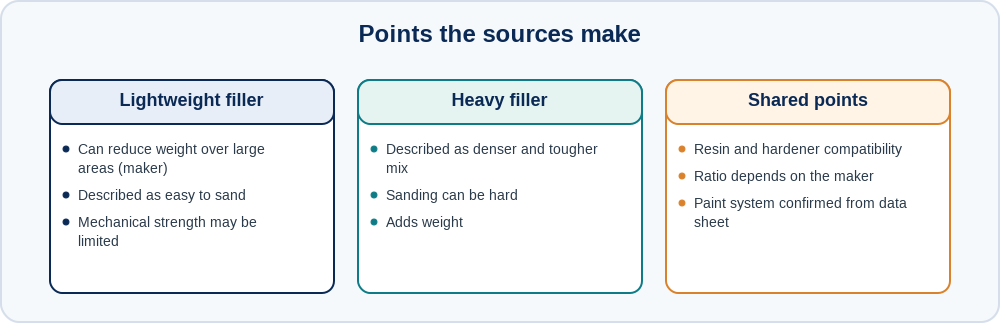
Maker accounts tend to say lightweight fillers can reduce weight over large areas, sand more easily and are practical for fairing. User accounts say the mechanical strength of lightweight mixes may be limited. These are generalisations, vary by maker and product and are not an independent test.
| Topic | Sources’ general account | Caution |
|---|---|---|
| Lightweight filler | Low weight, easy sanding | Mechanical strength may be limited |
| Heavy filler | Dense and tough mix | Hard to sand, adds weight |
| Shared | Resin and paint-system compatibility | Data sheet |
3. Heavy filler and shared points#
Heavy fillers tend to be described in sources as a denser, tougher and more impact-resistant mix; it is also reported that they can be hard to sand and add weight over large areas. These generalisations vary by maker and the data sheet governs for each product.
For both types resin and hardener compatibility, surface preparation and paint-system compatibility are confirmed from the maker’s document. Sources advise not assuming a filler is compatible with another maker’s resin; this is a general account and no substitute for the product instruction.
Many sources and users describe choosing by location of the job: lightweight mixes for fairing broad visible areas, denser mixes for small repairs needing strength, for example. That is a generalisation and varies by boat and job; for damage that may be structural a qualified specialist should be consulted.
Phrases in seller and maker accounts such as easy sanding or high strength may not rest on independent measurement and should not be treated as sufficient on their own for comparison. A maker document describes its own product and should not be read as a general property of a class.
Users differ too: some say they do the whole job with one filler, some use the two types together depending on the job. These are experiences not independently verified. This article does not say one filler is better than another.
In sum sources compare the two types on weight, sanding and strength; the difference lies in which suits which job and in what ratio. So for your own job consult the maker and a qualified yard.
Weight matters especially on larger boats and broad surfaces: sources say that where a mix is applied over a large part of a surface its contribution to total weight can differ between lightweight and heavy types. That is a generalisation; the real contribution depends on thickness and area and this article gives no figures or calculations.
4. A practical frame#
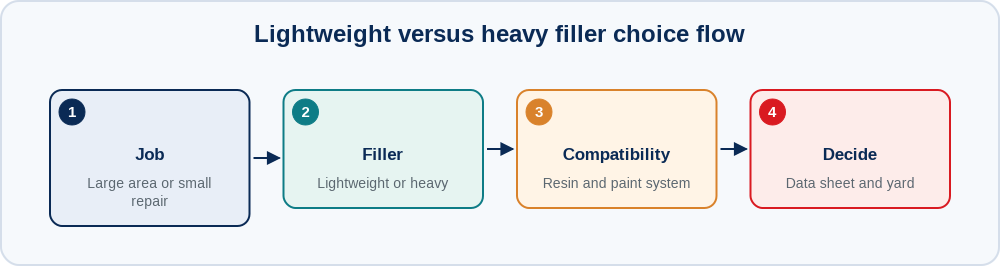
- Establish the job: broad fairing, small repair or possibly structural damage?
- Confirm the filler type from the data sheet and the maker.
- Confirm resin, hardener and filler compatibility within one maker’s system.
- Decide mixing, cure and sanding details per the maker’s instruction with a craftsman.
- Confirm primer and paint-system compatibility from the data sheet.
- Separate maker and user accounts.
- Keep records; read the safety data sheet.
5. Limits#
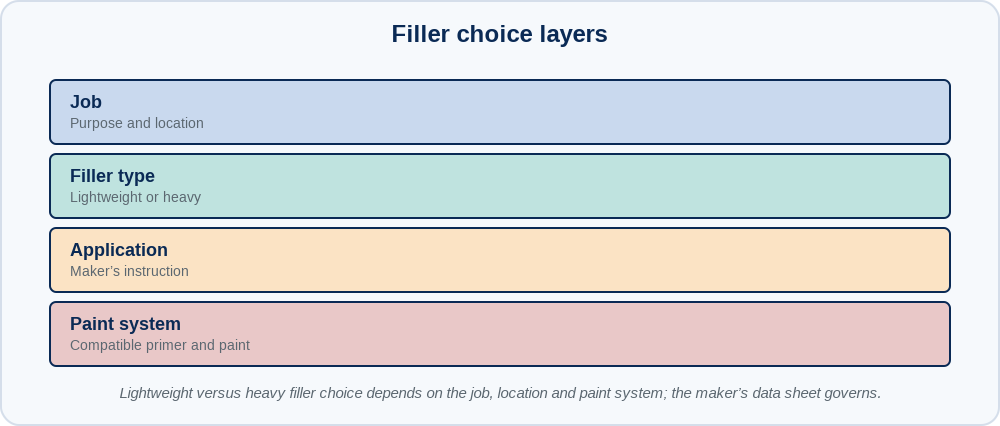
Sources overlap that lightweight fillers are described as lighter and easier to sand, heavy fillers as denser, and that paint-system compatibility must be confirmed from the data sheet; they differ on which filler suits which job and on ratios. Maker and user accounts are specific to their contexts. So there is no single right answer; the data sheet and the maker’s instruction govern. This article is not application advice.
5b. Where sources differ#
Makers describe filler types through their own products; users report strength and sanding experiences; some accounts say the two types are used together depending on the job. These are sources speaking in different contexts and with different interests. The difference means consulting the maker and a qualified yard for your own job.
This article is general information; it recommends no product, method, ratio, number of coats or time. The maker’s data sheet and a qualified yard govern.
5c. A practical frame for reading the sources#
The sources are magazines, makers, sellers and forums; each writes in its own context. None knows the job, the filler type or the paint system of your boat. So taking the shared message and consulting the maker and a qualified yard for detail is reasonable.
Epoxy resins, hardeners and sanding dust can carry skin and respiratory irritation or allergic sensitisation risk; sanding carries injury risk. This article describes no personal protection, ventilation or waste method; read the product’s safety data sheet, consult a qualified yard and follow the relevant safety rules. For damage that may be structural apply to a qualified specialist.
Seller and maker statements are the firm’s own account of its product and have not been independently verified. A product’s compatibility with another coating should always be checked in the product’s technical document; where a document and a guide conflict, the maker’s document and a qualified yard’s assessment should be used. Recording decisions and product details helps later maintenance.
6. Common mistakes#
- Choosing filler type on brand or price alone.
- Assuming different makers’ resin and filler are compatible.
- Trying to close structural damage with filler.
- Ignoring sanding difficulty.
- Treating a maker claim as an independent test.
- Not reading the safety data sheet.
- Keeping no records.
7. Checklist#
8. Conclusion#
Lightweight and heavy fillers are described in sources differently for weight, sanding and strength; the choice depends on the job and location. This article is general information; it gives no product, ratio or time and the maker and a qualified yard govern.
Frequently asked questions#
What is the main difference between lightweight and heavy filler?
Maker accounts say lightweight filler reduces weight and sands easily while heavy filler can be denser and tougher; it varies by product.
Which is stronger?
Sources tend to describe heavy filler as tougher; for work that may be structural apply to a qualified specialist.
Which sands more easily?
Maker accounts describe lightweight filler as easier to sand; this is not an independent measurement.
What is the mix ratio?
This article gives no ratio; it varies by product and the maker’s instruction governs.
Which paint goes over it?
A compatible primer and paint system is confirmed from the data sheet; this article recommends no product.
Was this guide helpful?
Thank you! Your feedback has been saved.
Guide content is for general information; in practice, the current technical data sheet of the product applies.
Keep reading
Related guides
Boat Colour Selection and Solar Reflectance: Effect of Heat Absorption on Surfaces
A study of the effect of boat paint colour on solar reflectance and surface temperature.
2 min read Paint and CoatingsCauses and Diagnosis of Paint Blistering
A study of the sources, types and diagnostic approach to blistering on boat paints.
2 min read Paint and CoatingsNumber of Coats in Epoxy Coating Systems
A study of the effect of the number of coats in epoxy coating systems on protective performance and thickness.
2 min read