
Paint and Coatings
Dew Point and Boat Painting
Dew point marks the limit at which condensation will begin in paint application. This article explains how to measure and calculate dew point, the margin against the surface and the risks through the day.
Short answer
Dew point is the temperature at which water vapour in the air begins to condense; if the surface to be painted falls below it a water film forms on the surface. Many standards and makers ask for the surface temperature to be at least 3 °C (5 °F) above dew point. Dew point is found from air temperature and relative humidity with a table, a dew point dial, a sling psychrometer or a dew point meter; surface temperature is measured with a surface thermometer. According to a technical note, condensation can leave a microscopic water film not visible to the eye and coatings applied over it suffer adhesion and cure problems. This article is general information; your product’s data sheet governs.
Key points
- Dew point is the temperature at which water vapour begins to condense; a surface below it gets a water film.
- Surface temperature should be at least 3 °C (5 °F) above dew point; ISO 8502-4 and SSPC recommend this margin.
- Dew point is found from air temperature and relative humidity with a table, dial, sling psychrometer or meter.
- Condensation may not be visible; avoid rapid temperature falls in the evening.
- Monitor dew point throughout application and drying, not only at the start.
1. What is dew point and why does it matter?#
Air can hold only a certain amount of water vapour at a given temperature. As air cools this capacity falls and at some point the air becomes saturated with water vapour; this temperature is called the dew point. When a cold surface falls below the dew point, moisture in the air condenses on the surface and a thin water film forms. In paint application this water film gets between paint and substrate. DeFelsko’s guide on measuring environmental conditions for coatings says most coatings will not dry properly at low temperatures and high relative humidity, that the impact of surface moisture on the life and performance of materials is less understood and recommends comparing dew point temperature with surface temperature so the two are far enough apart that moisture formation is unlikely.
A technical note from a flooring installer writes that condensation forms a microscopic water film invisible to the eye and that coatings applied over condensation will fail, listing results such as adhesion failure, amine blush, improper cure or surface hazing. That source is for resinous floor coatings but the chemical logic also holds for boat paints. For general temperature and humidity conditions see the related article; this article focuses on dew point and recommends no value for any specific product.
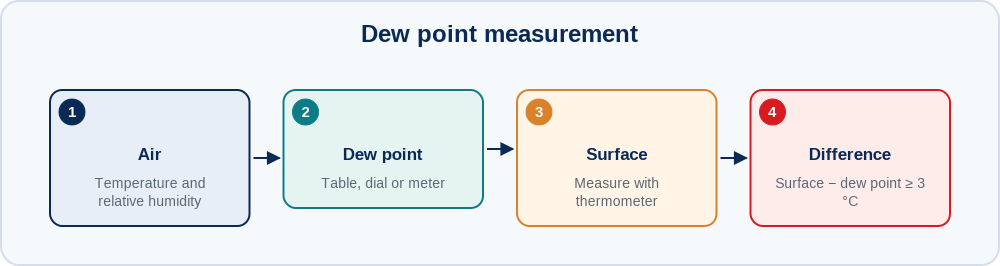
2. How is dew point measured?#
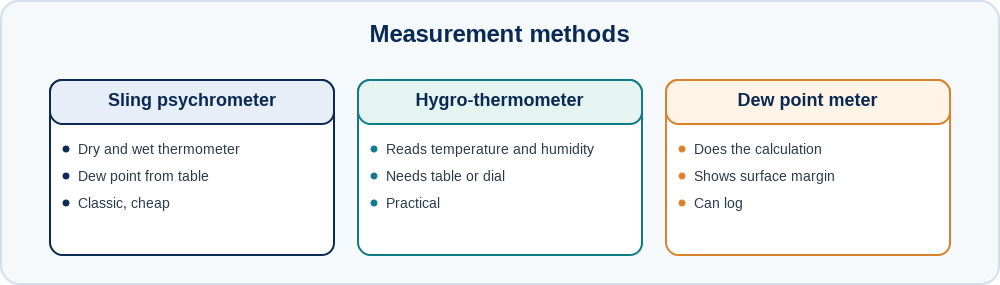
There are several ways to reach the dew point. The classic method is the sling psychrometer: one of two thermometers is covered with a wet wick; the instrument is whirled, dry and wet bulb values are read and the dew point is found from the difference with a table. The method published by the Iowa Department of Transportation for steel painting describes the psychrometer measuring air temperature (dry bulb) and wet bulb temperature, whirling two to three revolutions per second for about a minute and a half being usually ample for the values to stabilise and dew point being read from the table using the difference between the two. The same method lists time, dry bulb and wet bulb temperatures, dew point and surface temperature among the information to be reported.
There are more practical options too. Plant Services’ article says hand-held electronic gauges have been developed that measure surface temperature, air temperature and relative humidity and that the device most commonly used to measure dew point and relative humidity is the sling psychrometer. An equipment seller says a dew point meter measures and records relative humidity, air temperature, surface temperature, dew point temperature and the difference between surface and dew point and removes errors from tables and manual calculation; that is a product claim. International Yacht Paint says dew point can be calculated from relative humidity and air temperature and that many dew point tables are on the web; a hygro-thermometer measures relative humidity and temperature together and a surface thermometer is advised for surface temperature.
| Method | What it measures | Note |
|---|---|---|
| Sling psychrometer | Dry and wet bulb; dew point from table | Classic; takes a few minutes |
| Hygro-thermometer | Temperature and relative humidity | Table or dial needed for dew point |
| Dew point dial | Dew point from humidity and temperature | Simple and practical |
| Dew point meter | Air, surface, humidity, dew point, difference | Does the calculation; seller claim |
| Surface thermometer | Surface temperature | May differ from air temperature |
3. The margin: how far above dew point should the surface be?#
Painting at or just above the dew point is not safe; a margin is needed. An equipment seller writes that ISO 8502-4 and SSPC standards recommend keeping the surface temperature at least 5 °F (3 °C) above the dew point. The Iowa DOT method likewise requires the dew point to be at least 5 °F below the temperature of the steel being painted and gives the example of adding 5 degrees to a 60 °F dew point so the surface should not be below 65 °F. Plant Services reports as good painting practice that steel surface temperature be at least 5 °F above dew point during application. International Yacht Paint says the optimum surface temperature for paint application is normally around 6 °F above dew point. Because these sources come from different sectors the margin in the product’s own data sheet governs; the common value in most sources is about 3 °C.
Below are approximate dew point examples calculated from air temperature and relative humidity. These values are approximate figures I computed with a standard approximation formula (Magnus); instruments and tables may give small differences. In real application use your measuring instrument or table.
| Air temperature | Relative humidity | Approx. dew point | Hull at least (dew point + 3 °C) |
|---|---|---|---|
| 20 °C | 60% | 12.0 °C | 15.0 °C |
| 15 °C | 80% | 11.6 °C | 14.6 °C |
| 10 °C | 90% | 8.4 °C | 11.4 °C |
| 12 °C | 95% | 11.2 °C | 14.2 °C |
| 25 °C | 70% | 19.1 °C | 22.1 °C |
For example if the air is 12 °C and relative humidity 95 percent the dew point is about 11 °C; if the hull temperature is only a degree or two above that the margin is insufficient. A cold hull warms more slowly than the air; Yacht magazine says the hull should be as warm as the air or preferably three degrees warmer, otherwise condensation will occur. So looking only at air temperature is not enough; measure the hull temperature separately.
4. The course of the day and monitoring during application#
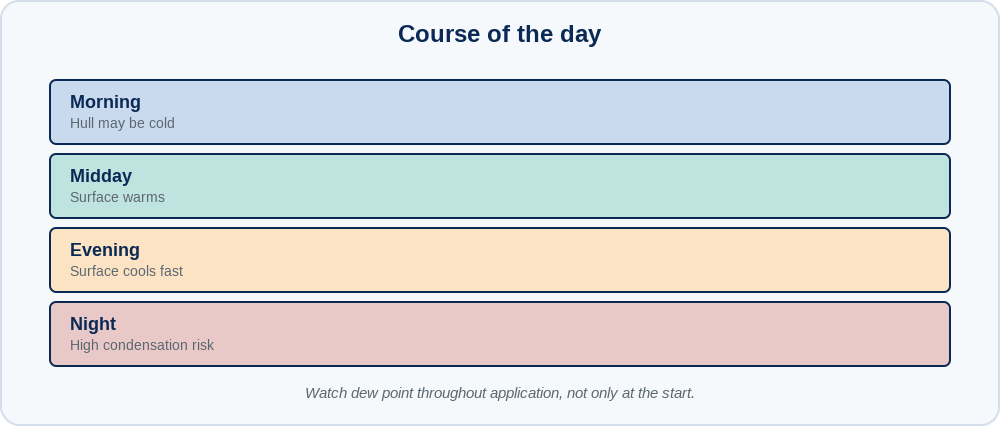
Dew point changes through the day and surface temperature changes too. Early in the morning the hull can stay cold from the night; at midday in the sun the surface warms fast; toward evening the surface cools fast and condensation risk rises. The resinous flooring technical note recommends avoiding coating during rapid temperature drops in the evening and monitoring dew point continuously throughout installation; the same logic suits boat painting. Yacht magazine reminds that material should not be left under the boat or in the car overnight, that temperatures drop rapidly after sunset and that in spring it is not uncommon for temperatures to drop below zero in the morning.
International Yacht Paint also says that as solvent evaporates from the paint it draws heat from the surface, cooling it; that is, surface temperature can also fall during application. So do the dew point check not only before starting but throughout the whole of application and drying. On large hulls one side being in shade and the other in sun makes surface temperatures differ; measure each area separately.
- Measure air temperature and relative humidity.
- Find the dew point from a table, dial or instrument.
- Measure the hull temperature in different areas.
- Verify surface − dew point is at least 3 °C.
- Compare with the margin and ranges in the data sheet.
- Re-measure at intervals throughout application and drying.
- If a rapid evening fall is expected finish early or consider postponing.
5. What if there is condensation?#
If paint is applied onto condensation adhesion weakens and it can peel later. According to Yacht magazine if condensation begins after application gloss worsens or the paint turns milky. In epoxy systems amine blush risk rises with the effect of moisture and carbon dioxide; International Yacht Paint says not to paint where paint will remain in a state of cure and be exposed to cold damp conditions and says blushing can happen when paint is applied as the temperature drops. If these signs appear see the maker’s surface cleaning and recoating instruction; in some cases washing with warm soapy water may be enough while an affected topcoat may need sanding and recoating. This is general guidance from a maker’s site; the data sheet governs for your product.
On a forum one user describes dew leaving white patches on a freshly epoxied boat left outside overnight and that he could remove them by slowly warming with a heat gun; this is one person’s experience and should not be taken as a general remedy. Another participant on the same forum writes that humidity and falling dew are different things, that working in hot humid weather is fine but a new surface should not be left outside while dew falls. This supports the idea that the problem comes from condensation more than from high humidity.
6. Common mistakes#
- Looking only at air temperature and not measuring the hull.
- Ignoring the dew point margin (≥ 3 °C).
- Applying late in the afternoon.
- Letting new paint be exposed to condensation outside overnight.
- Checking dew point only at the start.
- Taking one measurement on a hull with one side in sun and one in shade.
- Not recording measurements.
7. Checklist#
8. Conclusion#
Dew point marks the limit at which condensation begins in boat painting and the surface is asked to be at least 3 °C (5 °F) above it. Find dew point from air temperature and relative humidity with a table, dial, sling psychrometer or meter and measure hull temperature separately. Condensation may not be visible; avoid rapid evening temperature falls and leaving fresh paint outside overnight. This article is general information; your product’s data sheet and local conditions govern.
Frequently asked questions#
What is dew point?
The temperature at which water vapour in the air begins to condense; if the surface to be painted falls below it a water film forms on the surface.
Why a 3 °C margin?
Sources such as ISO 8502-4 and SSPC recommend keeping the surface at least 3 °C (5 °F) above dew point; this margin lowers the risk of condensation.
How do I find the dew point?
Measure air temperature and relative humidity and look at a dew point table or dial, use a sling psychrometer or use a meter that does the calculation itself.
Is condensation visible?
Not always. A technical note says condensation can form a microscopic water film not visible to the eye.
At what times does risk rise?
Late afternoon and night, as the surface cools fast. Maker notes advise avoiding painting during rapid temperature falls in the evening.
Was this guide helpful?
Thank you! Your feedback has been saved.
Guide content is for general information; in practice, the current technical data sheet of the product applies.
Keep reading
Related guides
Boat Colour Selection and Solar Reflectance: Effect of Heat Absorption on Surfaces
A study of the effect of boat paint colour on solar reflectance and surface temperature.
2 min read Paint and CoatingsCauses and Diagnosis of Paint Blistering
A study of the sources, types and diagnostic approach to blistering on boat paints.
2 min read Paint and CoatingsNumber of Coats in Epoxy Coating Systems
A study of the effect of the number of coats in epoxy coating systems on protective performance and thickness.
2 min read