
Paint and Coatings
Risks of Painting in Rainy and Humid Weather
Rain and humidity are the most frequent plan-breakers in boat painting. This article explains the effects of high humidity and rain on paint, the epoxy blush risk and what to do if the weather turns during application, using general sources.
Short answer
High humidity slows paint drying and condensation weakens adhesion and spoils gloss; International Yacht Paint advises not applying paint above a relative humidity of about 85 percent. In epoxy systems moisture and dew can form a waxy amine blush film; it prevents the next coat bonding and according to International can be cleaned with warm soapy water. For curing paint that has been rained on, the decision depends on how far the paint had cured, the product and the maker’s instruction; affected topcoats may need sanding and recoating. Watch the weather through preparation, application and drying. This article is general information.
Key points
- High humidity slows drying; International advises not applying paint above about 85 percent relative humidity.
- Condensation and dew can cause gloss loss, a milky look and weak adhesion.
- In epoxies moisture can form a waxy amine blush film; wash it off before further coats.
- If rain falls while paint cures the decision depends on the product and cure state; an affected topcoat may need sanding and recoating.
- Watch the forecast through the preparation, application and drying window; when uncertain postponing is generally cheaper.
1. How do humidity and rain affect paint?#
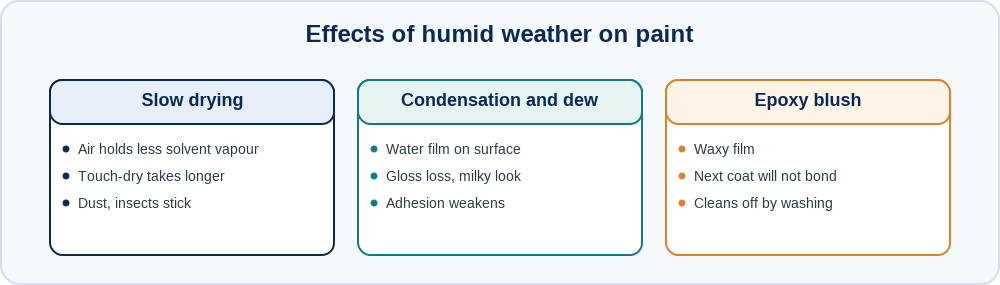
Rainy and humid weather is one of the most frequent plan-breakers in boat painting. Moisture in the air and water on the surface can affect drying, cure, appearance and adhesion. International Yacht Paint’s expert advice says that as relative humidity increases the amount of solvent vapour the air can hold falls and so the paint dries more slowly. Teknos also writes that overlooking temperature and humidity can cause costly problems such as slow drying, paint running and poor adhesion. This article is a general summary and recommends no humidity value or time for any product.
For the relation between temperature, humidity and dew point see the articles “Paint Temperature and Humidity” and “Dew Point and Boat Painting”. This article focuses on the rain and high-humidity scenario: what happens if rain falls when paint is not yet dry or the air is very humid, and what can be done.
2. Slow drying, dust and insects#
In high humidity paint stays wet or tacky for longer. During this time dust, pollen, insects and airborne particles can stick to the surface, resulting in a rough, spotted finish. International Yacht Paint says air and surface temperature affect the drying properties of any paint and that not following recommended drying times can result in coating failure including improper drying, wrinkling and loss of adhesion. The same source says overcoating too early can cause wrinkling, blistering and loss of gloss. Because drying times lengthen in humid weather, do not try to shorten overcoat and sanding intervals; keep to the intervals the data sheet gives for humidity and temperature.
TotalBoat’s support note says it is best to begin painting in the morning on a clear, dry day when there is no danger of morning dew settling on the surface, that windy conditions and direct sunlight should be avoided and that air, surface and paint temperature should match the manufacturer’s specification. That is a retailer/manufacturer support note; it can be taken as a general application principle.
| Risk | Cause | Result |
|---|---|---|
| Slow drying | Less solvent vapour evaporates | Dust and insects stick; long wet period |
| Condensation | Surface below dew point | Weak adhesion, gloss loss, milky look |
| Dew falling | Cold surface at night and morning | Marks on fresh paint |
| Amine blush | Epoxy, moisture and cold | Waxy film; next coat will not bond |
| Rain drops | Water on wet paint | Marks, bubbles, surface defects |
3. Epoxy amine blush and moisture#
In epoxy systems the best-known result of moisture is amine blush. According to International Yacht Paint’s expert advice amine blush is a waxy by-product that appears as epoxy cures; a solvent-free epoxy resin releases a wax-like film to the surface during cure, its appearance depends on the moisture in the air during cure and it is not always visible. Blush can keep subsequent products from fully curing or performing correctly or cause yellowing; unless cleaned properly the problem may go unnoticed for a long time. The same source says the best way to reduce blushing is to work in warm temperatures (the epoxy sets up fast, shortening the blush window) and with humidity at low levels. Another International page writes that bloom or blush is easily removed with warm soapy water and the cured epoxy underneath is unaffected, while topcoat paints affected by moisture will require sanding and recoating.
On the CLC Boats forum one user describes rain coming just after a boat was freshly epoxied and a blush-like appearance forming; another member writes that amine blush is normal for most epoxies and can be unrelated to rain, usually washed off with water and a scouring pad. These are user comments and can vary by product and system; there is disagreement among sources on the cause of blush. Practical result: if after epoxy there is a waxy or cloudy look on the surface, wash and sand it as the maker advises before the next coat.
4. Dew and condensation#
High humidity and falling dew are not the same. A moderator on the CLC Boats forum says the distinction between “humidity” and “falling dew” matters, that heat and humidity are fine for boatbuilding and that the trouble came from dew settling on epoxy in the midst of curing. International Yacht Paint also advises that condensation should not form during application and drying and not to paint where paint will remain in a state of cure and be exposed to cold damp conditions. So painting late in the evening and leaving the new surface outside overnight can be especially risky.
Yacht magazine writes that if condensation begins after application gloss can worsen or the paint can look milky. So the decision to paint in humid weather depends not only on relative humidity but also on surface temperature and the night-time fall. Verify the surface is at least 3 °C above dew point; see the dew point article for detail.
5. What to do if rain falls#
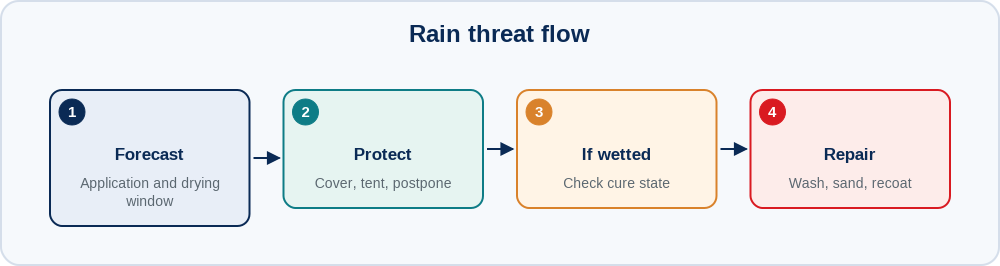
There is no firm recipe; if rain falls the decision depends on how far the paint had cured, the product and the severity of the rain. One forum participant suggests, if rain touches a newly applied coat, blowing the water off with a leaf blower and in the worst case sanding and applying another coat; that is a single view and may not suit your product. The general logic is: if rain has touched a drying film, inspect the surface once it is dry; if there are marks, blush or blistering clean, sand and recoat according to the maker’s advice. International Yacht Paint says topcoats affected by moisture will require sanding and recoating.
As a precaution do not start painting on days when rain is expected; follow the forecast through the preparation, application and drying stages. If needed paint under a tent, tarp or cover; for those methods see the article “Tent and Protection Arrangement for Outdoor Boat Painting”. On painting day check the data sheet for the product’s “rain resistance time”; this varies by product and temperature and no value is given in this article.
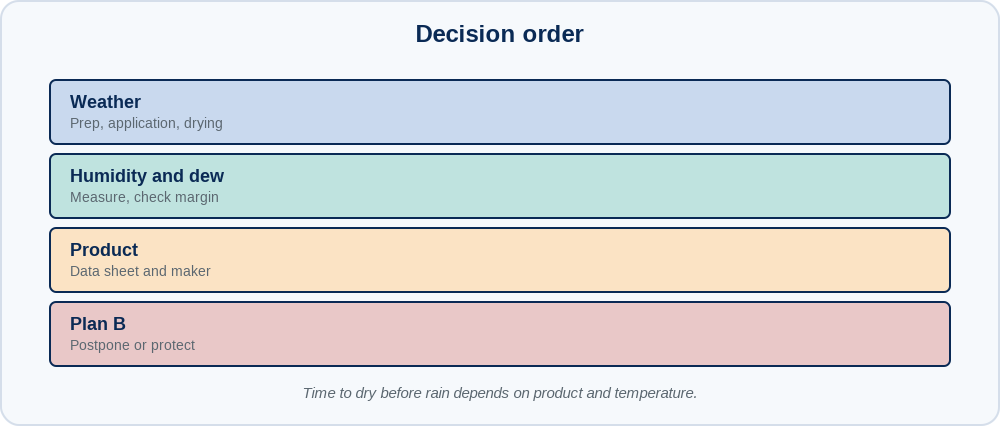
- Check the forecast through preparation, application and drying.
- Measure air and surface temperature, relative humidity and dew point.
- If rain is expected consider postponing or covering the structure.
- Will the paint dry enough before rain? See the data sheet.
- If wetted inspect the surface once dry.
- If there is blush or marks clean; sand and recoat if needed.
- Record the conditions and what was done.
6. Common mistakes#
- Starting to paint without checking the forecast.
- Rushing in high humidity and cutting drying times.
- Leaving new paint outside overnight.
- Going on to the next coat without washing epoxy blush.
- Not measuring temperature and dew point.
- Spoiling the paint in a panic when rain arrives (wiping, brushing).
- Not recording conditions.
7. Checklist#
8. Conclusion#
Rain and high humidity can spoil paint drying, gloss and adhesion; in epoxies moisture raises the amine blush risk. International advises not applying paint above about 85 percent relative humidity; topcoats affected by moisture may need sanding and recoating. Follow the weather from preparation to drying and, if uncertain, postpone or cover the structure. This article is general information; the product data sheet and maker’s instruction govern.
Frequently asked questions#
Can I paint in humid weather?
Within data-sheet limits it may be possible; but International advises not applying paint above about 85 percent relative humidity. Some forum users describe successful work in hot humid weather but those are single experiences.
What is epoxy blush?
A waxy film that comes to the surface as epoxy cures; per International it can stop later products curing fully. Moisture and low temperature raise the risk.
How is blush cleaned?
Per International blush is easily removed with warm soapy water and the cured epoxy underneath is unaffected; topcoats affected by moisture will need sanding and recoating.
What should I do if rain hits fresh paint?
It depends on cure state and product. Ask the maker or see the data sheet; once dry inspect the surface, clean any blush or marks and sand and recoat if needed.
Are dew and humidity the same thing?
No. A moderator on the CLC Boats forum says high humidity and falling dew differ and that problems mostly come from dew settling on the surface. Even so the exact limit is in the product data sheet.
Was this guide helpful?
Thank you! Your feedback has been saved.
Guide content is for general information; in practice, the current technical data sheet of the product applies.
Keep reading
Related guides
Boat Colour Selection and Solar Reflectance: Effect of Heat Absorption on Surfaces
A study of the effect of boat paint colour on solar reflectance and surface temperature.
2 min read Paint and CoatingsCauses and Diagnosis of Paint Blistering
A study of the sources, types and diagnostic approach to blistering on boat paints.
2 min read Paint and CoatingsNumber of Coats in Epoxy Coating Systems
A study of the effect of the number of coats in epoxy coating systems on protective performance and thickness.
2 min read