
Paint and Coatings
Pot Life and Working Time Management in Paint
The moment two-component paint is mixed the clock starts. This article explains the pot-life concept, how it varies with temperature and how to manage it in application, with examples from maker documents and general sources.
Short answer
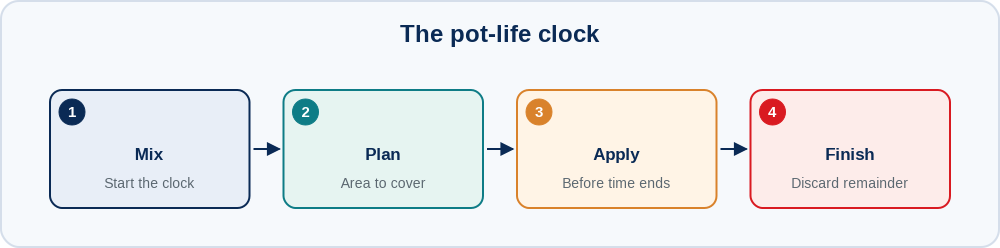
Pot life is the maximum time a two-component coating stays suitable for application under stated conditions after mixing; once it has expired the material must not be used even if it still looks usable. Hempel says that in chemically curing two-component paints (epoxy, polyurethane) pot life shortens as paint temperature rises, and by a rule of thumb is reduced by about half for each 10 °C increase. Maker data sheets confirm this: for example for one polyurethane finish a 2-hour pot life at 25 °C can fall to 45 minutes at 40 °C. Start the clock at mixing, plan the area to cover in advance and in hot weather keep the paint cool and work in small batches. This article is general information.
Key points
- Pot life is the time the mix stays applicable; it changes markedly with temperature.
- Per Hempel’s rule of thumb pot life roughly halves for each 10 °C rise in paint temperature.
- When time is up the material must not be used even if it looks usable; the end may not be visible.
- In hot weather store paint cool, mix small batches and use a cooling tub if needed.
- Read the data sheet time for your mix temperature; start the clock when you mix.
1. What is pot life?#
Two-component coatings, meaning most epoxies and polyurethanes, start to cure the moment base and hardener are mixed. The time the mix stays applicable is called pot life or working time. According to an industry note pot life is the maximum period during which the coating remains suitable for application under the specified conditions and once it has expired the material must not be used even if it still appears usable. This is because the mix viscosity rises, flow worsens and the applied film spreads poorly; in addition as the reaction advances adhesion and film properties can also suffer.
This article gives a general summary and recommends no time for any product. Always read pot-life values from the product’s technical data sheet, in the row that matches your mix temperature. For mix ratio and induction see the related articles.
2. How does temperature change pot life?#
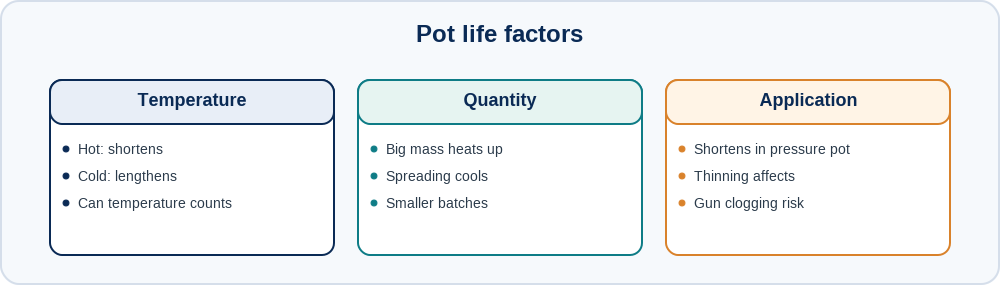
Hempel’s guide on application in hot climates says chemically curing two-component paints (epoxies, polyurethanes) show reduced pot life as paint temperature increases and gives a simple rule of thumb: pot life is reduced by 50 percent for each 10 °C (18 °F) increase in paint temperature. The same guide says storing the material in a cooled location until use reduces this issue. This is a rule, not an exact formula; the curve varies by product and the maker’s table governs.
Maker data sheets show the curve. For example in the data sheet of an International Yacht Paint polyurethane undercoat pot life falls from 5 hours to 1 hour with temperature; for other products in sources similar tables show time shortening as temperature rises. A Sika document for a water-based two-component polyurethane topcoat gives 50 minutes at 10 °C, 30 at 20 °C and 20 at 30 °C and further warns that the end of pot life is not visible, so attention must be paid to the time. In a document for an acrylic polyurethane finish the time is given as 2 hours at 25 °C and 45 minutes at 40 °C. These are examples from maker documents; your product may differ.
| Product type (example) | Cool | Hot |
|---|---|---|
| Polyurethane undercoat (International data sheet) | 5 hours (low temperature) | 1 hour (around 35 °C) |
| Water-based two-component PU (Sika) | 50 min (10 °C) | 20 min (30 °C) |
| Acrylic polyurethane finish (maker document) | Hours (low temperature) | 45 min (40 °C) |
| High-solids systems (Sigma document) | 7 hours (10 °C) | 3 hours (30 °C) |
3. What happens when time is up?#
When pot life ends the mix begins to gel in the pot. It may still look liquid; but viscosity has risen, flow and spread are impaired and the reaction has advanced. Applying then can lead to problems such as orange peel, poor adhesion, gloss loss and failure to cure properly. An industry note also says that when time is exceeded the material should not be used even if it looks usable. Adding solvent to extend the time is no solution either; solvent lowers viscosity temporarily but does not stop the reaction and the product may lose coating properties.
The warning in Sika’s document matters: the end of pot life may not be visible. So the decision must rest on the clock, not on the question “is it still flowing”. Start a timer when you mix and plan to finish application before time runs out. Discard leftover mix if the time has been exceeded; make a fresh mix for the next job.
4. Managing pot life in hot weather#
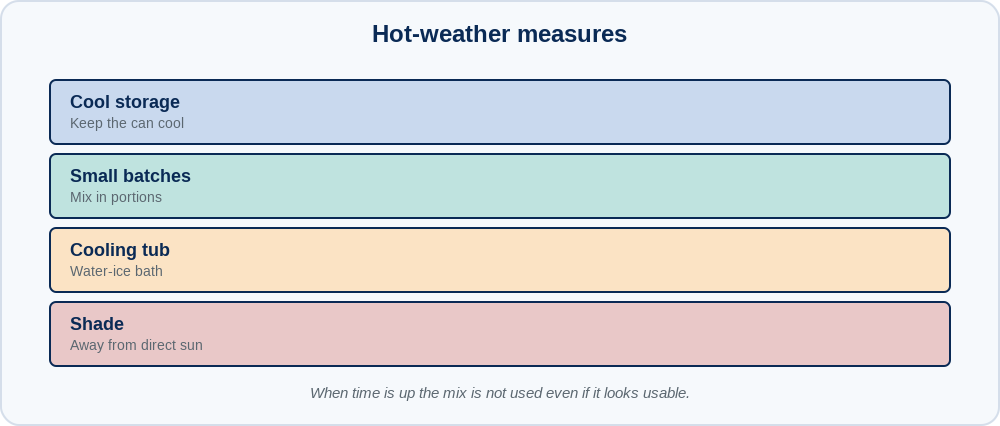
Hempel’s hot-climate guide lists several measures: storing material in a cool place until use, cooling the paint container during application (for example keeping it inside a big container of water and ice) and other arrangements that reduce the effect of heat. The same guide says orange peel, sagging and a short overcoating interval also increase in heat. The yacht paint maker Epifanes says pot life will be shortened in a pressure container due to temperature rise inside the container; that is, closed pressure systems can worsen both heat and time.
In practice working in small batches is among the most effective methods. A big mass cannot give off the heat of reaction and so heats up inside, shortening pot life further; paint spread as a thin layer gives off heat easily. So if you cannot finish a mix in one go, it is safer to mix half, apply and then prepare the second part. Avoiding direct sun and keeping the can in the shade and cool also help.
- Read the pot life for your mix temperature from the data sheet.
- Divide the area into sections according to the time.
- Store paint cool; use a cooling tub in heat.
- Start a timer the moment you mix.
- Mix in small batches.
- Finish before time is up; discard leftover mix.
- Do not try to extend the time by adding solvent.
5. Plan and records#
A good application plan accounts for pot life. Divide the hull into sections according to the mix quantity and time you can use; assign a team member to each section; have one person mix while another applies. As air temperature rises make sections smaller. Note the clock, temperature and quantity for each mix. These records help find the cause if defects appear later. In multi-coat systems remember each coat has separate times and overcoating intervals; see the data sheet for detail.
Application method also affects time. In spraying, thinning and pressure-pot use can shorten time; in brush and roller application, because the pot is open and the paint a thin layer, the mix can thicken quickly in hot weather. To avoid gun and hose clogging make sure equipment is cleaned before time runs out; follow the cleaning instruction in the product’s data sheet.
6. Common mistakes#
- Not starting the clock at mixing.
- Mixing a big batch at once and overrunning the time.
- Trusting data sheet time without considering mix temperature.
- Reducing an expired thickening mix with solvent and using it.
- Leaving the can in the sun in heat.
- Forgetting the time shortening in a pressure pot.
- Not cleaning equipment before time is up.
7. Checklist#
8. Conclusion#
Pot life is the time two-component paint stays applicable after mixing and it shortens markedly with temperature; Hempel’s rule of thumb is that it roughly halves for each 10 °C rise. When time is up the mix must not be used even if it looks usable and the end may not be visible. Start the clock at mixing, read the data sheet for your mix temperature, keep paint cool in heat and work in small batches. This article is general information; the maker’s data sheet for your product governs.
Frequently asked questions#
Are pot life and drying time the same?
No. Pot life is the time the mix stays applicable in the pot; drying and cure times are the hardening times of the applied film.
How much does pot life shorten in heat?
Hempel’s rule of thumb is that it roughly halves for each 10 °C rise in paint temperature; for exact values see the product’s data sheet.
Can I use the mix after time is up if it still looks fine?
No. After the time has expired the mix must not be used. A Sika product document also warns that the end of pot life may not be visible.
How do I extend pot life?
Storing paint cool, mixing small batches and using a cooling tub are among the measures in Hempel’s hot-climate guide. Do not try to extend it by adding solvent.
Does pot life change in a pressure pot?
Yes. A yacht paint maker says pot life will be shortened in a pressure container due to the temperature rise inside the container.
Was this guide helpful?
Thank you! Your feedback has been saved.
Guide content is for general information; in practice, the current technical data sheet of the product applies.
Keep reading
Related guides
Boat Colour Selection and Solar Reflectance: Effect of Heat Absorption on Surfaces
A study of the effect of boat paint colour on solar reflectance and surface temperature.
2 min read Paint and CoatingsCauses and Diagnosis of Paint Blistering
A study of the sources, types and diagnostic approach to blistering on boat paints.
2 min read Paint and CoatingsNumber of Coats in Epoxy Coating Systems
A study of the effect of the number of coats in epoxy coating systems on protective performance and thickness.
2 min read