
Paint and Coatings
Differences Between a Polyurethane Topcoat and Gelcoat
People renewing a boat’s exterior often face the same question: polish and protect the gelcoat, or have it painted with polyurethane? This article compares the structure, strengths, weaknesses and decision criteria of the two systems, based on sources.
Short answer
Gelcoat is the outer resin layer of a fibreglass hull applied in the mould; a polyurethane topcoat is a separate paint film applied over it. Sources say two-part polyurethanes generally stand out in hardness, gloss and abrasion resistance, some being harder than the gelcoat they cover, while gelcoat can turn porous over time. Paint costs more and is prep-intensive; gelcoat polishing is cheaper but limited if oxidation has advanced. The decision depends on current condition, budget and expectations; the data sheet and expert opinion come first.
Key points
- Gelcoat is the resin layer that is part of the hull; a polyurethane topcoat is a separate film applied over it.
- Two-part polyurethanes generally stand out in hardness, gloss and abrasion resistance; per sources some can be harder than gelcoat.
- Gelcoat can turn porous over time; polishing can remove oxidation but has limits.
- Paint costs more and is prep-intensive; wrong prep and incompatible systems cause trouble.
- For light oxidation consider polish, for widespread decline paint; decide with expert assessment.
1. Two different things: structure and role#
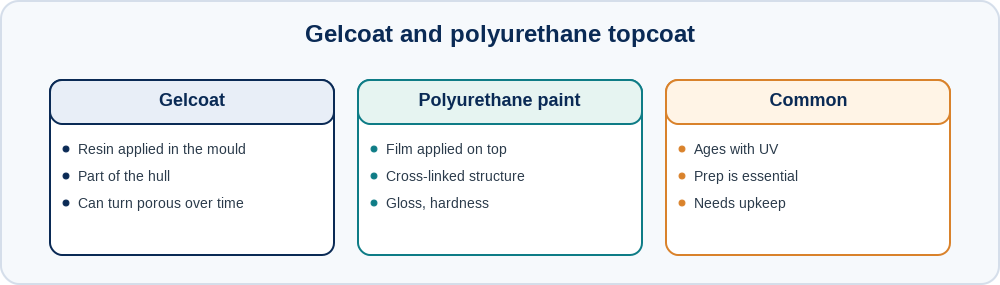
Gelcoat is the usually pigmented resin layer that forms the exterior of a fibreglass boat and is applied as the first coat in the mould; that is, it is part of the hull. A polyurethane topcoat is a separate protective and decorative paint film applied later over the hull. A boating magazine piece explains that gelcoat polymers are a catalysed layer that will become more porous over time, whereas a two-part polyurethane system lays down a tight layer of cross-linked polyurethane giving deep shine and long-lasting gloss. That account reflects the product and author view but sums up the basic difference between the two systems well.
The importance of this difference: when gelcoat ages (oxidation, cracks, dullness) you can largely restore it by polishing; when a painted surface ages compounding is usually limited, because a paint film is not as thick a material as gelcoat. So rather than “which is better?”, the more accurate question is “which suits this boat’s present condition and my expectations?”.
2. Hardness, gloss and abrasion resistance#
A boating site writes that two-part polyurethane marine paints tend to have considerably greater scuff resistance than any single-part paint, while some such as Awlgrip or Imron are harder than the gelcoat to which they are applied. A retailer guide says that under ideal application conditions (proper primer, correct mixing ratio, suitable temperature and humidity, spray application) a two-part polyurethane topside gives a finish noticeably harder, glossier and longer-lasting than the best one-part system. A paint maker also says two-part products have better properties in gloss, colour retention, hardness, longevity, chemical and abrasion resistance and overall film integrity; that is a maker claim.
Even so a two-part paint is not scuff-proof: an official of a paint maker says two-part paints such as Perfection offer excellent resistance to abrasion but can still wear through in excessive circumstances, while one-part systems are easier to touch up than high-performance two-part systems and may be more suitable for such areas. An independent magazine test reports that one-part products stole the show on ease of application but the highest marks for gloss, hardness and durability went to two-part polyurethane coatings.
| Feature | Gelcoat | Polyurethane topcoat |
|---|---|---|
| Position | Part of the hull (in the mould) | Separate film applied on top |
| Hardness | Gelcoat resin | Some two-part paints can be harder than gelcoat (per a source) |
| Ageing | Oxidation, porosity | Loss of gloss with UV; product dependent |
| Repair | Recovery with compound and polish | Touch-up; one-part easy, two-part harder |
| Cost, effort | Polish low | Paint high, prep intensive |
3. Cost, effort and risk#
A round-up site says one-part polyurethanes are easier and more forgiving for DIY, while two-part systems need precise mixing and careful application and are generally more toxic, especially when sprayed. A retailer guide also says two-part polyurethanes demand more surface preparation and priming. A support article says two-part polyurethanes can cost two to four times more per square foot than one-part; that is a seller statement and varies by product. So the decision to paint involves prep labour and application risk more than product price.
On risk the key issue is compatibility: a retailer guide says not to paint two-part over old alkyd enamel or one-part polyurethane, because aggressive solvents can soften and lift the old film. If you do not know the type of the existing system get a painter’s view; this is also covered in our 1K versus 2K comparison.
4. When polish, when paint?#
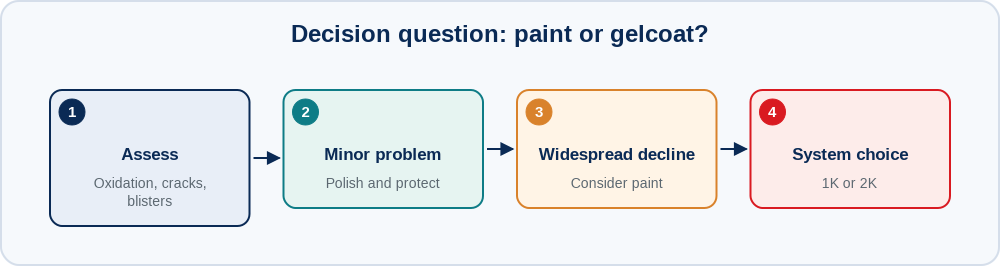
According to sources, for light oxidation and dullness polishing is often enough; unless gelcoat is completely worn it can largely be restored. If there are widespread cracks, deep wear, dullness that will not return, a wish for a colour change or earlier poor repairs, paint comes into play. When choosing paint ask: Is the problem superficial or structural? Does my budget cover both paint and prep? Can I keep up the upkeep schedule? For gelcoat issues see our polishing articles, and for moisture and blistering the related diagnosis articles.
A round-up piece says a DIY topside job can last one to five years depending on the paint and where the boat lives; for a professionally sprayed two-part system a retailer guide says gloss can be kept for many years. These are estimates tied to climate, upkeep and application quality; yours may differ.
- Establish the surface condition: oxidation, cracks, blisters, old paint.
- For light problems try polish and protection first.
- If considering paint find out the type of the existing system.
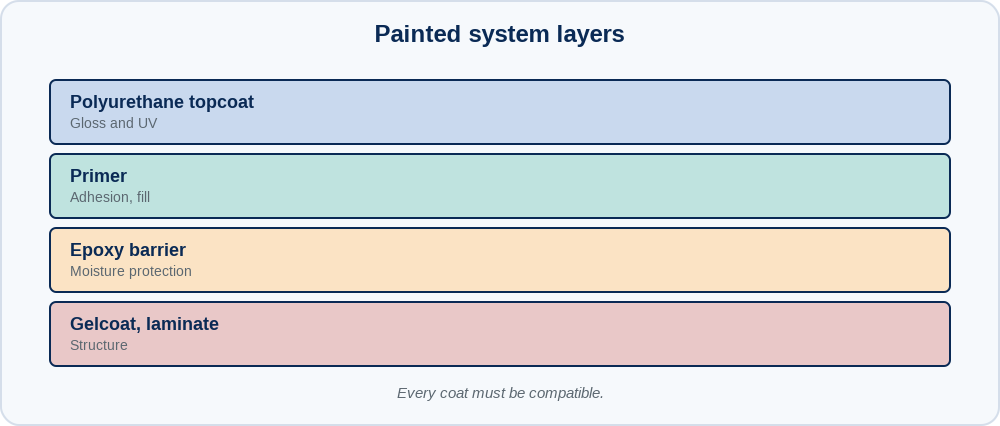
- Decide 1K or 2K; choose a compatible primer and barrier.
- Count prep, application and upkeep cost together.
- Proceed per the data sheet and expert opinion.
4b. Questions to ask the contractor#
If you decide to paint, when getting quotes ask these in writing: Which primer and barrier system will be used and why? How was the existing film type determined? How will application temperature and humidity be controlled? Which product in which coat, how many coats, and what are the drying times? What are the warranty and upkeep recommendations? A contractor who cannot answer clearly may be leaving the risk of the job with you. For gelcoat polishing ask what abrasive level will be used and how much material will be removed.
Also ask to see samples of finished work and, if possible, an example a year or two after application: ageing, not fresh gloss, shows the quality of prep and system. Compare offers not just on price but on the composition of the system and the amount of prep, since a cheap offer often means reduced prep.
5. Common misconceptions#
- Thinking paint fully replaces gelcoat.
- Thinking two-part paint is scuff-proof.
- Applying two-part paint without knowing the old film type.
- Neglecting prep.
- Assuming covering gelcoat problems with paint is permanent.
- Counting cost as only the paint price.
6. Checklist#
7. Conclusion#
Gelcoat is part of the hull and can be recovered by polishing; a polyurethane topcoat is a system applied on top that, when two-part, is generally harder and glossier but costlier and prep-intensive. The decision depends on your situation, budget and upkeep expectation. This article is general information; the data sheet and expert opinion come first.
Frequently asked questions#
Are gelcoat and polyurethane paint the same?
No; gelcoat is the resin layer of the hull applied in the mould, polyurethane paint is a separate film applied on top.
Is polyurethane harder than gelcoat?
One source says some two-part paints (such as Awlgrip or Imron) can be harder than the gelcoat they are applied to; it depends on the product.
Which lasts longer?
One source says a complete refit with top-quality two-part paint can look good for ten years or more; this is an estimate and depends on use and upkeep.
What is done before painting gelcoat?
The surface is cleaned, repairs made and prep suited to the paint system applied; the data sheet and painter come first.
Can paint be turned back to gelcoat?
Practically hard; rather than returning a painted surface to gelcoat the paint is renewed. Ask an expert.
Was this guide helpful?
Thank you! Your feedback has been saved.
Guide content is for general information; in practice, the current technical data sheet of the product applies.
Keep reading
Related guides
Boat Colour Selection and Solar Reflectance: Effect of Heat Absorption on Surfaces
A study of the effect of boat paint colour on solar reflectance and surface temperature.
2 min read Paint and CoatingsCauses and Diagnosis of Paint Blistering
A study of the sources, types and diagnostic approach to blistering on boat paints.
2 min read Paint and CoatingsNumber of Coats in Epoxy Coating Systems
A study of the effect of the number of coats in epoxy coating systems on protective performance and thickness.
2 min read