
Refit and Maintenance
Drinking-Water Tank Epoxy Lining: Selection, Stripe Coat, Cure and Disinfection
Epoxy lining a drinking-water tank is not just choosing a paint; it is applying a certified system to a correctly prepared surface in line with the maker’s document, then curing, flushing and checking before service. This article summarises source accounts; it is not application instruction.
Short answer
Sources describe drinking-water-suitable epoxy linings as documented by approvals such as NSF/ANSI 61 (and 600 for extraction) or, in the UK, WRAS/BS 6920, say a certification listing can state a maximum dry film thickness and that coat count and thickness vary with substrate and application. Coating makers write that a stripe coat is applied to sharp edges, welds and corners and that overcoat interval and cure depend on temperature and humidity. This article recommends no product, thickness, time or dose; the maker’s technical data sheet, survey and a qualified applicator govern.
Key points
- Drinking-water epoxy must be certified; a certificate belongs to a specific formulation and may carry a maximum thickness.
- A stripe coat is described as reaching required thickness on welds, edges and corners.
- Coat count, overcoat interval and cure follow the maker’s technical data sheet.
- Flushing and disinfection after cure are separate steps; dose and time vary between sources.
- Acceptance checks such as thickness measurement and holiday (pinhole) testing are recorded.
1. Choosing a lining: the documents lead#
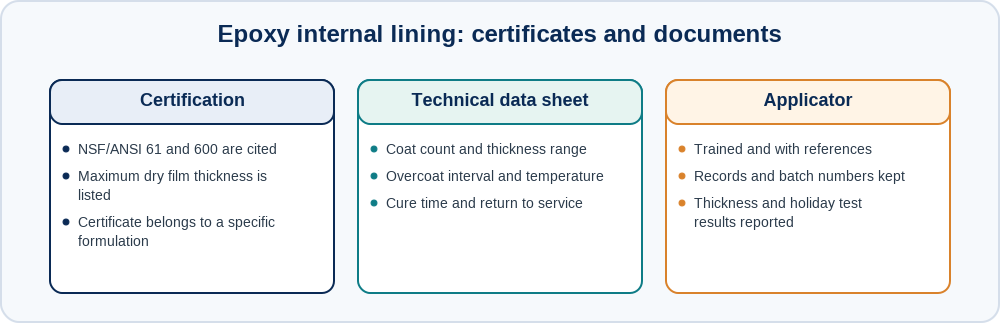
In drinking-water tank lining the first question is not “which paint?” but “which document?”. Sources cite NSF/ANSI 61 and, for extraction requirements, NSF/ANSI 600 for the US, WRAS approval and BS 6920 for the UK; other countries may have different rules. A coating maker’s potable-water product page says the certification listing states a maximum allowable dry film thickness and that coat count and thickness vary with substrate, application method and exposure. This article is a general summary of source accounts; it recommends no product, thickness, time or dose. Maker and seller statements are labelled and need independent verification.
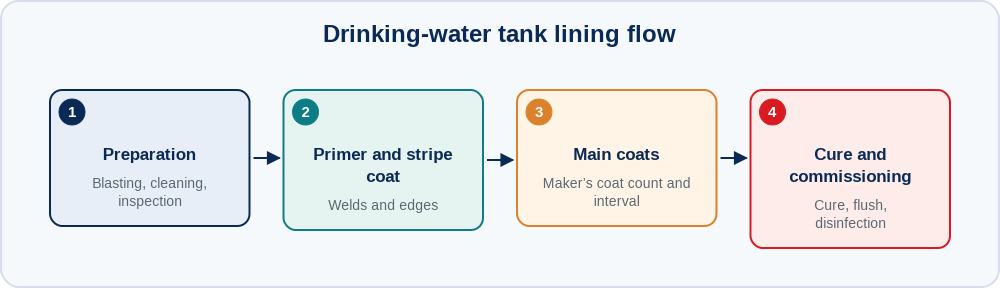
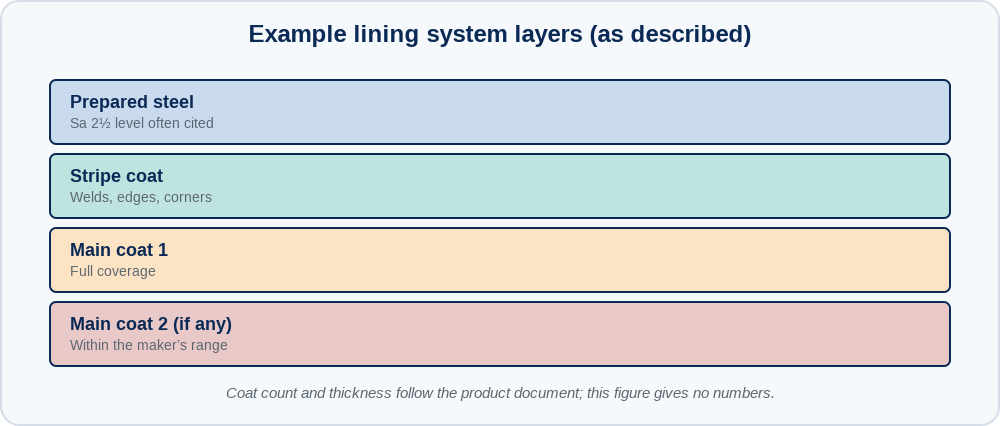
The certificate’s scope should be read carefully. A certificate generally applies to a specific formulation and application condition, and may not cover the whole product family. Rather than assuming a product certified for municipal tanks is also suited to a yacht tank, small volume, tight access and difficult cure conditions should be discussed with the maker and a qualified applicator. One industrial example describes a zinc-rich primer, a brush-applied stripe coat and a ceramic epoxy topcoat, each certified; that is a water-tank example and not a template for yacht tanks.
| Document | What it describes | Why it matters |
|---|---|---|
| Certification listing | NSF/ANSI 61/600 or WRAS approval; maximum thickness | Drinking-water suitability and limit |
| Technical data sheet | Coat count, thickness range, overcoat interval, cure | Application and acceptance criteria |
| Safety data sheet | Solvent, respiratory and skin risks | Confined-space and protection plan |
2. Surface and stripe coat#
Surface preparation before lining is covered in a separate article: blast grade, profile, salt and dust checks are described as the items that decide lining life. The point stressed here is that a lining system cannot be better than the quality of the prepared surface. Coating makers’ presentations say a stripe coat is applied to plate edges, welds, pipes, ladders and awkward access areas to reach the required thickness. On sharp edges and weld profiles liquid coating pulls back by surface tension and ends thin, which is why the stripe coat is seen as critical. Whether it goes before or after the main coats and at what interval depends on the maker’s document.
Application conditions are also described: sources note that humidity and dew-point limits (for example the relative humidity and above-dew-point temperature conditions in the ship ballast-tank standard) matter during coating as much as in surface preparation. Air movement and dehumidification inside the tank are tools often described by equipment suppliers and coating makers. Their suitability for a yacht tank and the limit values are in the maker’s document; this article gives no values.
3. Main coats, thickness and overcoat interval#
Sources say typical internal lining systems can be two or three coats, but coat count follows the maker’s system. Overcoat interval and temperature limits are critical for most epoxies: if the interval is exceeded the surface may need preparing for the next coat to adhere, and if coated too early solvent may be trapped. This is in the maker’s data sheet and this article gives no time. Thickness is measured after each coat; wet film and dry film measurements are different things and the dry film must not exceed the maximum in the certification listing.
The application method (brush, roller, airless spray) is stated in the maker’s document. Brush and roller are described for small tanks and spray for larger surfaces; spraying in a confined space adds solvent-vapour and ventilation risk. Mix ratio and pot life are decisive in two-component epoxies; a wrong ratio can affect cure and drinking-water suitability. Mixing is therefore done to the maker’s instruction and recorded.
4. Cure, flushing and disinfection#
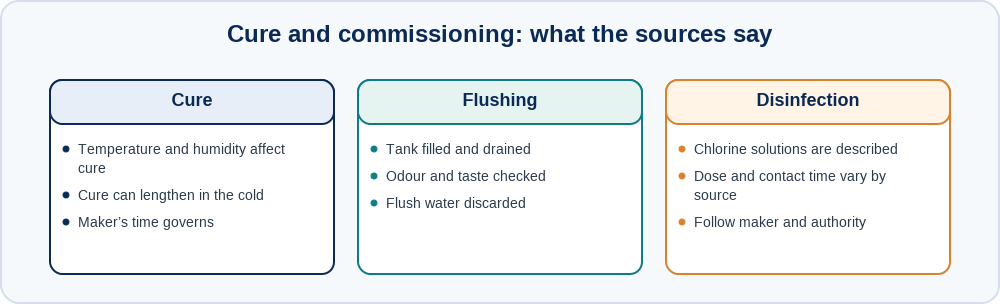
Cure is the chemical completion of the lining. Sources say cure depends on temperature and humidity, can lengthen in the cold and that an under-cured lining may impart odour and taste to water. In one sailing publication’s example the water from epoxy-coated tanks always tasted of plastic; that is a user experience and the cause is not certain, but it suggests the importance of adequate cure and flushing. Cure time and return-to-service conditions belong to the maker’s document.
Before service, filling and draining the tank (flushing) and checking odour and taste are commonly described. For disinfection sources cite chlorine solutions, hydrogen peroxide and standardised shock-and-rinse procedures (such as ANSI A119.2); dose and contact time vary between sources and this article gives no dose. The effect of chlorine on some materials such as aluminium is debated, but for an epoxy-lined steel tank the maker’s and the relevant authority’s instruction governs. Safe disposal of the disinfection water is also subject to environmental rules.
5. Acceptance: thickness and holiday testing#
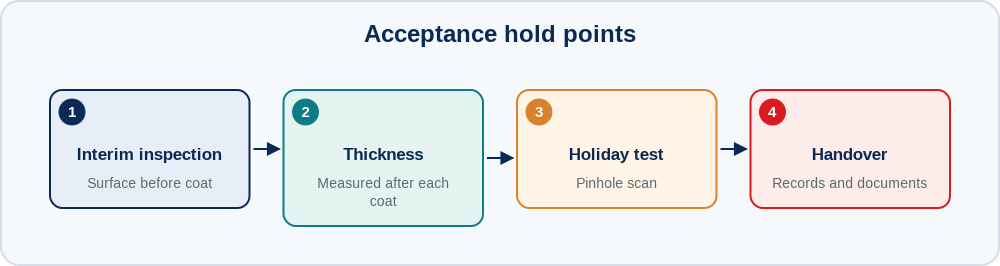
After coating, acceptance checks are made: visual inspection (runs, blisters, missed areas), dry film thickness measurement and a holiday (pinhole) scan. Holiday testing finds fine holes in the lining; low-voltage wet-sponge or high-voltage spark methods are described and which suits depends on coating thickness and the maker. This article recommends no voltage or method. Defects found are marked and repaired per the maker’s repair instruction and retested; all results are recorded.
The importance of records is stressed again: product batch numbers, mixing and application dates, ambient conditions, thickness readings, holiday results and repairs are kept. These records may be needed for warranty, future inspection and demonstrating drinking-water suitability. Sources also say lining life depends on operation and maintenance; an annual inspection and cleaning plan should be made.
The maintenance and repair plan is also part of the lining decision. Sources say lining life depends not only on the product but on application quality, operating conditions and inspection frequency. If blistering, peeling, discolouration or a change in the odour and taste of the water is seen, draining and inspecting the tank is a commonly described approach. Small damage is said to be repairable locally to the maker’s repair instruction, while widespread damage may need the surface re-prepared and recoated; a survey and the maker decide which applies. If a lining warranty exists, its conditions (applicator competence, records, inspection) should be read carefully, and differences between seller statements and the warranty document should be clarified in writing. This article gives no information on warranty length or scope, and each boat needs its own assessment.
6. A practical frame#
- Obtain the drinking-water certification, maximum thickness and technical data sheet from the maker in writing.
- Record the surface-preparation acceptance (grade, profile, salts, dust).
- Plan stripe-coat timing and locations per the maker’s document.
- Record mixing, overcoat interval, ambient conditions and thickness for every coat.
- Have the holiday scan and repairs done by a method suited to the maker.
- Have cure, flushing and disinfection done per the maker’s and the authority’s instruction; check odour and taste.
- Take delivery of all documents and records; plan an annual inspection.
5. Limits#
Sources overlap that drinking-water epoxy should be certified, that a stripe coat is applied to reach thickness at critical places, that cure depends on temperature and that acceptance includes thickness and holiday testing. Coat count, thickness, overcoat interval, cure time and disinfection dose vary between sources and products. So there is no single right answer; the maker’s document, a survey and a qualified applicator govern. This article is not engineering, application or drinking-water-safety advice.
5b. Where sources differ#
One maker describes a two-coat system while another may suggest a different coat count and interval; one publication describes chlorine disinfection while another cites peroxide; one user thinks taste is about cure, another ties it to product choice. These are sources speaking in different contexts and with different interests. The difference means applying to the maker’s document and a qualified applicator for your own tank.
This article is general information; it recommends no product, method, ratio, number of coats or time. The maker’s data sheet and a qualified yard govern.
5c. A practical frame for reading the sources#
The sources are magazines, makers, sellers and forums; each writes in its own context. None knows the lining product, thickness, cure time or disinfection dose of your boat. So taking the shared message and consulting the maker and a qualified yard for detail is reasonable.
Applying epoxy inside a tank carries confined-space, solvent-vapour, skin and respiratory irritation and fire risk. This article describes no protection, ventilation or gas-testing method. Read the safety data sheets, follow confined-space rules and consult a qualified specialist; do not work alone. For critical matters such as drinking-water safety the opinion of a qualified specialist governs.
Seller and maker statements are the firm’s own account of its product and have not been independently verified. A product’s compatibility with another coating should always be checked in the product’s technical document; where a document and a guide conflict, the maker’s document and a qualified yard’s assessment should be used. Recording decisions and product details helps later maintenance.
6. Common mistakes#
- Using an uncertified epoxy in a drinking-water tank.
- Exceeding the maximum thickness in the certification.
- Skipping the stripe coat or leaving edges thin.
- Ignoring overcoat interval and temperature limits.
- Short cure and filling the tank early.
- Choosing disinfection dose and rinse at random.
- Not recording thickness and holiday results.
7. Checklist#
8. Conclusion#
Epoxy lining of drinking-water tanks is described in sources as documents and certification, stripe coat, main coats, cure-flush-disinfection and acceptance checks. This article is general information; it is not application, engineering or drinking-water-safety advice and recommends no product, thickness, time or dose.
Frequently asked questions#
Is any epoxy suitable for a drinking-water tank?
No; sources describe the need for a certified drinking-water system. A certificate belongs to a specific formulation and the document should be verified with the maker.
What is a stripe coat?
An additional brush-applied coat on welds, edges and corners where reaching the required thickness is hard; the maker’s document says when and how.
How many coats?
Coat count and thickness vary with product and application; consult the maker’s data sheet and the maximum thickness in the certification.
How long is the cure?
This article gives no time; sources say cure depends on temperature and humidity, and the maker’s time governs.
Why a holiday test?
It is described as an acceptance check to find invisible pinholes in the lining; consult the maker and the relevant standard for method and voltage.
Was this guide helpful?
Thank you! Your feedback has been saved.
Guide content is for general information; in practice, the current technical data sheet of the product applies.
Keep reading
Related guides
Steel Yacht Freshwater Tanks: Design, Material and Internal Lining Guide
The material, design and drinking-water-suitable internal lining of a steel boat’s freshwater tank, summarised from organisation, magazine and maker accounts with their limits.
14 min read Refit and MaintenanceBlasting Inside Tanks: Surface Preparation Standards and Good Practice
How blasting is described for the interior surface preparation of steel tanks: Sa grades, profile, salt and humidity limits and confined-space safety, summarised from standards and maker accounts.
14 min read Refit and MaintenanceGrey Water, Black Water and Shower Tanks: Corrosion, Lining and Design
Why grey, black and shower tanks on steel boats corrode, what an internal lining does and design details, summarised from source accounts.
11 min read