
Refit and Maintenance
Blasting Inside Tanks: Surface Preparation Standards and Good Practice
The life of a coating inside a tank is described as depending largely on the surface beneath it: clean metal, the right profile, no salts and no dust. This article summarises blasting inside steel tanks from standards, maker guidelines and case accounts; it is not application instruction or safety advice.
Short answer
A steel-construction information site writes that surface preparation not only cleans steel but also introduces a suitable profile to receive the protective coating, and that to BS EN ISO 8501-1 the blast grades are Sa 1 (light), Sa 2 (thorough), Sa 2½ (very thorough) and Sa 3 (blasting to visually clean steel). A corrosion publication says the IMO ballast-tank performance standard (PSPC) requires full blasting to ISO Sa 2½ for primary preparation. A coating maker’s summary of PSPC gives a profile of 30–75 µm, a total soluble salt limit of 50 mg/m² NaCl, and says blasting should not occur if relative humidity exceeds 85% or if the surface is not at least 3°C above the dew point; these are ship ballast-tank values and may not apply directly to yacht tanks.
Key points
- Blasting not only cleans but also creates the profile the coating grips (steel-construction information site).
- Sa 2½ is often cited for immersion service; IMO PSPC requires Sa 2½ and a 30–75 µm profile for primary preparation (ship ballast-tank standard).
- Soluble salts, humidity and dew point, and weld and edge preparation are separate control items.
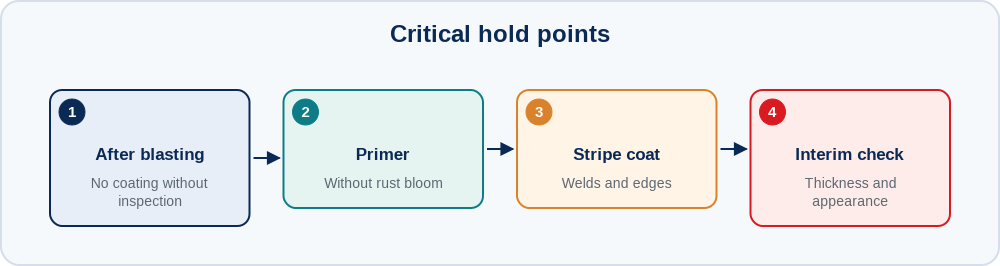
- Inspection after blasting is a critical hold point; cleanliness, profile, salts and dust are verified before coating.
- Blasting inside a tank carries confined-space, dust, static and fire risks; a qualified specialist and the relevant rules govern.
1. Why blasting? What does surface preparation do?#
A steel-construction information site describes surface preparation as not only cleaning the steel but also introducing a suitable profile to receive the protective coating. For coatings in immersion service such as tanks, sources present surface preparation as the most decisive step in the system: residual moisture, salt, rust or oil can cause trouble under the coating later. This article is a general summary of standards, maker guidelines and case accounts; it recommends no abrasive type, pressure, time or thickness for any particular tank. Many values come from the IMO ballast-tank performance standard (PSPC) and maker summaries of it; those describe shipbuilding conditions and may not apply directly to yacht tanks, so each value is given with its source.
2. Starting condition and preparation#
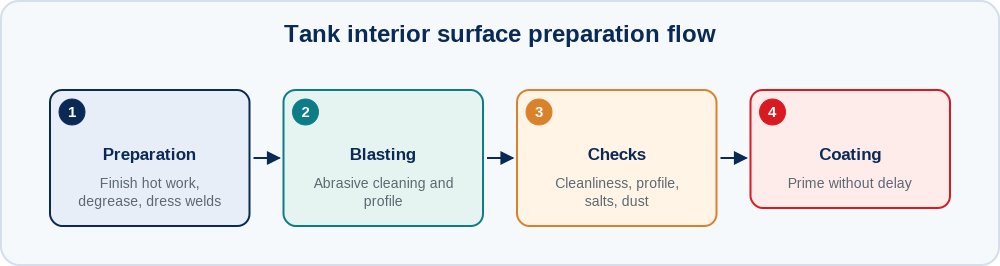
Before blasting the surface condition is assessed. A steel-construction information site writes that untreated steel is classified by rust grades (A to D) under BS EN ISO 8501-1, grade D meaning steel on which mill scale has rusted away and general pitting is visible. A coating maker’s tank-lining guide says rust grade B is the maximum accepted for raw steel and that rust-grade C areas need separate handling; that is a maker guideline and may not be the same for every coating system. The same guide says welds must be free of spatter, slag, undercuts, visible pores and end craters, that the weld profile must be dressed (citing ISO 8501-3 descriptions) and that all hot work such as welding and flame cutting outside the tank must be finished before the tank is released for blasting.
| Item | Sources’ general account | Caution |
|---|---|---|
| Rust grade | ISO 8501-1 A–D; B described as the maximum accepted on raw steel | Maker document governs |
| Weld and edge | Spatter, slag and undercuts removed; sharp edges rounded | Hot work finished before blasting |
| Contamination | Oil, grease and salt cleaned first | Blasting can embed contamination |
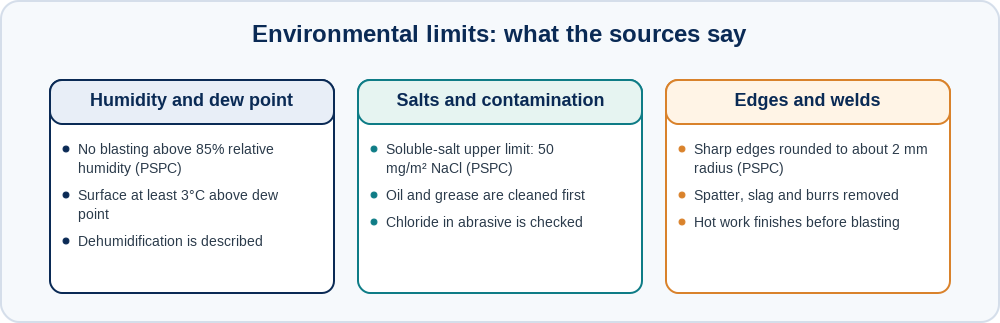
The ship ballast-tank standard asks, in secondary surface preparation, for sharp edges to be rounded to about 2 mm radius by three-pass grinding or equivalent and for welds, defects and contamination to be treated to ISO 8501-3; that is a value relayed from a coating maker’s PSPC summary and is not a design requirement for a yacht tank. The principle is clear, though: coating thins on sharp edges and fails there first. The same logic explains stripe coating: a coating maker’s presentation says a stripe coat is applied to places where it is difficult to get the required coating thickness, such as plate edges, welds, pipes, ladders and awkward access areas, and is important for reaching the required thickness there.
3. Blast grades: Sa 1 to Sa 3#
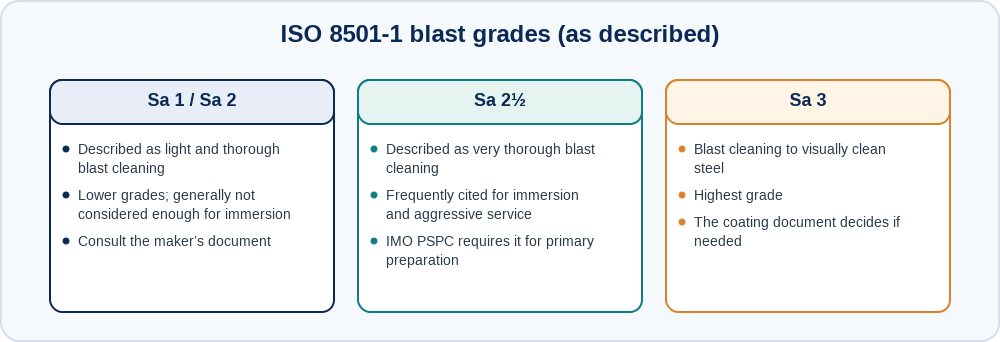
A steel-construction information site writes that under BS EN ISO 8501-1 the standard grades of abrasive blast cleaning are Sa 1 (light), Sa 2 (thorough), Sa 2½ (very thorough) and Sa 3 (blasting to visually clean steel). A coating maker’s guide says for new building the most common process is a three-step one based on abrasive blasting and that ISO 8501-1 is a photographic standard. A blasting-equipment firm’s technical note says where products are recommended for immersion or aggressive atmospheric conditions the blasting standard required will generally be Sa 2½ (ISO 8501-1) or SSPC-SP10; that is an equipment firm’s account. A corrosion publication says PSPC requires full blasting to ISO Sa 2½ for primary surface preparation followed by (preferably prequalified) shop primer.
On a user forum Sa 2½ is described with simple percentage statements such as “eighty percent clean”; such percentage descriptions vary between sources and, because the standard itself is defined by photographic references, the standard or the maker’s document should be consulted directly. This article gives no percentage equivalent of a grade. The required grade depends on the coating system: in a Belzona case account (a maker case) the interior of a ship sewage tank was blasted to SA 2.5 and a 75-micron profile, the existing lining was removed entirely and the whole application was completed over four days; in another case by the same maker, power-tool cleaning was used for a newly fabricated grey-water tank. The two cases show different maker systems and different conditions and are maker statements; this article prefers neither.
4. Profile, abrasive and salt#
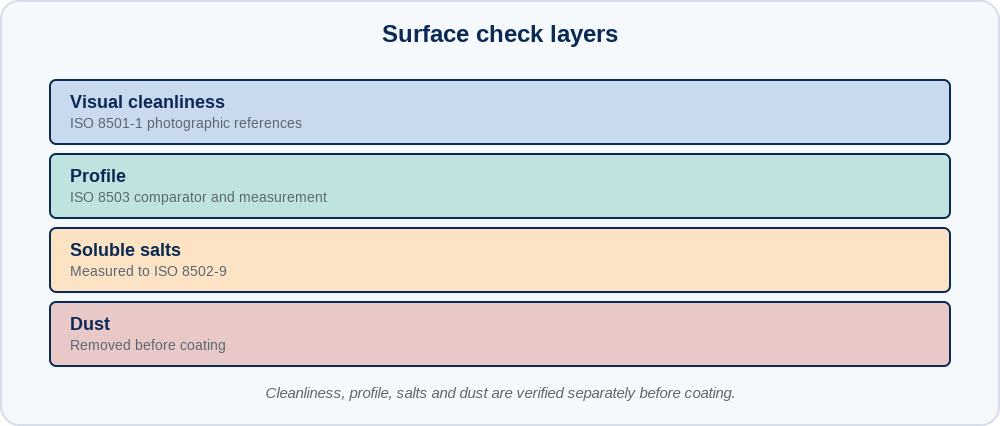
A corrosion publication writes that sharp angular abrasive particles (grit) cause notches in the substrate whose orientation is stochastic, while spherical steel or cast-iron shot is used in shop-priming plants. The ISO 8503 series defines surface roughness of blast-cleaned steel; a standards page says ISO 8503-2 is applicable only to Sa 2½ and Sa 3 blast-cleaned surfaces blasted with shot or grit abrasives. Abrasives themselves are defined in the ISO 11124 to 11127 series, which a surface-preparation guide cites. A military technical specification lists separate test kits for chlorides in abrasives and for chloride, sulfate and nitrate ions on steel and coated surfaces; that is a public-body specification and shows in principle that salt contamination of both abrasive and surface should be measured.
The ship ballast-tank standard gives a total soluble salt limit of 50 mg/m² NaCl (measured to ISO 8502-9); the coating maker’s PSPC summary gives the same value and a profile range of 30–75 µm (ISO 8503-1/2). The steel-construction information site writes that ultra-high-pressure water jetting (BS EN ISO 8501-4) removes soluble salts more effectively than blasting because the steel profile generally remains unchanged, that injecting small amounts of abrasive into the water stream can induce a rougher profile but increases operating cost, and that where inhibitors are not used, surface rusting after wet blasting is usually removed by a final light dry blast. That shows a trade-off between salt and profile; which method suits depends on the yacht tank geometry and the coating system, and this article recommends no method.
5. Environment: humidity, dew point and dehumidification#
The coating maker’s PSPC summary writes that blasting should not take place if relative humidity is above 85% and/or the steel surface temperature is not 3°C above the dew point; a government document gives the same conditions in its primary surface preparation table. These values are from a ship-building standard; the value to apply to a yacht tank is in the coating maker’s document. A dehumidification supplier describes dehumidifying the air inside a tank during blasting and painting to prevent condensation and rust bloom and allow the work to proceed as a continuous process; that is a supplier account. A coating maker’s presentation says that where a delay between blasting and coating is needed, dehumidification systems or holding primers can be used. The suitability of such tools depends on the coating system and the maker.
Inspection after blasting is stressed as a separate step: a coating maker’s presentation says it is important to inspect after blast cleaning and before applying any lining system and calls it a “critical hold point”. The coating maker’s tank-lining guide says the tank must be clean, dry and in a suitable condition for surface preparation and application of the lining.
6. Confined space, dust and safety#
The US Occupational Safety and Health Administration’s shipyard page says confined-space entry is among the leading hazards of mechanical paint removal and cleaning work, that such work produces dust that can be a significant health hazard in confined or enclosed spaces, that equipment capable of generating static electricity (including ventilation systems and abrasive blasting) must be grounded and bonded, that hot work must not be performed in the space or adjacent spaces while flammable or combustible cleaning solvents are being used and that an airline respirator may be used where ventilation does not provide adequate safety. A naval technical handbook says a large volume of ventilation is necessary during blasting to maintain visibility and production efficiency. This article presents no safety procedure; for tank entry and blasting, confined-space rules, gas testing, ventilation and personal protection belong to a qualified specialist and the relevant authority.
Details outside the tank also matter: on a user forum it is discussed that abrasive dust from blasting a yacht tank can escape into pipes and pump connections, so connections should be closed and the system flushed afterwards; that is an unverified user experience and this article does not present it as a general rule. Still, protecting the piping connected to the tank during and after coating is a sensible principle in itself and should be planned with a surveyor.
7. A practical frame: before and after blasting#
- Have the tank’s structural condition (wall thickness, pitting) established by a survey; blasting can thin the wall and a coating gives no structural strength.
- Obtain in writing from the coating maker’s document the blast grade, profile range, salt and environmental limits.
- Finish all hot work and weld dressing before blasting; have sharp edges and welds prepared per the maker’s document.
- Degrease the tank before blasting; ask about abrasive cleanliness and salt contamination.
- Record humidity, temperature and dew point; if needed work with a qualified applicator on dehumidification.
- At the hold point after blasting, record the inspection of cleanliness, profile, salts and dust.
- Plan confined-space safety and dust management with a qualified specialist.
5. Limits#
Sources overlap that blasting not only cleans but creates profile, that Sa 2½ is often cited for immersion and that environment, salts, edges and welds are separate control items. They differ on the required grade (Sa 2½ or power-tool cleaning), the suitable method (dry blasting, wet blasting, ultra-high-pressure water), profile values and the holding condition. Numerical values mostly come from the ship ballast-tank standard and maker summaries and may not apply directly to yacht tanks. So there is no single right answer; the coating maker’s document, a survey and a qualified applicator govern. This article is not engineering, safety or application advice.
5b. Where sources differ#
One maker case blasts a tank to SA 2.5 and about 75 microns while another coats a new grey-water tank after power-tool cleaning; one publication says ultra-high-pressure water removes salt better while another stresses abrasive profile; a forum describes Sa 2½ in percentages while the standard defines it by photographs. These are sources speaking in different contexts and with different interests. The difference means applying to the maker’s document and a qualified applicator for your own tank.
This article is general information; it recommends no product, method, ratio, number of coats or time. The maker’s data sheet and a qualified yard govern.
5c. A practical frame for reading the sources#
The sources are magazines, makers, sellers and forums; each writes in its own context. None knows the blast grade, profile or safety conditions of a tank of your boat. So taking the shared message and consulting the maker and a qualified yard for detail is reasonable.
Blasting inside a tank carries confined-space, dust, noise, fire and static-electricity risk, with possible respiratory, eye and hearing injury, asphyxiation and explosive-atmosphere danger. This article describes no personal protection, ventilation or gas-testing method. Follow confined-space entry rules, the relevant safety standards and a qualified specialist’s instruction; do not work alone. For safety-critical matters the opinion of a qualified specialist governs.
Seller and maker statements are the firm’s own account of its product and have not been independently verified. A product’s compatibility with another coating should always be checked in the product’s technical document; where a document and a guide conflict, the maker’s document and a qualified yard’s assessment should be used. Recording decisions and product details helps later maintenance.
6. Common mistakes#
- Estimating the Sa grade from percentage statements.
- Coating straight after blasting without inspection.
- Not measuring soluble salts and abrasive contamination.
- Blasting without preparing sharp edges and welds.
- Ignoring humidity and dew point and causing rust bloom.
- Not protecting tank connections and piping from dust and abrasive.
- Neglecting confined-space safety and gas testing.
7. Checklist#
8. Conclusion#
Blasting inside tanks is described in sources as preparation, blast grade, profile, salt and environmental control and post-blast inspection, with Sa 2½ often cited for immersion. This article is general information; it is not surface-preparation, engineering or safety advice and recommends no values for a yacht tank.
Frequently asked questions#
What does Sa 2½ mean?
Under ISO 8501-1 it is described as “very thorough blast cleaning” and is often cited for immersion service. The required grade is in the coating maker’s document.
Why does surface profile matter?
A steel-construction information site writes that surface preparation introduces a suitable profile to receive the coating; the ship ballast-tank standard asks for 30–75 µm, and for a yacht tank the maker’s document should be consulted.
Why are soluble salts measured?
The ship ballast-tank standard sets a total soluble salt limit of 50 mg/m² NaCl; salt under a coating can cause blistering, so it is measured.
How long can one wait after blasting?
This article gives no time; sources describe dehumidification and holding primers for coating without rust bloom after blasting.
Is blasting inside a tank safe?
It carries confined-space, dust, static-electricity and fire risk; bodies such as OSHA describe these risks, and a qualified specialist and the rules govern.
Was this guide helpful?
Thank you! Your feedback has been saved.
Guide content is for general information; in practice, the current technical data sheet of the product applies.
Keep reading
Related guides
Steel Yacht Freshwater Tanks: Design, Material and Internal Lining Guide
The material, design and drinking-water-suitable internal lining of a steel boat’s freshwater tank, summarised from organisation, magazine and maker accounts with their limits.
14 min read Refit and MaintenanceDrinking-Water Tank Epoxy Lining: Selection, Stripe Coat, Cure and Disinfection
Product documents, stripe coat, cure, flushing and disinfection steps in epoxy lining of drinking-water tanks, summarised from source accounts with their limits.
11 min read Refit and MaintenanceGrey Water, Black Water and Shower Tanks: Corrosion, Lining and Design
Why grey, black and shower tanks on steel boats corrode, what an internal lining does and design details, summarised from source accounts.
11 min read