
Paint and Coatings
Digital Thickness Measurement and Yacht Paint History: How to Build a Record File
On most yachts no one knows how thick the paint is; it is estimated. Digital measurement and regular records take maintenance decisions out of guesswork. This article explains measurement methods by hull type and how to build a paint-history file.
Short answer
Dry film thickness (DFT) is the total thickness of the paint system and is the basic data for maintenance decisions. Magnetic methods are used on ferrous steel, eddy-current on non-ferrous metals such as aluminium and ultrasonic on fibreglass, wood and composites; some ultrasonic gauges can show more than one layer separately. Fixing measurement points and recording values with date, conditions and product information builds a history that is valuable for season-to-season comparison and for later repainting, sale or warranty discussions.
Key points
- Dry film thickness (DFT) is the basic data for maintenance and renewal decisions.
- Magnetic methods suit steel, eddy-current non-ferrous metals and ultrasonic fibreglass and wood.
- Some ultrasonic gauges can show more than one layer separately.
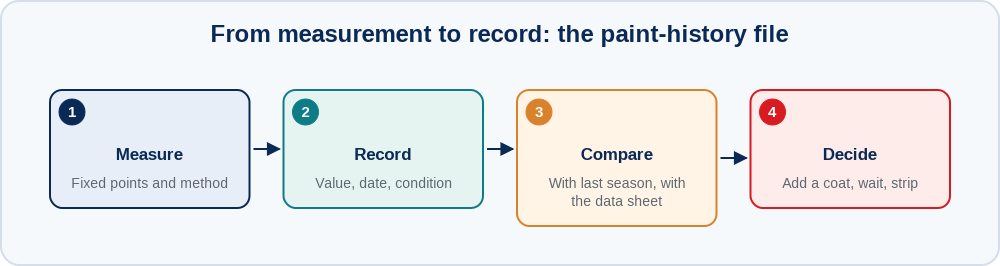
- Keep measurement points and method fixed; record value, date, conditions and product together.
- A regular record file gives a trustworthy history in resale and in a warranty discussion.
1. Why should we know the thickness?#
The most common sentence about a yacht’s paint is “there are a few coats”. How many coats, how thick they are in total and how they are distributed are often unknown. Yet this information is the most concrete data on whether to add a coat, whether the old system must be stripped, how a repair should be planned and when a problem began.
This article explains thickness measurement and turning the results into a paint-history file. The text is not device or brand advice; the measurement method should be chosen according to the hull material and the manufacturer’s instruction.
2. Measurement methods: the hull material decides#
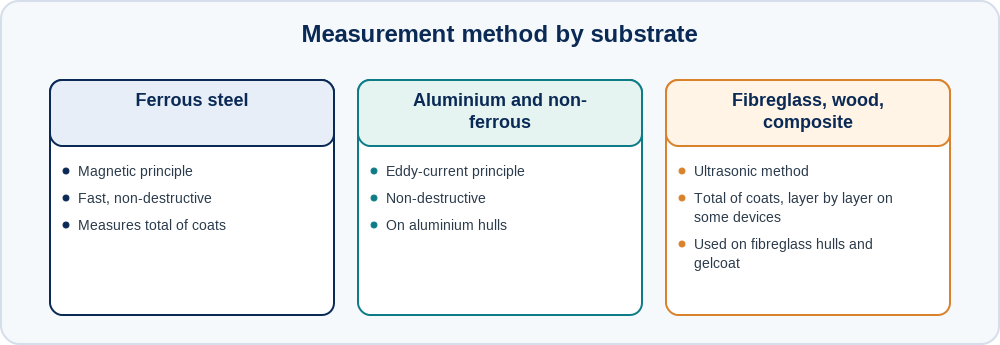
Coating thickness gauges divide into two main types: magnetic and ultrasonic. An equipment supplier says magnetic gauges are used for ferrous metals and ultrasonic gauges for both ferrous and non-ferrous surfaces. Another maker says electronic coating gauges use magnetic and eddy-current principles to measure thickness on both ferrous and non-ferrous metals.
For non-metallic surfaces the situation is different. Ultrasonic coating thickness measurement is becoming common on rigid substrates such as wood, plastic and composites. One maker says these gauges non-destructively measure coating thickness on non-metal substrates including wood, concrete, plastic and composites. Another supplier says some gauges can measure coating thickness on fibre hulls such as GFRP and CFRP in shipbuilding and can show several layers (up to eight) at once. An ultrasonic-gauge maker has also published a separate application note on measuring fibreglass gelcoat thickness.
| Hull | Common method | Note |
|---|---|---|
| Ferrous steel | Magnetic | Measures the total of the coats |
| Aluminium and non-ferrous metals | Eddy-current (ultrasonic on some gauges) | Non-destructive |
| Fibreglass (GRP/CFRP) | Ultrasonic | Some gauges show more than one layer separately |
| Wood, composite | Ultrasonic | Surface and moisture condition can affect the result |
3. What is measured and where?#
The value of measurement lies in repeatability. Measurement points should therefore be fixed with a template or photograph and measured from the same points every season. Points can be chosen from critical areas such as the waterline, mid-hull, shoulder, stern, rudder and keel. Some advanced gauges can store thousands of readings and log conditions at time intervals, which makes it easier to make the record file digital.
- Waterline and just below: wear and maintenance intensity are high.
- Shoulder and stern: knocks, rubbing and handling marks.
- Rudder, around the propeller and keel: areas of strong corrosion and galvanic effects.
- Reference points: baseline measurements from undamaged, “typical” areas.
- Repair areas: to follow the thickness difference between old and new systems.
4. What does thickness tell us?#
Thickness data does not make a decision by itself but prepares the ground for several questions. In an eroding antifouling the remaining thickness shows whether it can complete the season. In a hard antifouling the accumulated coat thickness shows whether the surface is approaching the point where it must be stripped. In an epoxy barrier system thickness is compared with the manufacturer’s recommended coat and total thickness. In a topcoat renewal the existing system’s thickness limits how much can be sanded.
A thickness measurement should always be interpreted together with the target values in the manufacturer’s data sheet and the surface condition (moisture, cracks, blisters). A number is not a verdict without context.
5. The paint-history file: a “yacht paint passport”#
A paint-history file is a regularly kept record that combines thickness measurements with product, application and maintenance information. The word “passport” does not describe an official document; it denotes a personal record file for the boat. A paint specialist in the superyacht sector stresses the need for a traceable and transparent system in which all information such as daily climate conditions, dry film thickness measurements, orange peel and gloss readings can be logged through the paint process. The same approach can be applied on smaller boats with a simple file.
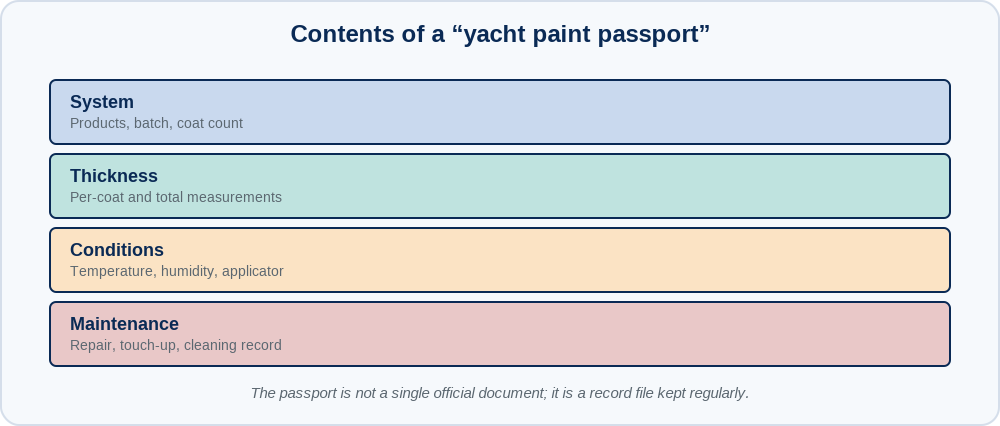
- System: products applied, batch numbers, coat count and application dates.
- Thickness: per-coat (where possible) and total thickness measurements; measurement points.
- Conditions: application temperature, humidity, dew point and applicator.
- Maintenance: repairs, touch-ups, cleaning method and dates.
- Photographs: from the same angles every season.
- Documents: manufacturers’ data sheets, warranty terms, written approvals.
6. Why is the record valuable?#
- Decision: the scope of the next maintenance rests on data, not guesses.
- Diagnosis: when a problem arises it is known which coat and under what conditions it was applied.
- Warranty: provides documents in a discussion with the manufacturer or applicator.
- Sale: shows the buyer the history and state of the system.
- Continuity: information is not lost even if the yard, crew or owner changes.
These benefits also show that a record is not a guarantee in itself: a record does not replace quality but makes quality manageable and provable.
7. Common measurement mistakes and limits#
A gauge that is not chosen to suit the surface and material can give misleading results. For example, on metal a conventional ultrasonic gauge measuring the total thickness of painted metal can measure the paint layer at the speed of sound in steel and give erroneous results; a purpose-built gauge and probe should therefore be chosen for paint thickness. Calibration, surface roughness, curvature and moisture can also affect the result. It makes sense to follow the gauge maker’s instruction and calibration advice and, if necessary, consult a specialist.
8. A short case: two seasons, two decisions#
On the first boat the owner says “there are a few coats” and applies a new antifouling coat every year. After five years the film has thickened, in places cracking and flaking begin, and it is unclear how extensive the stripping should be. On the second boat the owner measures from fixed points each season, records the values and, on seeing total thickness approaching the manufacturer’s recommendation, plans a controlled strip.
The second owner also strips; but does so on the basis of data and in good time, not after a failure. This difference determines both cost and the quality of the result.
9. Checklist#
10. Common mistakes#
- Judging thickness by guess.
- Measuring from different points each season.
- Recording a value without context (date, product, conditions).
- Not choosing a gauge to suit the surface or skipping calibration.
- Putting off the record at season end with “I’ll do it later”.
11. Conclusion#
Knowing the thickness of the paint takes the maintenance decision out of guesswork. Measure with a method suited to the hull material, from fixed points and regularly; record values with date, conditions and product information and build a paint-history file. This file lets you decide better today and gives confidence tomorrow when you hand the boat on.
Frequently asked questions#
What is DFT?
Dry film thickness: the thickness of the paint after it has dried and cured. It is the basic data for maintenance and renewal decisions.
How is thickness measured on a fibreglass hull?
Ultrasonic methods are used on non-metallic surfaces. Some gauges show the total thickness, others show layers separately.
Is the method different for steel and aluminium?
Yes. Magnetic gauges are used for ferrous metals; eddy-current or ultrasonic gauges for non-ferrous metals.
How should I keep the record?
At each measurement record the point, value, date, weather condition and product information in the same way; support it with photographs.
Does paint history help at sale?
A documented paint and maintenance history shows the buyer the state of the system and builds trust; the value effect varies with the market.
Was this guide helpful?
Thank you! Your feedback has been saved.
Guide content is for general information; in practice, the current technical data sheet of the product applies.
Keep reading
Related guides
Number of Coats in Epoxy Coating Systems
A study of the effect of the number of coats in epoxy coating systems on protective performance and thickness.
2 min read Sealing and SikaflexDetecting Moisture Leaks Before Painting: Finding Hidden Water Paths in the Hull
A study of detecting hidden moisture leaks in the hull and deck before painting and their effect on the paint system.
2 min read Paint and CoatingsCauses and Diagnosis of Paint Blistering
A study of the sources, types and diagnostic approach to blistering on boat paints.
2 min read