
Paint and Coatings
Low-VOC and Water-Based Yacht Paints: Regulation, Performance and Application Reality
VOC regulation is quietly changing the make-up of yacht paints. Solvent is falling and new systems are arriving. This article explains what low-VOC and water-based systems are, when they make sense and what to watch in application.
Short answer
VOC (volatile organic compound) refers to substances released into the air from the solvents in paint, which can be harmful to human health and are implicated in ozone formation. Regulation such as the European Union’s Directive 2004/42/EC limits VOC emissions from the use of organic solvents in certain paints. Manufacturers develop high-solids, water-based and solvent-free systems; each brings different requirements for application temperature, humidity, cure and equipment. Low VOC does not remove safety measures.
Key points
- VOCs are compounds released into the air from solvents and linked to health effects and ozone formation.
- The EU Directive 2004/42/EC limits VOC emissions from organic solvent use in certain paints.
- Manufacturers try to reduce solvent through high-solids, water-based and solvent-free systems.
- In water-based and low-VOC systems temperature, humidity and cure conditions can be more critical.
- Low VOC does not make ventilation, PPE and reading the SDS unnecessary.
1. What is VOC and why is it discussed?#
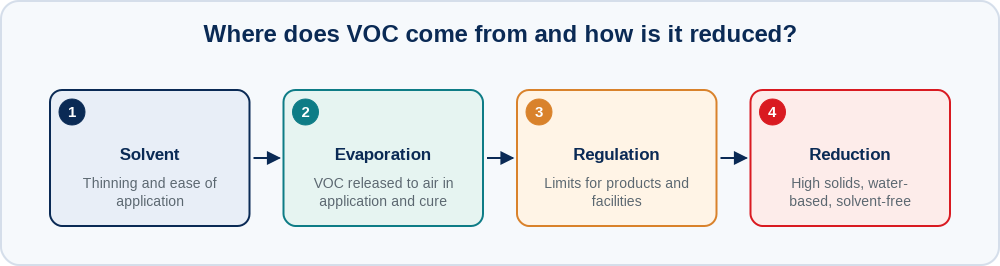
Paint consists of solvent, pigment, binder and additives. A brand executive explains that the solvent makes the paint thinner and less viscous and so easier to apply, and that once the paint has spread the solvent evaporates, leaving the paint evenly applied. Most solvents are volatile organic compounds (VOCs); many are considered hazardous air pollutants because they can be harmful to human health and are implicated in ozone formation.
This article treats low-VOC and water-based yacht paints in terms of regulation, performance and application reality. The text is not product or legal advice; the product data sheet and local legislation are decisive.
2. Regulation: the quiet transformer#
In Europe Directive 2004/42/EC governs limiting VOC emissions from the use of organic solvents in certain paints and varnishes and vehicle refinishing products. The directive defines VOC by initial boiling point. The brand executive says VOC rules have been applied across many industries in the US and Europe for over ten years, have more recently come into force in Hong Kong and South Korea, and that stricter rules are being drawn up in South Korea and China, with the EU expected to follow.
Hong Kong’s list for vessel paints shows that VOC limits vary by paint category: for example limits of about 340 grams per litre for high-gloss coatings and 450 grams for marine maintenance coatings. These numbers are one region’s vessel-paint rule; they do not apply directly to pleasure craft or other regions, but they show that limits are defined by category.
A yard article from the superyacht sector also says increasingly strict environmental legislation has meant certain components must be left out of paint, which makes the painting process more difficult. In short, regulation changes both the make-up of the product and the application conditions.
3. Three approaches: high solids, water-based, solvent-free#
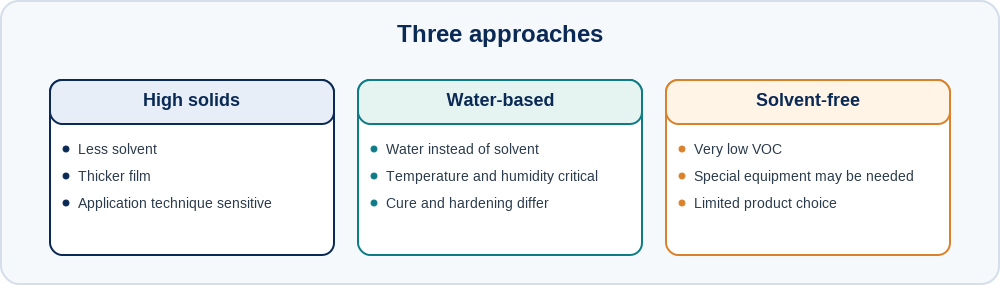
- High solids: less solvent is used for the same film. A thicker film may be applied; application technique and temperature can become more sensitive.
- Water-based: water largely replaces the solvent. Temperature, humidity and cure conditions can behave differently from solvent-borne systems.
- Solvent-free: aims for very low VOC. A brand executive says solvent-free coatings can also raise productivity by reducing the fire and explosion risk of doing hot work and paint application together.
The same executive says one manufacturer, after 15 years, developed a single-coat product that it reports cut solvent emissions from about 250 grams per litre to nine grams, a 97 percent reduction. This is a manufacturer’s claim for a commercial-ship product; it does not mean there is a direct equivalent for yachts. But it shows the direction: cutting solvent seriously.
4. Performance: verify from the data sheet#
Whether a low-VOC or water-based product suits a yacht depends on properties such as gloss, UV resistance, hardness, cure and repairability. The label “low VOC” or “water-based” says nothing about these. A manufacturer in the superyacht sector says its single-stage polyurethane topcoat combines high gloss, hardness and micro-scratch resistance with repairability and has lower VOCs than traditional topcoats. This is a manufacturer’s claim; but it shows performance and VOC being targeted together.
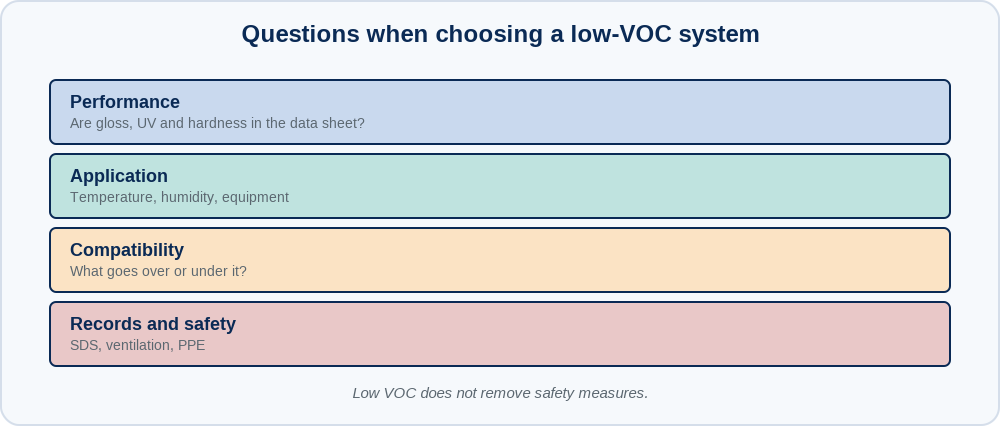
| Subject | Question to ask | Why it matters |
|---|---|---|
| Gloss and UV | Are values in the data sheet? | Yacht appearance and life |
| Application conditions | What are the temperature and humidity ranges? | Can be more critical for water-based products |
| Cure and hardening | Recoat interval, full-cure time? | Schedule and surface hardness |
| Compatibility | What goes over and under it? | Adhesion and appearance |
| Equipment | Is a special gun or booth needed? | Cost and choice of applicator |
5. Application reality#
Water-based and low-VOC systems can change habits in application. The temperature, humidity and cure behaviour an applicator knows from solvent-borne systems may differ. The ranges and recoat intervals in the manufacturer’s data sheet should therefore be followed more strictly. The applicator’s experience with the system matters as much as the product itself.
When moving to a new system, applying on a small test area or asking for on-site support from the manufacturer’s technical representative is a low-cost, high-value step.
6. Safety: low VOC does not mean safe#
A low-VOC product may also contain a hardener or another hazardous component. Ventilation, personal protective equipment and reading the safety data sheet (SDS) are therefore always needed. The paint-safety and respiratory-protection articles on our site treat this in detail. Low VOC is no reason to give up safety measures.
- Read the SDS: components, hazards and precautions.
- Plan ventilation: booth, filtration or open air with sufficient air change.
- Use personal protective equipment: suitable respirator, gloves and goggles.
- Measure application conditions: temperature, humidity and dew point.
- Record: product, batch, conditions and date.
7. A short case: two choices#
The first yard applies a new water-based topcoat as if it were the old solvent-borne system, on a humid day, keeping the recoat interval short. The result is a gloss difference and late cure. The second yard follows the data sheet and the manufacturer’s technical representative, measures temperature and humidity, applies and approves a small test area and then paints the whole surface.
The second approach may look slower; but with new systems the biggest risk is carrying old habits over unchanged. Adopting new technology also means accepting a new learning curve.
8. Pre-decision checklist#
9. Common mistakes#
- Thinking low VOC means “harmless”.
- Applying a new system with old habits.
- Not verifying gloss and UV values from the data sheet.
- Applying over the existing system without checking compatibility.
- Treating regulation as only a bureaucratic obligation.
10. Conclusion#
VOC regulation is shaping yacht paints toward less solvent. High-solids, water-based and solvent-free systems may suit regulation, health and the environment better, but may be more sensitive to application conditions. Verify performance from the data sheet, question the applicator’s experience, check compatibility and do not give up safety measures.
Frequently asked questions#
What is VOC?
Volatile organic compound. It is released into the air from solvents in paint; some are considered harmful to human health and linked to ozone formation.
Is low-VOC paint safe?
It contains less solvent but that alone does not mean “safe”. Ventilation, personal protective equipment and the safety data sheet (SDS) are still needed.
Is water-based paint durable enough on yachts?
It depends on the product. Gloss, UV and hardness values should be verified in the manufacturer’s data sheet and the application temperature and humidity range followed.
Why does regulation matter?
Regulation limits the solvent that products and application facilities may contain, steering makers toward new systems.
Can a low-VOC product go over the existing system?
Compatibility depends on the product pair. The manufacturer’s compatibility table or written approval is decisive.
Was this guide helpful?
Thank you! Your feedback has been saved.
Guide content is for general information; in practice, the current technical data sheet of the product applies.
Keep reading
Related guides
Occupational Safety, Ventilation and Personal Protective Equipment in Painting
A study of solvent vapour risks, ventilation requirements and personal protective equipment in paint application.
2 min read Paint and CoatingsPainting in Varying Weather: The Effect of Temperature and Humidity
A study of the effect of temperature and relative humidity during paint application on drying, film formation and adhesion.
2 min read Paint and CoatingsColour Stability and UV Resistance in Yacht Paints
A study of the fading caused by sunlight on paint colours, UV resistance and the components that preserve this property.
2 min read