
Underwater
Underwater Paint on Electric and Hybrid Yachts: Galvanic Corrosion and Stray Current
On electric and hybrid yachts, different metals, high-energy systems and paint meet in the same place under water. Paint can both prevent corrosion and show a sign of a fault. This article treats galvanic corrosion and stray current from the paint perspective.
Short answer
Galvanic corrosion is a passive process that arises when dissimilar metals contact in seawater and is managed with anodes; stray-current corrosion comes from an external electrical current and an anode alone does not solve it. When using copper-based antifouling on aluminium hulls or drives, the epoxy barrier coat plays a critical role in preventing localised galvanic corrosion between the antifouling and the metal. Blistering of underwater paint and uneven anode wear can be signs of an electrical problem. This article is not a test specific to electric drives but an interpretation of general marine-corrosion principles from the paint side.
Key points
- Galvanic corrosion is passive and managed with anodes; stray-current corrosion comes from an external current and an anode alone does not solve it.
- On aluminium surfaces copper-based antifouling needs care; the epoxy barrier coat plays a critical role.
- Blistering of underwater paint and a white powdery deposit can be signs of corrosion.
- Uneven anode wear can indicate an electrical problem.
- Anodes must not be painted; a galvanic isolator or isolation transformer is considered at the dock connection.
1. Why are electric and hybrid yachts a separate subject?#
Electric and hybrid drives bring high-energy electrical systems into an environment where many metals (drive housing, shaft, propeller, rudder, hull) are already present under water. This makes the relation between paint and corrosion visible. Underwater paint is not only a fouling matter; it is a barrier between metal and seawater and can also show the first sign of an electrical problem.
An important note: the information here rests on general sources about marine corrosion. I did not find an independent, comprehensive test of how electric drives interact with paint; the claims are therefore limited to general principles and the electric drive manufacturer’s recommendation always takes priority. The text is not engineering advice.
2. Two corrosion types: galvanic and stray current#
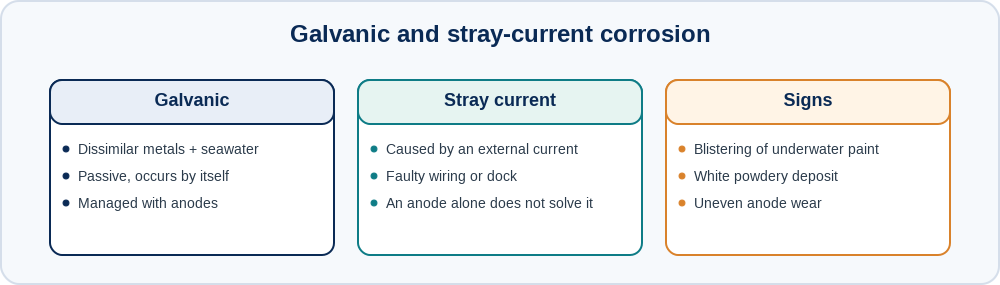
A marine publication explains that underwater metals are exposed to two basic types of corrosion: galvanic corrosion and stray-current corrosion. Both can harm the boat, propeller and motor. Another source stresses that galvanic corrosion is a passive process; when the fundamentals are met it happens by itself, independent of electrical systems, marinas or the boat next door, and anodes protect only against galvanic corrosion.
Stray-current corrosion arises when an external electrical current causes an electrochemical reaction with the boat’s metal components; the source can be faulty wiring or electrical equipment on the boat or at the dock. The same source says the most aggressive electrical effect comes from direct current (DC). Anodes do not solve a stray-current problem; but anodes can also be a sign of another problem: on twin-motor boats uneven anode wear between port and starboard can indicate an electrical influence flowing between the engines.
| Property | Galvanic | Stray current |
|---|---|---|
| Source | Dissimilar metals + seawater | External electrical current (faulty wiring, dock) |
| Nature | Passive, by itself | Tied to an electrical source |
| Protection | Anodes, material choice, protective coating | Find and remove the source; isolation; electrical system maintenance |
| Is an anode enough? | Yes (right anode, right place) | No; an anode alone does not solve it |
| Sign | Anode wear, paint blistering | Fast, local damage; uneven anode wear |
3. Where does paint fit in this picture?#
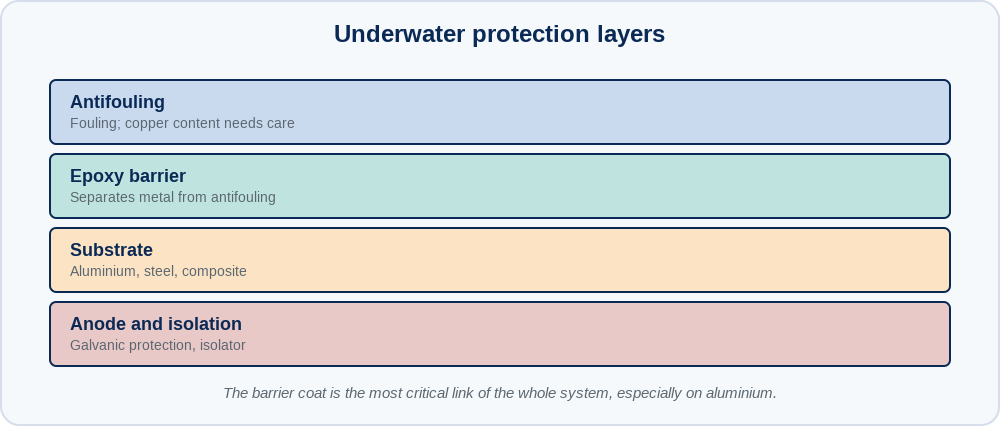
Paint plays two roles here. First, it is a physical barrier separating metal from seawater. Second, it is a diagnostic tool: a marine publication says the first sign of galvanic corrosion is blistering of paint below the waterline starting at sharp edges and a white powdery substance forming on exposed metal. Blistering of underwater paint is therefore not just an aesthetic problem but a sign of possible corrosion.
Aluminium surfaces are especially sensitive. A marine publication says aluminium is sensitive to both galvanic and electrically induced corrosion and that aluminium boats kept in the water should consider coatings not only against growth but for corrosion protection. The same publication advises great caution with copper-based antifouls, because epoxy barrier coats are integral in ensuring that no localised galvanic corrosion occurs between the antifouling and the metal, which can be incredibly aggressive.
4. Anodes: the right type, unpainted#
Galvanic corrosion is managed with anodes. A publication describes galvanic corrosion as a giant battery cell set up on the hull. The anode type matters: one source says magnesium anodes can perform well in freshwater but can cause cathodic corrosion damage to aluminium in seawater and damage bottom paint. Too many zinc anodes can, in extreme cases, damage some bottom paints but will not damage underwater metals.
A manufacturer’s expert says anodes should never be painted, calling it a surprisingly common mistake. It is also advised to source anodes from reputable suppliers and to consider a galvanic isolator or isolation transformer at marinas where stray-current risk exists at the dock. Another source reminds that a galvanic isolator does not prevent alternating stray-current corrosion.
5. Practical consequences in electric and hybrid systems#
In electric and hybrid drives the integrity of wiring and insulation is the most important factor determining stray-current risk. A marine publication says keeping everything tight, free from corrosion and protected from water ingress is imperative so that the hull is not used to conduct power and stray current has no chance to look for alternative paths. This is especially important for electric-drive owners: the person ensuring the electrical integrity of the system and the person applying the underwater paint should share the same information.
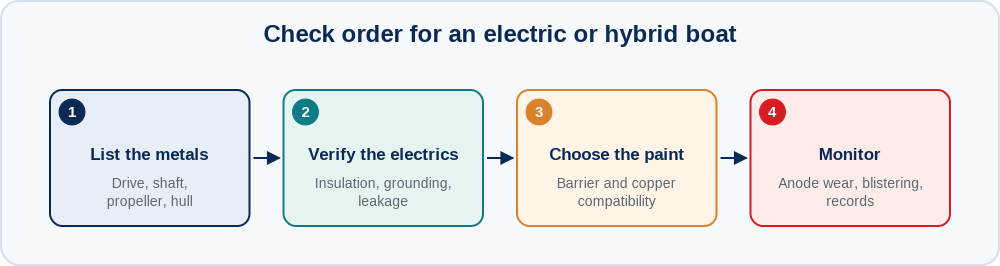
- List the metals: drive housing, shaft, propeller, rudder, hull and other underwater metals; identify where different metals touch.
- Verify the electrics: get a written report from a specialist electrician on insulation, grounding and leakage.
- Choose the paint: confirm with the manufacturer the compatibility between the barrier-coat system, the antifouling’s copper content and the metals.
- Manage the anodes: right type, right place and unpainted; assess whether an isolator or isolation transformer is needed at the dock.
- Monitor and record: anode wear, paint blistering and white deposit; photographs from the same points every season.
6. Which questions should be asked?#
- What does the drive manufacturer recommend for underwater paint and anodes? Is there a written recommendation?
- If the hull material is aluminium, is there manufacturer approval for the antifouling’s copper content?
- How are the thickness and integrity of the epoxy barrier coat verified around the drive and on the hull?
- Is a galvanic isolator or isolation transformer used at the dock connection?
- At what intervals and from which points is anode wear recorded?
- Who carries out electrical-system maintenance and stray-current checks, and how often?
7. A short case: the same sign, two interpretations#
On a hybrid aluminium boat blistering and a white powdery deposit appear in the paint around the drive. The first approach regards this as “poor paint quality”, sands the area and repaints; a few months later the sign returns. The second approach treats the sign as a possible corrosion indicator: it examines anode wear, has the electrical insulation checked by a specialist, verifies the integrity of the barrier coat and only then paints.
The second approach takes longer but finds the root cause. Blistering in underwater paint often shows a result, not the cause.
8. Checklist#
9. Common mistakes#
- Painting the anodes.
- Treating blistering as only a paint problem and not looking for the root cause.
- Applying copper-based antifouling on aluminium without manufacturer approval.
- Not recording anode wear and ignoring unevenness.
- Running electrical and paint work without each knowing of the other.
10. Conclusion#
On electric and hybrid yachts paint must be considered together with corrosion. Galvanic corrosion is managed with anodes; stray current is removed by finding its source. Protecting the epoxy barrier coat, not painting the anodes and recording blistering and anode wear are the most practical steps. Always consult the drive manufacturer’s written recommendation and an electrical specialist.
Frequently asked questions#
What is the difference between galvanic and stray-current corrosion?
Galvanic corrosion is a passive process formed by dissimilar metals in seawater and is managed with anodes. Stray-current corrosion comes from an external electrical current; anodes do not solve it.
Can copper-based antifouling be used on an aluminium hull?
A marine guide advises great care; epoxy barrier coats are vital to prevent localised galvanic corrosion between the antifouling and the metal. Manufacturer approval and the applicator’s assessment are decisive.
Can I paint the anodes?
No. A manufacturer’s expert says anodes must not be painted; paint prevents the anode from working.
Can paint blistering be a sign of corrosion?
Yes. According to a marine guide the first sign of galvanic corrosion is blistering of underwater paint starting at sharp edges and a white powdery deposit on exposed metal.
Is there a special rule for electric boats?
The principles in this article belong to general marine corrosion. For electric drives the manufacturer’s corrosion, grounding and paint recommendation is decisive.
Was this guide helpful?
Thank you! Your feedback has been saved.
Guide content is for general information; in practice, the current technical data sheet of the product applies.
Keep reading
Related guides
Protective Systems for Propeller and Rudder Areas
A study of the protective systems used in moving, high-friction areas such as propellers and rudders, and their selection criteria.
2 min read UnderwaterChoosing Antifouling: A Decision Based on Usage Profile
A decision-focused study explaining how the type of antifouling should be chosen according to the frequency of use and water conditions.
2 min read UnderwaterManaging the Waterline Zone with a Paint System
A study of the special conditions around the waterline of a boat and how this zone is managed with a paint system.
2 min read