
Hull Repair
Does Ceramic Coating Really Work on a Yacht Hull?
Ceramic coating has become popular fast in boating, promising hard, hydrophobic protection that lasts years. Sources, however, show much of the promise depends on preparation and upkeep. This article looks at what it does well and where it is overstated.
Short answer
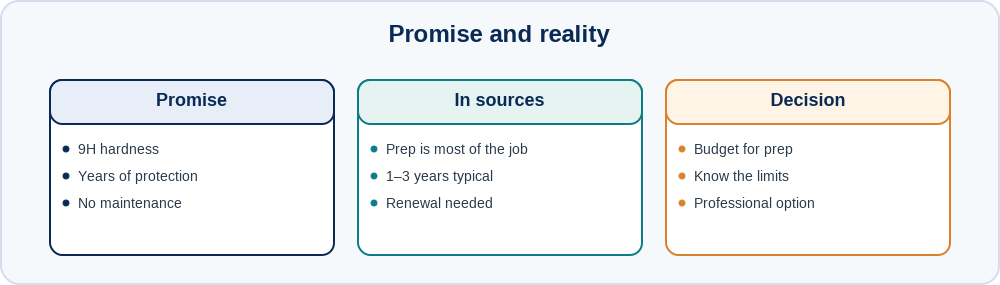
On a properly prepared hull, ceramic coating can give water repellency, easier cleaning and UV resistance; but life and performance depend on application and upkeep. Sources stress that most of the job is surface preparation: one magazine writer says about 80% of his time went on prep. Applying coating over oxidation can accelerate hazing. Maker claims (9H hardness, years of life) should be read as vendor claims; one review expects the coating to look good for a few years. This article is general information; the product data sheet comes first.
Key points
- Ceramic coating promises water repellency, easy cleaning and UV resistance; results depend on prep and upkeep.
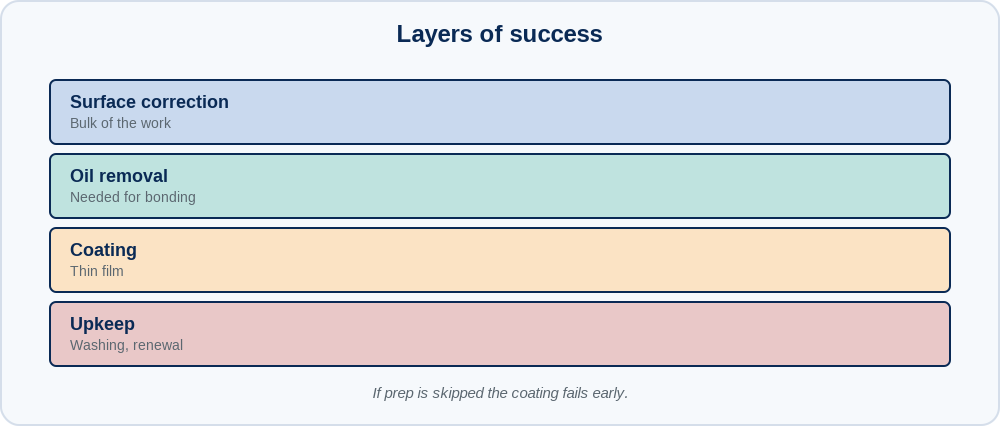
- Most of the work is surface correction and oil removal; skipping prep leads to early failure.
- Applying over oxidation can accelerate hazing; correct first.
- Claims such as 9H hardness and years of life are vendor claims; sources mention typically 1–3 years.
- DIY products are presented as shorter-lived, professional systems as more durable; renewal and upkeep are needed.
1. What is ceramic coating and what does it promise?#
Ceramic coating is a liquid product, usually silicon-dioxide (SiO2) based, that leaves a very thin hard film on the surface. A magazine writes that coatings work by penetrating the gelcoat, sealing out impurities and blocking damaging UV light. One maker claims its product bonds with the substrate at a molecular level to form a permanent clear coating removable only by abrasion and carries a 9H hardness rating. These are manufacturer claims; independent verification is a separate matter.
The practical aim in boating is this: water beads and runs off, dirt and salt clean more easily, and UV absorbers reduce the rate of fading and chalking. One source summarises the effects that way. Another product promises that dirt such as bird droppings and fish residue sticks less. But keep expectations realistic: a coating does not make a hull trouble-free, it reduces the maintenance load.
2. Preparation is most of the job#
Many sources carry the same message: the job is surface preparation. A boating magazine writer says that on his tired-looking 14-year-old boat at least 80% of the time was spent preparing the various surfaces and substances, whereas on a newer or better maintained boat this phase would be much quicker. Another publication says all the buffing hours will go to waste because each area treated with ceramic must be treated with some kind of liquid prep. A round-up article lists skipping prep as the single biggest reason DIY applications fail.
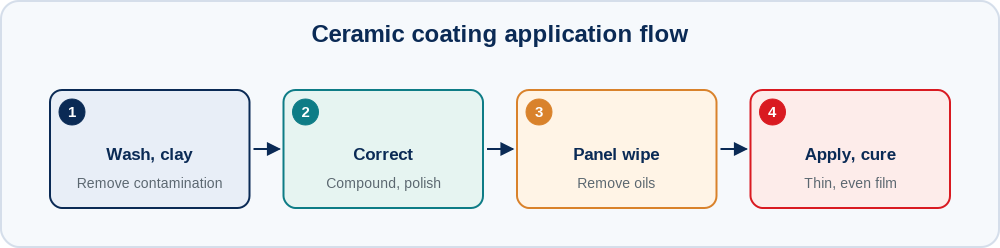
A forum user writes that his detailer said the first application would take all day because of extra prep; that is one experience. The general framework is: wash, remove contaminants, compound and polish where needed, then degrease and apply thinly and evenly. If any stage is skipped the coating either does not bond properly or locks in the flaws.
| Stage | Purpose | If skipped |
|---|---|---|
| Wash, decontaminate | Remove dirt and salt | Contamination stays under the coating |
| Correct (compound, polish) | Remove oxidation and scratches | Flaws are locked in |
| Panel wipe | Remove polishing oils | Poor bonding |
| Apply, cure | Thin, even film | High spots, streaks |
3. The oxidation warning#
The most important warning: a boating magazine states that if there is any oxidation on the gelcoat, applying the ceramic coating over it will accelerate the hazing process. Another magazine writes that protective coatings, because of their clarity, reveal remaining oxidation and in some cases amplify it and allow it to continue beneath the surface. So do not change the order: remove oxidation first, then coat. See our article on oxidation.
4. Durability: a realistic lifetime#
Manufacturers usually describe years of protection; a round-up article says makers may claim two to five years but that on a coastal mooring in full sun with regular use one can expect one to three years of strong performance with upkeep. A review article reports that the applied system should keep the boat looking good for the next three years. These figures are estimates and passed-on experience, not independent long-term measurement; life varies with climate, use, zone (vertical hull side, shaded cockpit, metal) and upkeep.
Judging durability by water beading alone is misleading; one source stresses that beading should not be the only measure. A boating magazine also cites a short renewal interval of three months for a light rinse-on product; some products are short-lived across a season. So read the real expected life for your product from the data sheet and from user experience together.
5. DIY or professional?#
A magazine says professional application is recommended for more durable ceramic products. A publication notes DIY is cheaper but you do all the prep yourself with no assurance of the result. Most of the cost is labour, not material: one source says correcting a 28-foot boat with moderate oxidation can take two technicians a full day, while the coating itself goes on in hours. Exact prices vary by region and boat length so we give no figures here.
Removal is also hard: a forum writer says coatings are costly to maintain and hard to strip, and a magazine reports that for reapplication the process of surface correction must restart with wet sanding or heavy cutting compounds. So this is a hard-to-reverse decision. If you plan to repaint later, take into account that ceramic can affect paint adhesion and consult your painter.
6. Speed and performance claims#
The claim that ceramic coating makes a boat faster is often heard. A writer on a boat-design forum says measurable speed gain occurs only in perfect wind and water, and that coatings are costly and hard to strip; that is one person’s view. For the underwater zone do not use a coating in place of antifouling; see our waterline article. A coating alone is no guarantee against fouling organisms.
- Wash the surface and remove contaminants.
- Remove oxidation with compound and polish if needed.
- Wipe off polishing oils with the recommended liquid.
- Apply the product thinly and evenly; observe curing time.
- Observe the first-wash wait in the data sheet.
- Wash regularly and renew as the maker recommends.
6b. On which boat does it make sense?#
Ceramic coating makes most sense on boats whose surface is in good condition, that get regular upkeep and that see a lot of sun and salt, because ease of washing and UV resistance give a concrete gain there. On a heavily oxidised or scratched hull the correction cost comes first and the benefit of the coating sits inside that cost. When planning the budget, budget the preparation, not the coating; the coating itself is the small part of the job.
For comparison consider that regular wax or sealant also protects the surface but needs renewal more often. A coating promises to reduce that frequency but does not remove the prep and renewal burden. When deciding, weigh your own habits, the time you will give to upkeep and the berth (sun, salt, bird traffic). If unsure, try a small test area; panels treated side by side with wax and coating will show which works for you in your climate.
7. Common mistakes#
- Applying coating over an oxidised surface.
- Skipping prep (degreasing).
- Taking maker claims for independent measurement.
- Treating water beading as the only durability test.
- Not levelling high spots before curing.
- Using it instead of antifouling on the underwater zone.
8. Checklist#
9. Conclusion#
On a well-prepared surface ceramic coating can give water repellency, easier cleaning and UV resistance, but success depends on prep and upkeep. Read maker claims as vendor claims, do not apply over oxidation and plan a realistic life of a few years. This article is general information, not legal or financial advice.
Frequently asked questions#
Does ceramic coating really benefit a boat?
On a properly prepared surface it can give water repellency and easier cleaning; the benefit depends on prep and upkeep.
How long does it last?
Makers may claim two to five years; one source says one to three years of strong performance can be expected on a coastal mooring in full sun with upkeep. These are estimates.
Can it go on an oxidised hull?
No; a magazine says applying over oxidation will accelerate hazing. Correct the surface first.
DIY or professional?
DIY products are cheaper but leave prep and outcome to you; for more durable products one magazine recommends professional application.
Is upkeep needed?
Yes; one source mentions a yearly touch-up. Regular washing and suitable products are needed.
Was this guide helpful?
Thank you! Your feedback has been saved.
Guide content is for general information; in practice, the current technical data sheet of the product applies.
Keep reading
Related guides
Boat Colour Selection and Solar Reflectance: Effect of Heat Absorption on Surfaces
A study of the effect of boat paint colour on solar reflectance and surface temperature.
2 min read Paint and CoatingsCauses and Diagnosis of Paint Blistering
A study of the sources, types and diagnostic approach to blistering on boat paints.
2 min read Paint and CoatingsNumber of Coats in Epoxy Coating Systems
A study of the effect of the number of coats in epoxy coating systems on protective performance and thickness.
2 min read