
Paint and Coatings
Why Does Painting in Direct Sun Cause Problems?
A sunny day looks tempting for painting a boat; yet direct sun heats surface and paint and triggers many problems. This article explains the effect of sun on paint and practical measures using maker and industry sources.
Short answer
A surface in direct sun can be markedly hotter than the air; then the solvent in the paint flashes off too fast, the film cannot flow and level and bubbles, orange peel and coat-to-coat adhesion problems increase. Wooden Boat says the temperature of the surface is as important as air and paint temperature and that applying refrigerated paint to a boat baking in the sun does not solve the problems. TotalBoat writes that on a surface baking in direct sun varnish can cure too quickly on contact and prevent adhesion between coats. The answer: work in shade or at cool hours, measure surface temperature, keep paint cool and proceed in small sections. This article is general information.
Key points
- Surface temperature is as important as air and paint temperature; direct sun can push the surface far above air temperature.
- In sun solvent flashes off fast; the film does not level and bubbles, orange peel and coat-to-coat adhesion problems increase.
- Hempel says the general rule is that surface temperature should not exceed 40 °C; some products have an upper limit around 41 °C.
- Work in shade or in morning and late afternoon; spread prep and painting over separate days.
- Keep paint cool, keep a wet edge with small sections and consider the maker’s hot-weather reducer if offered.
1. Why does a surface get so hot in the sun?#
A surface in direct sun can be much hotter than the air. A paint maker’s article says the summer sun can push surfaces 20 °F (about 11 °C) or more above air temperature and that direct sunlight on freshly applied paint may result in poor adhesion, premature drying and bubbling, with metal surfaces quickly becoming blistering hot. Hempel’s hot-climate application guide writes that it is a general industry rule and common painting practice that surface temperature does not exceed 40 °C (104 °F), but that this is not always realistic in some regions or projects and that steel temperature may be even higher if exposed to direct sun. A forum participant also recalls that with ambient temperature in the mid 30s an object in direct sun could be significantly warmer, which could put it outside the specified range.
This article is a general summary and recommends no temperature limit for any product. Each product’s surface, air and paint temperature range is in its data sheet. For the relation between temperature, humidity and dew point see the related articles.
2. Effects of the sun on paint#
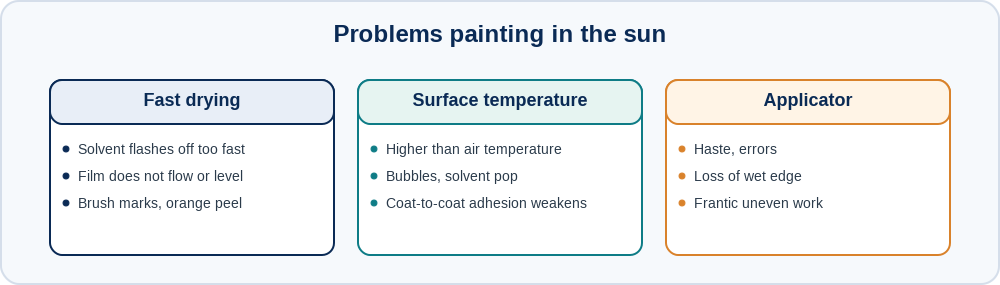
Wooden Boat magazine’s hot-weather account stresses an important point: the temperature of the surface to be painted is just as important as the air temperature and the temperature of the paint. If you spread refrigerated paint in hot air onto a hot surface of a boat that has been sitting in the sun the problems persist, because as soon as the paint meets the hot air and is applied to the hot surface the solvents flash off quickly. TotalBoat’s guide to applying varnish in hot weather says that on a surface baking in direct sun the varnish can cure too quickly on contact and prevent adhesion between coats and that solvent-based varnishes have an ideal application range of 60 to 85 °F for substrate, air and varnish temperatures. A TotalBoat support note also says allowing topside paint to cure in direct sunlight can cause solvents to evaporate faster, making the paint tacky too quickly. These are maker statements; your product may differ.
Hempel’s guide lists problems that can arise in heat: dry spray, sagging and running, reduced pot life, orange peel and cosmetic problems. The same guide says that for dry spray the surface temperature should generally not exceed 60–65 °C (140–149 °F) and that extra thinning will often be necessary; but extra thinning can increase the tendency to sag. A forum user describes losing the wet edge when paint turns tacky as soon as it touches a hot dry surface, which leads to brush marks and an uneven finish. So the problem lies not only in paint chemistry but in the shortening of the time the applicator has to do the work.
| Effect | Mechanism | Possible result |
|---|---|---|
| Fast solvent flash-off | Solvent evaporates quickly on hot surface and air | Film does not level, brush marks, orange peel |
| Very hot surface | Surface above air temperature | Bubbles, solvent pop, weak adhesion |
| Coat-to-coat adhesion | Under-coat hot and cures fast | Adhesion between coats weakens |
| Loss of wet edge | Paint turns tacky quickly | Lap lines and marks |
| Short pot life | Warmed paint gels quickly | Waste, application suffers |
3. Bubbles, solvent pop and orange peel#
On a hot surface the solvent in the paint tries to flash off quickly before the film surface closes; if the surface dries first and traps solvent beneath, bubbles and pinholes can form. TotalBoat’s spray guide lists runs and sags, pin-holing, solvent pop, fish eyes, blistering, mottling and orange peel among common spraying problems. In sun many of these increase. International Yacht Paint says residual heat (of a substrate warmed by sun) can result in poor flow and levelling, rapid drying, cracking and loss of gloss. For orange peel and bubbles see the related articles.
In line with the general warning that applying onto a sun-warmed undercoat can weaken coat adhesion, Wooden Boat writes that squeezing preparation and painting into the same afternoon is a bad idea and that doing prep one day and paint the next gives a better result. That is an experienced practitioner’s advice; judge it according to your boat’s conditions. The same source also recalls that even in sunny places direct sun can quickly heat the substrate.
4. Practical measures#
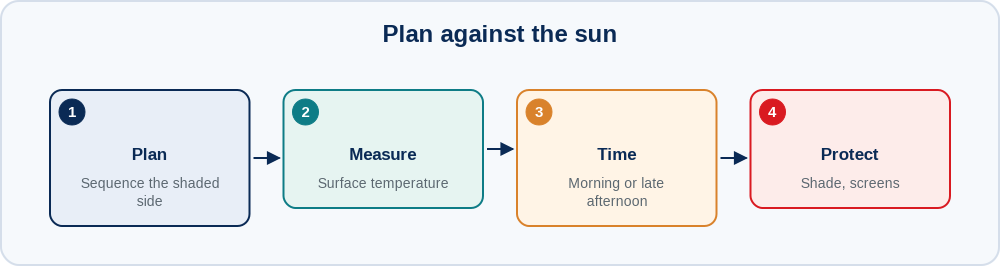
Move painting to hours protected from the sun: the cool hours of morning or shaded areas are preferred. TotalBoat advises that once the sun is directly overhead and surfaces have been baking it is usually time to stop and pick back up the following morning. Divide the hull into sections and sequence the shaded side; finish before the sun swings round and the surface heats. Shading the surface with a shade, tarp or screen is also an option (see the related article). Measure surface temperature with a surface thermometer and compare it with the data-sheet range; International notes residual heat can cause trouble and recommends measuring.
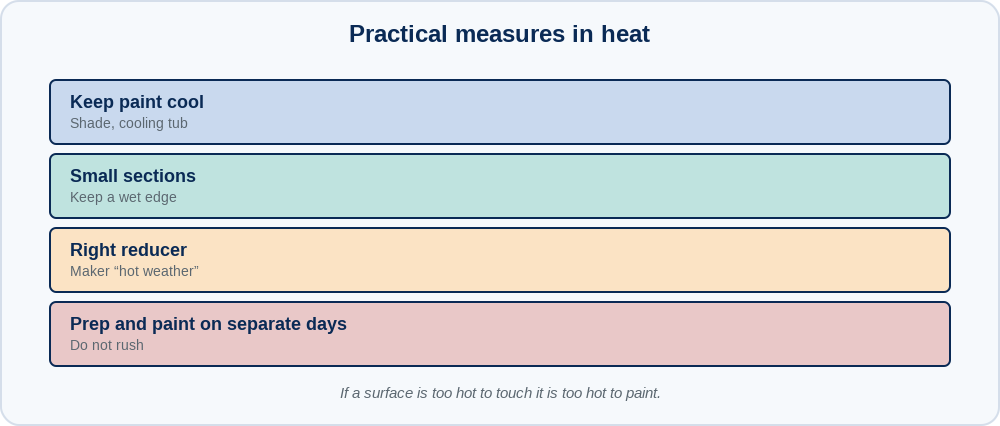
Keep the paint cool: TotalBoat recommends keeping cans in a cool shaded space, letting warm varnish cool before applying and not leaving cans in a car or in direct sun. Hempel also recommends storing material cool until use and using a cooling container during application. If the maker offers a hot-weather (slow-evaporating) reducer consider it; according to Jamestown Distributors a hot-weather reducer makes paint cure more slowly. But remember extra thinning can increase sagging and do not exceed the data-sheet limit.
- Measure air, surface and paint temperature; compare with the data sheet.
- Start on the shaded side; finish before the sun swings round.
- Store paint cool and in shade; use a cooling tub in heat.
- Proceed in small sections; keep the wet edge.
- If needed consider the maker’s hot-weather reducer; do not exceed the limit.
- Do prep and painting on separate days where possible.
- When the sun is overhead stop and resume the next morning.
5. Wet edge and the applicator factor#
Because paint turns tacky quickly in the sun, keeping a wet edge becomes hard. On a forum a single user describes painting a deck in direct sun and heat, everything being sped up to a fever pitch, working in panicky haste and meeting brush strokes and missed patches. This is one person’s experience but it illustrates the mechanism well: heat and haste multiply application errors. The remedy is to make sections smaller, work as a team (one applies while another tips off) and reduce time pressure.
Direct sun can heat a surface fast not only in summer but also at the end of winter and start of spring. Wooden Boat notes that even in cold regions direct sun can quickly heat the substrate and that painting projects should not be squeezed into one or two days. Also the difference between a cold hull early in the morning and one heated by midday sun is large; repeat measurement through the day.
6. Common mistakes#
- Painting in the midday sun.
- Looking only at air temperature and not measuring the surface.
- Leaving paint in the sun.
- Squeezing prep and painting into the same afternoon.
- Over-thinning in heat.
- Working large sections and losing the wet edge.
- Applying a new coat onto a hot, dry surface.
7. Checklist#
8. Conclusion#
Direct sun pushes the surface far above air temperature; solvent flashes off fast, paint does not level and bubble, orange peel and coat-to-coat adhesion problems increase. Measure surface temperature, work in shade or cool hours, keep paint cool and proceed in small sections; spread prep and painting over separate days. This article is general information; your product’s data sheet and the maker’s instruction govern.
Frequently asked questions#
Why is painting in the sun a problem?
Direct sun heats the surface; the solvent in the paint flashes off too fast, the film cannot flow and level and bubbles, orange peel and weak adhesion become more likely.
What is the upper limit for surface temperature?
It depends on the product. Hempel says the general rule is that surface temperature should not exceed 40 °C; one International product document gives a 41 °C limit. See your own product’s data sheet.
Is keeping the paint cold enough?
No. Wooden Boat says surface temperature matters too and that applying cool paint to a boat baking in the sun does not solve the problem.
What time should I paint?
The cool hours of morning or times when the sun does not overheat the surface are preferred; TotalBoat advises stopping when the sun is overhead and surfaces have been baking and resuming the next morning.
How do I know if the surface is too hot?
Measure with a surface thermometer. A paint maker recalls the rule “if it’s too hot to touch it’s too hot to paint”; still, measurement governs.
Was this guide helpful?
Thank you! Your feedback has been saved.
Guide content is for general information; in practice, the current technical data sheet of the product applies.
Keep reading
Related guides
Boat Colour Selection and Solar Reflectance: Effect of Heat Absorption on Surfaces
A study of the effect of boat paint colour on solar reflectance and surface temperature.
2 min read Paint and CoatingsCauses and Diagnosis of Paint Blistering
A study of the sources, types and diagnostic approach to blistering on boat paints.
2 min read Paint and CoatingsNumber of Coats in Epoxy Coating Systems
A study of the effect of the number of coats in epoxy coating systems on protective performance and thickness.
2 min read