
Paint and Coatings
Fouling Intensity in the Mediterranean and Aegean by Season
When and how heavily fouling occurs in the Mediterranean and Aegean varies with temperature, region and marina. This article offers a seasonal framework based on general sources; it gives no month-by-month intensity values.
Short answer
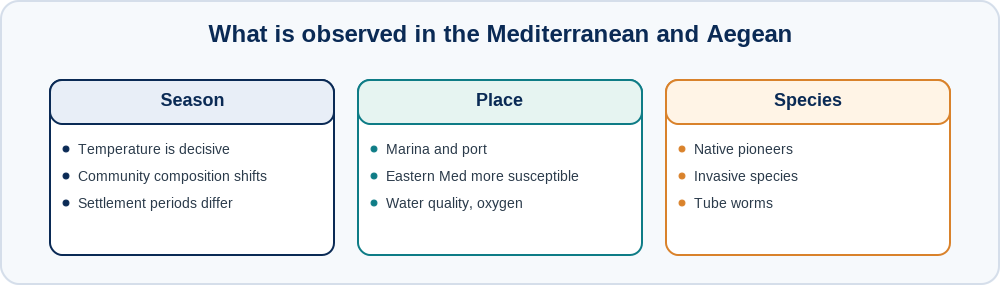
Fouling intensity changes with the seasons; according to EVAC temperature is the main driver of growth rate and seasonal variation and community composition also differs by season. Panel studies in the Mediterranean show pioneer settlement concentrating in particular quarters of the year (in Lezzi et al., 2017 the July-October quarter stands out). The AlienPorts survey of Greek marinas notes that recreational marinas can be accumulation points for biofouling and that the eastern Mediterranean may be more susceptible. This article is general information; it gives no intensity value for a given marina and month, and local data govern.
Key points
- Temperature is the main driver of fouling growth rate and seasonal variation (EVAC).
- Community composition changes with the season; pioneer settlement may concentrate in particular periods.
- Marinas can be accumulation points for biofouling; the eastern Mediterranean may be more susceptible (AlienPorts).
- Water temperature and dissolved oxygen can affect settlement (Alexandria harbour study).
- Intensity varies by region and marina; local data and the data sheet govern.
1. Why does season matter?#
Fouling is organisms settling and growing on a surface, and this process varies markedly with season and region. According to EVAC’s review temperature is the main driver of growth rate and seasonal variation; in very cold waters growth is minimal and it speeds up in warm waters. Community composition also differs by season: different groups of organisms dominate at different times of year. This article is a general summary; it gives no intensity value for a given marina or month and recommends no paint.
Winter water in the Mediterranean and Aegean is milder than in northern seas, so the assumption that “winter stops fouling” is generally not true here, though intensity and species mix still change with the season. The exact calendar of that change depends on place and must be established from local data.
2. What do panel studies in the Mediterranean show?#
In the 2017 study by Lezzi and colleagues, PVC panels were used as macrofouling collectors in the Mediterranean; panels were installed at different times in April, July and October 2013 and January 2014 and surveyed mainly in the July-October quarter. The study reports that recruitment of pioneer native species occurred independent of immersion time, on both bare and previously colonised surfaces, and that some non-indigenous species persisted and became dominant in late macrofouling communities. This is a panel study in one region over limited years; it cannot be applied directly to another marina or year.
A study carried out in the Eastern Harbour of Alexandria in 2019-2020, using seasonal sampling, notes that water temperature and dissolved oxygen can significantly affect settlement and reports that tube worms such as Hydroides elegans reached high biomass. That is an Egyptian harbour study; it carries no direct value for Turkish coasts but is useful to illustrate the role of temperature and oxygen.
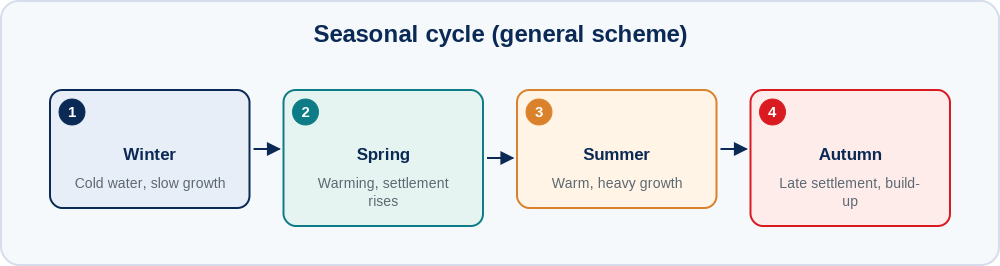
| Period | General tendency | Note |
|---|---|---|
| Winter | Growth slows but may not stop | Varies by region |
| Spring | Settlement and growth rise with warming | Pioneer species |
| Summer | Heavy growth in warm water | Temperature decisive (EVAC) |
| Autumn | Late settlement, year-long build-up | Period that stands out in panel studies |
3. Marinas and the eastern Mediterranean#
The 2026 AlienPorts survey examined fouling and associated macrobenthic assemblages in the marinas of Rhodes (Levantine), Heraklion and Piraeus-Zea (Aegean) and Patra (Ionian) between 2021 and 2022, using photoquadrat and scraped sampling. It records twelve non-indigenous and seven cryptogenic species in the photoquadrats, notes that some species were newly recorded in Greek waters and says eastern Mediterranean marinas may be more susceptible to establishment of non-indigenous species than the western basin because of their proximity to the Levantine Basin. It also writes that biofouling communities can develop on virtually any submerged vessel surface irrespective of hull type, material or usage pattern, which makes recreational marinas effective accumulation points.
These findings are not enough to derive an intensity value such as “this much in the Aegean” for a boat. They do suggest the marina itself can be a source and place of accumulation, so boats lying in the same marina may develop similar communities. For your own marina, observations by local users and yards complete this framework.
4. Practical planning#
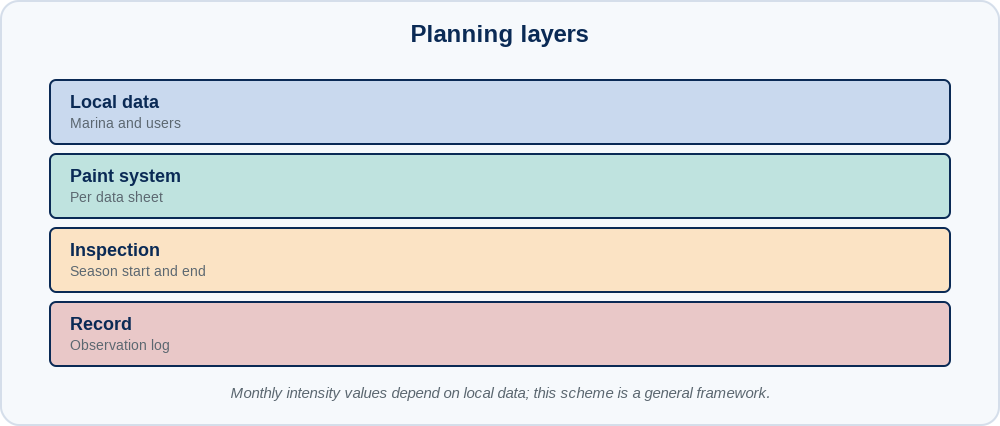
Seasonal information shapes the plan, not the paint choice. Surface and paint condition are checked before launch at the start of the season; observation is made mid-season and at the end. Because fast growth is expected in warm months, short-interval inspection and, if needed, cleaning can be planned for boats that are seldom used. For cleaning method, biocide regulation and waste see the related articles and local rules.
In paint choice the product data sheet, usage profile and local conditions govern; this article recommends no product. Yards and users in your area are often a valuable source of local knowledge on which systems work, but individual accounts are not firm evidence.
- Learn your marina’s seasonal fouling pattern from local users and the yard.
- Inspect surface and paint condition before launch.
- Choose the paint system from the data sheet and usage profile.
- Consider shortening the inspection interval in warm months.
- Check propeller, rudder, anode and intake areas separately.
- Record observations month by month and feed them into next season’s plan.
- Follow local rules for cleaning and waste.
5. Observation log and realistic expectation#
The most reliable local data is your own observation. Each season note the launch date, the time and type of the first growth noticed, cleaning dates and the paint system. After a few seasons you build a personal seasonal calendar for your marina. This log gives a concrete basis when talking to the yard about paint performance and inspection interval.
Keep expectations realistic too: panel studies and marina surveys were done in particular years and places; climate, water quality and the spread of non-native species can change over time. So read the periods in sources as an example, not a fixed calendar.
5b. The role of temperature, oxygen and water quality#
Besides temperature, dissolved oxygen, nutrient level and water quality can also affect settlement. The Alexandria study reports that these variables can significantly affect settlement. In ports and enclosed marinas where water exchange is limited, nutrient and organic load can increase, which can support micro and macro growth. This is a general tendency and carries no value for a specific marina.
The same boat may experience different fouling in a bay near the open coast and in an enclosed marina. So before copying the experience of neighbouring marinas, question whether water conditions are similar. Ask local users in which areas (propeller, rudder, anode area) growth starts first.
6. Common mistakes#
- Assuming fouling stops in winter.
- Treating a single panel study as a calendar.
- Copying another region’s experience to your own marina.
- Keeping no observation record.
- Thinning inspections in warm months.
- Skipping propeller, rudder and anode areas.
- Ignoring local rules in cleaning.
7. Checklist#
8. Conclusion#
Fouling intensity varies by season and region; temperature is the main driver and community composition differs by season. Mediterranean panel studies and the Greek marina survey show settlement concentrating in particular periods and marinas acting as accumulation points. This article is general information; for a specific marina and month, local data and the product data sheet govern.
Frequently asked questions#
In which season is fouling worst?
There is no single answer. According to EVAC temperature is decisive and communities change with the season; in one Mediterranean panel study pioneer settlement concentrated in the July-October quarter, but that is a regional, year-specific observation.
Is there a difference between the Aegean and the Mediterranean?
A survey of Greek marinas reports differences between regions and says the eastern Mediterranean may be more susceptible to invasive species; for monthly intensity comparison see local data.
Does fouling stop in winter?
Growth slows in cold water (EVAC) but does not stop; in the mild Mediterranean winter settlement and growth can continue. See local conditions.
Why does more accumulate in a marina?
The AlienPorts survey notes that recreational marinas are effective points for fouling communities to persist and spread.
Does this article recommend paint?
No. For paint choice see the product data sheet and the experience of yards and users in your area.
Was this guide helpful?
Thank you! Your feedback has been saved.
Guide content is for general information; in practice, the current technical data sheet of the product applies.
Keep reading
Related guides
Boat Colour Selection and Solar Reflectance: Effect of Heat Absorption on Surfaces
A study of the effect of boat paint colour on solar reflectance and surface temperature.
2 min read Paint and CoatingsCauses and Diagnosis of Paint Blistering
A study of the sources, types and diagnostic approach to blistering on boat paints.
2 min read Paint and CoatingsNumber of Coats in Epoxy Coating Systems
A study of the effect of the number of coats in epoxy coating systems on protective performance and thickness.
2 min read