
Refit and Maintenance
Grey Water, Black Water and Shower Tanks: Corrosion, Lining and Design
Grey water, black water and shower tanks are a different service environment from the drinking-water tank: organic waste, soap, grease, odour and often oxygen-poor conditions. This article summarises their corrosion, lining options and design details from source accounts; it is not engineering or regulatory advice.
Short answer
Sources describe waste tanks as working, unlike drinking-water tanks, in an environment with organic waste, bacteria and odour-forming compounds in which the steel wall can corrode. Coating makers describe chemical-resistant systems for ship sewage and grey-water tanks: in one maker case a sewage tank interior was blasted to SA 2.5 and about a 75-micron profile and the application completed in four days; in another case by the same maker a newly fabricated grey-water tank was lined after power-tool cleaning. These are maker cases and not templates for yacht tanks; lining choice depends on the maker’s document, a survey and a qualified applicator.
Key points
- Grey water, black water and shower tanks work in an organic-waste and odour environment unlike drinking water.
- Sources describe corrosion and wall-loss risk in waste tanks; a lining is used to reduce it.
- Waste-tank lining asks for a chemical-resistance document, not a drinking-water one; maker cases show different preparation levels.
- Slope, full drainage, venting and access are decisive in design.
- Discharge regulations vary by region; the relevant authority and a qualified specialist govern.
1. Three tanks, three different environments#
On steel boats waste systems are usually split into three groups: grey water (showers, basins, galley), black water (toilets) and the shower sump (a small chamber that collects shower water and is pumped out). Each environment is different. Grey water carries soap, grease, hair and organic residue, which prepare ground for bacterial growth and biofilm. Black water contains biological waste and toilet chemicals. A shower sump fills and empties often in a small volume and meets hot water and soap. This article is a general summary of source accounts; it recommends no design, lining product or regulatory reading for a particular boat. Maker and seller statements are labelled.
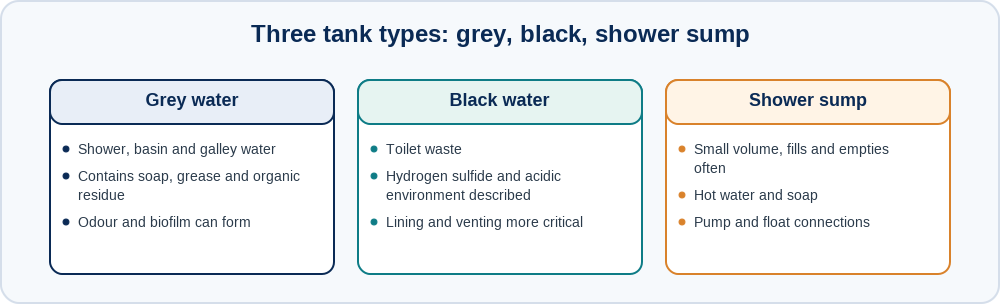
| Type | Environment | Caution |
|---|---|---|
| Grey water | Soap, grease, organic residue; odour and biofilm | Full drainage and easy cleaning |
| Black water | Toilet waste; odour and corrosive environment described | Venting and lining more critical |
| Shower sump | Small volume, hot water, frequent cycles | Pump and float connections |
2. Why do waste tanks corrode?#
Sources say what separates waste tanks from drinking-water tanks is the organic load in a wet environment. Bacterial breakdown of organic waste can produce odour compounds and acidic conditions; sulfide formation is described in oxygen-poor conditions and such an environment is said to be able to attack steel. Closed, poorly vented tanks that stay full for long periods are therefore especially at risk. The humid and gas phase matters too: condensation and gas build-up in the top of the tank can speed corrosion on unlined steel. These are general descriptions and each tank’s real environment depends on use, temperature and cleaning habits.
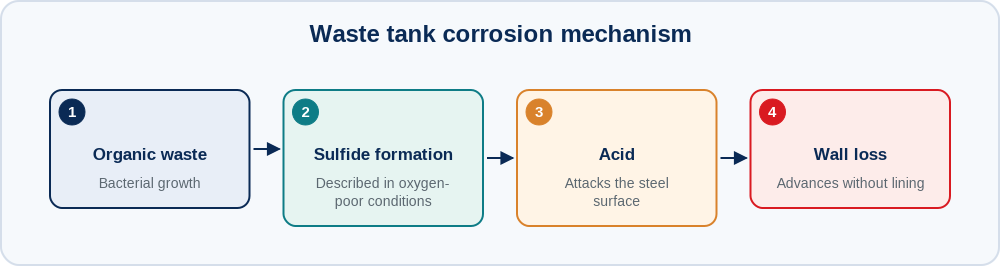
The consequence of corrosion is not only cosmetic: wall thinning can lead to leakage, and leakage to waste water entering the bilge or a neighbouring tank. Sources therefore describe regular inspection of waste tanks too. A coating maker’s tank-lining guide says a lining is meant to mitigate corrosion, prevent product contamination and give assurance against leakage, but that no lining gives a tank structural strength; that principle applies to waste tanks as well. Where the wall has thinned seriously, structural repair or plate replacement rather than coating may be needed, and that decision belongs to a qualified specialist.
3. Lining: what does it do and what to watch#
Waste-tank lining asks for a different document from drinking-water lining. Where drinking water looks for contact approvals such as NSF/ANSI 61 or WRAS, for waste the central questions are chemical resistance, abrasion and sealing. In a coating maker’s case account the interior of a ship’s sewage tank was blasted to SA 2.5 and a 75-micron profile, the existing lining removed entirely and the whole application completed in four days. In another case by the same maker the interior of a newly fabricated grey-water tank was prepared by power-tool cleaning and lined. These two cases are maker statements showing different systems and conditions; this article prefers neither and recommends no preparation grade for a yacht tank.
Surface-preparation principles are the same for waste tanks: removal of oil and salt, blast grade and profile, weld and edge preparation and post-blast inspection are covered in a separate article. A stripe coat applies here too: welds, corners and edges are where reaching the required thickness is hard. The maker’s document’s coat count, thickness and overcoat interval are applied. Cure and return to service also follow the maker’s document; in a waste tank, flushing and an odour check still matter.
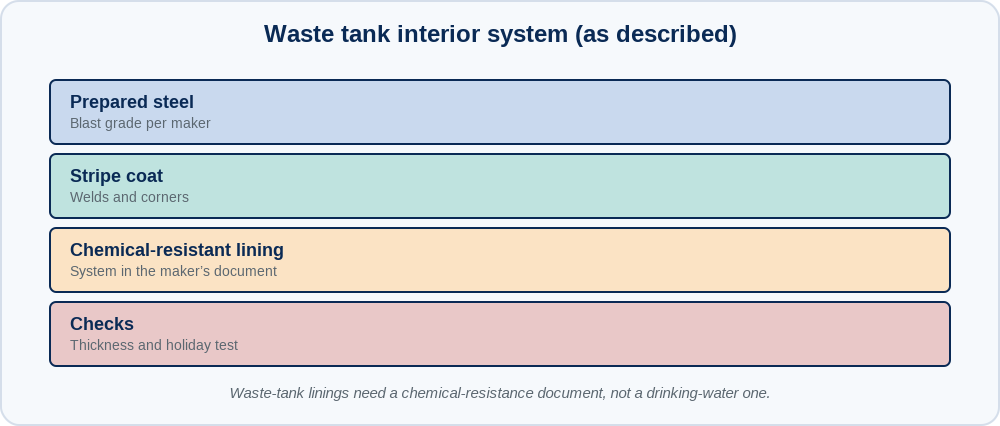
| Question | Why | From where |
|---|---|---|
| Chemical resistance | Organic waste and cleaning chemicals | Maker’s technical data sheet |
| Surface preparation | Blast grade and profile vary by maker | Maker’s document, survey |
| Acceptance checks | Thickness and holiday testing | Maker’s and applicator’s records |
4. Design details: slope, venting and access#
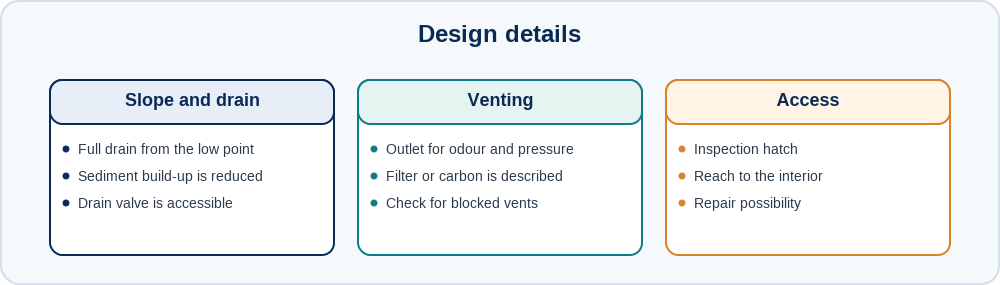
In waste tanks design details matter as much as the lining. An outlet at the lowest point and suitable slope for full drainage reduce sediment build-up and ease cleaning. Venting is described for managing pressure and odour; a blocked vent can cause both odour and pump problems. An inspection hatch and reach to the interior are needed for future lining repair and cleaning. As described in the drinking-water tank article, hatch gaskets and sealants must suit the tank environment. This article recommends no dimension or position; those belong to the designer.
Shower sump tanks are small but heavily used. Pump and float connections, soapy hot water and the build-up of hair and sediment are described as common causes of blockage and odour in them. Small volume raises the importance of full drainage and easy cleaning. On a user forum it is written that filtering hair before the sump and regular cleaning reduce the problem; that is an unverified user experience and may not hold for every boat.
5. Discharge, regulation and environment#
Discharge of waste water and especially black water is subject to regulation and rules vary by region, distance from shore and vessel type. International rules, flag-state and coastal-state regulations and port rules may each apply. This article does not interpret regulation; the relevant authority and the rules in force should be consulted. Chemicals used in tank cleaning and the discharge of wash water to the environment are also subject to rules. Lining and maintenance records can be useful during checks as documents showing the tank’s condition and operation.
6. Maintenance, inspection and records#
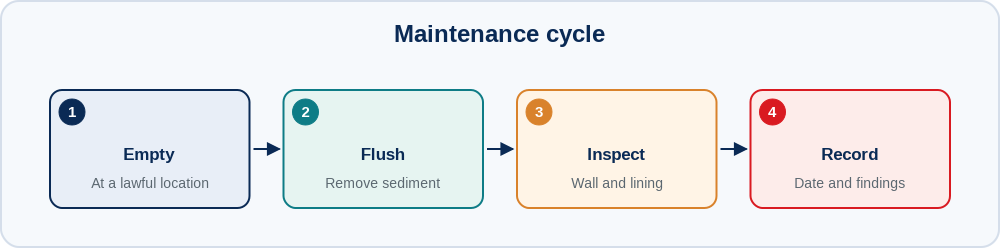
Maintenance of waste tanks starts with regular emptying and flushing. Removing sediment, checking odour and venting, checking the sealing of hatches and connections and occasional interior inspection are the main steps described. If blistering, peeling, rust staining or signs of leakage appear in the lining, draining and inspecting the tank and, where needed, repairing it to the maker’s repair instruction is described. Inspection results and dates are recorded; such records help later with lining warranty and survey. Detailed inspection methods are covered in the final article.
Part of the maintenance approach is choosing cleaning chemicals. Some cleaners and deodorisers can harm linings, gaskets and pipes; the coating maker’s chemical-resistance document shows which substances and exposure times are accepted. This article recommends no product or dose. Using high-concentration cleaners in a confined space also carries respiratory and skin risk; the safety data sheet should be read.
7. A practical frame#
- Define the tank type (grey, black, shower sump) and its environment; learn the regulation and discharge arrangements from the relevant authority.
- Have the tank’s structural condition established by survey; a lining does not restore wall loss.
- Obtain the chemical-resistance document, surface-preparation requirements and technical data sheet from the coating maker.
- Plan the stripe coat, coat count, thickness and holiday test per the maker’s document.
- Check slope, full drainage, venting and inspection access at the design and repair stage.
- Plan regular emptying, flushing and inspection; record the results.
- Plan confined-space safety with a qualified specialist.
5. Limits#
Sources say waste tanks are a corrosive environment because of organic load, that a lining is used to reduce corrosion and that slope, venting and access matter. They differ on the surface-preparation grade needed (SA 2.5 or power-tool cleaning in maker cases), the suitable lining system and maintenance frequency. Maker cases describe their own systems and are not templates for yacht tanks. So there is no single right answer; the maker’s document, a survey and the relevant authority govern. This article is not engineering, regulatory or application advice.
5b. Where sources differ#
One maker case blasts a sewage tank to SA 2.5 and about 75 microns while another lines a new grey-water tank after power-tool cleaning; one user finds a hair filter enough while a maker stresses chemical-resistant lining. These are sources speaking in different contexts and with different interests. The difference means applying to the maker’s document and a qualified applicator for your own tank.
This article is general information; it recommends no product, method, ratio, number of coats or time. The maker’s data sheet and a qualified yard govern.
5c. A practical frame for reading the sources#
The sources are magazines, makers, sellers and forums; each writes in its own context. None knows the tank’s lining, discharge or safety conditions of your boat. So taking the shared message and consulting the maker and a qualified yard for detail is reasonable.
Working in waste tanks carries confined-space, toxic and flammable gas (for example hydrogen sulfide), oxygen deficiency, biological hazard and solvent-vapour risk. This article describes no protection, ventilation or gas-testing method. Follow confined-space rules and plan gas testing and ventilation with a qualified specialist; do not work alone. For safety-critical matters the opinion of a qualified specialist governs.
Seller and maker statements are the firm’s own account of its product and have not been independently verified. A product’s compatibility with another coating should always be checked in the product’s technical document; where a document and a guide conflict, the maker’s document and a qualified yard’s assessment should be used. Recording decisions and product details helps later maintenance.
6. Common mistakes#
- Assuming drinking-water approval is enough for waste-tank lining.
- Trying to fix wall thinning with a coating.
- Not considering venting and full drainage in design.
- Not researching waste discharge regulation.
- Leaving no inspection access.
- Not checking cleaning chemicals for lining compatibility.
- Neglecting confined-space and gas risk.
7. Checklist#
8. Conclusion#
Grey water, black water and shower tanks are described in sources as organic load and corrosion, chemical-resistant lining, slope-venting-access design and maintenance. This article is general information; it is not engineering, regulatory or application advice and recommends no product or preparation grade.
Frequently asked questions#
Are grey and black water tanks the same?
No; grey water comes from showers, basins and galley and black water is toilet waste. Sources describe their environments differently and regulations may treat them differently.
Why does a waste tank rust?
Sources describe a corrosive environment formed by organic waste, bacteria and odour compounds; without a lining wall loss can advance.
Is drinking-water epoxy used in a waste tank?
Waste-tank lining asks for a chemical-resistance document; drinking-water approval is a separate matter. The maker’s document governs the choice.
Is blasting mandatory?
One maker case describes SA 2.5 blasting and another power-tool cleaning; the preparation needed depends on the maker’s document.
Where can I discharge the tank?
That depends on regulations and region; consult the local authority and the rules in force. This article is not legal advice.
Was this guide helpful?
Thank you! Your feedback has been saved.
Guide content is for general information; in practice, the current technical data sheet of the product applies.
Keep reading
Related guides
Steel Yacht Freshwater Tanks: Design, Material and Internal Lining Guide
The material, design and drinking-water-suitable internal lining of a steel boat’s freshwater tank, summarised from organisation, magazine and maker accounts with their limits.
14 min read Refit and MaintenanceBlasting Inside Tanks: Surface Preparation Standards and Good Practice
How blasting is described for the interior surface preparation of steel tanks: Sa grades, profile, salt and humidity limits and confined-space safety, summarised from standards and maker accounts.
14 min read Refit and MaintenanceDrinking-Water Tank Epoxy Lining: Selection, Stripe Coat, Cure and Disinfection
Product documents, stripe coat, cure, flushing and disinfection steps in epoxy lining of drinking-water tanks, summarised from source accounts with their limits.
11 min read