
Paint and Coatings
Galvanic Corrosion and Marina Electrical Leaks
A boat on shore power in a marina is also tied to its neighbours’ corrosion problems. This article summarises galvanic corrosion, the stray-current difference, electrical danger in water and ways of protection from sources; it is not safety advice.
Short answer
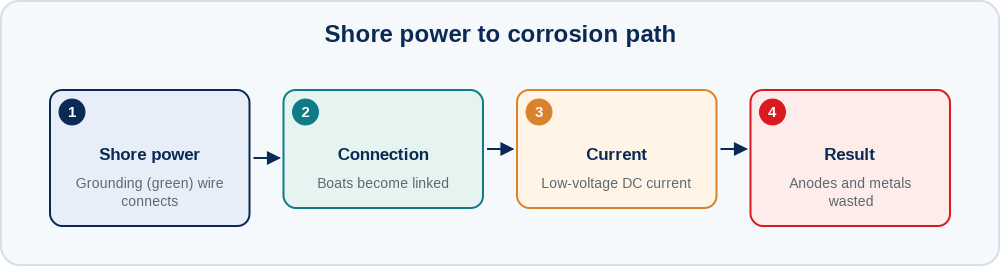
Every boat plugged into shore power is connected to other boats in the marina through the green wire, the system’s grounding conductor; BoatUS writes that this creates a galvanic cell and that neighbouring boats’ problems can carry to your metals. Steve D’Antonio in Cruising World says any marina with shore-power hookups may produce corrosion issues and that the corrosion is nearly always from other vessels, not the marina’s facilities. BoatUS treats galvanic and stray-current corrosion as separate events and writes that even a few milliamps of AC in the water can paralyse a swimmer’s muscles. This article is general information; for electrics and safety consult a qualified marine electrician.
Key points
- Boats on shore power are linked through the grounding (green) wire and a galvanic cell forms (BoatUS).
- Galvanic current is a DC current from the natural voltage difference between metals and returns via the shore grounding wire and the water (Victron).
- Corrosion mostly comes from other boats rather than marina facilities (Cruising World, D’Antonio).
- Stray-current corrosion is separate from galvanic and can be very fast; AC current in water is dangerous to swimmers (BoatUS).
- A galvanic isolator or isolation transformer are common solutions; a qualified marine electrician is needed.
1. What is galvanic corrosion?#
When dissimilar metals are electrically connected in an electrolyte (seawater), the more active metal corrodes. Victron’s book describes galvanic current as a DC current caused by the natural voltage difference between metals and says that currents entering a boat via the shore-power earth wire and returning to shore via the water can cause corrosion to underwater metals such as hull, propeller and shaft. Sacrificial anodes wear in place of the metals to be protected by this logic. This article is a general summary; it is not electrical or safety advice and some sources are maker or seller claims.
A BoatUS article says the rules governing galvanic corrosion are exactly the same whether metals are in direct contact or connected by the shore-power grounding wire. So an electrical connection in a marina can set up the corrosion cell even without direct contact.
2. Shore power and neighbouring boats#
According to BoatUS every boat plugged into shore power is connected to other boats in the marina through the green wire, the system’s grounding conductor; this creates a galvanic cell. The same article says that when the boat is plugged in, anodes connected to its grounding system also contribute to protecting the other boats on the same dock. Soundings writes that properly wired boats connected to shore power at a marina are susceptible to galvanic corrosion caused by neighbouring boats with depleted zincs. A Boating Test article notes that bad or deteriorated marina wiring can cause extreme corrosion on exposed metal parts and electric shocks in the water and possibly inside the boat.
In Cruising World Steve D’Antonio writes that the term “hot marina” is tough to define, that any marina with shore-power hookups may produce corrosion issues and that it is nearly always a result of other vessels, not the marina’s facilities; he adds that there is no shortage of misunderstanding about the role shore power plays. That is an expert view and may not hold for every marina. If you suspect a problem talk to the marina management and a qualified electrician.
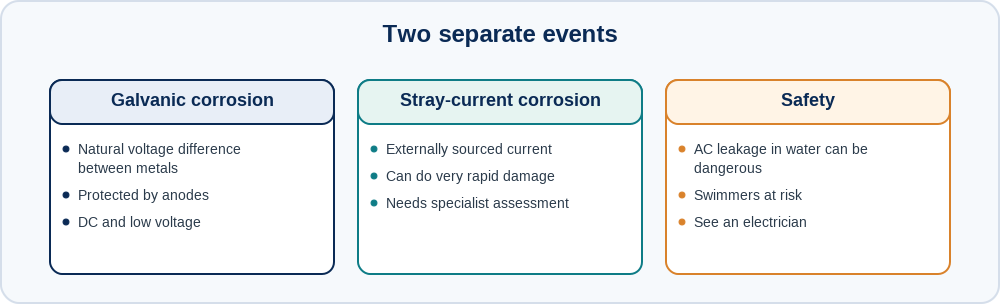
| Event | Source | Caution |
|---|---|---|
| Galvanic corrosion | Natural voltage difference between metals; link via shore grounding wire | Protected by anodes; DC, low voltage |
| Stray-current corrosion | An external current source | Can do very rapid damage; specialist needed |
3. Stray-current corrosion and danger in the water#
A BoatUS article writes that stray-current corrosion is less common than galvanic corrosion but can drive normally cathodic metals to become anodic and that damage can be very fast; it includes an answer noting metal fittings in contact with bilge water could be wrecked in a few days or even hours. The same article says even a few milliamps of AC electricity in the water can paralyse a swimmer’s muscles, causing him or her to drown. Sail magazine also speaks of danger to swimmers if the boat could be energised via the DC ground and bonding system and says “don’t do it”.
This is general warning information; if you suspect a hazard (conduction in the water or electric shock) do not enter the water and contact a qualified electrician and marina management. This article is not safety advice; local regulation and a qualified specialist govern.
4. Ways of protection#
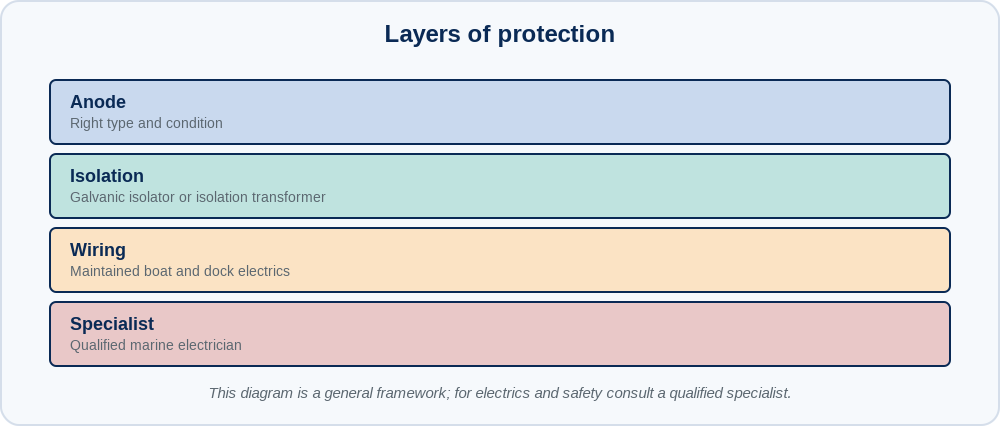
Sources mention two main methods to prevent galvanic corrosion: a galvanic isolator and an isolation transformer (Victron, BoatUS). A BoatUS article says boats plugged into shore power on a regular basis need a galvanic isolator. Victron says the isolator prevents galvanic corrosion by blocking low-voltage DC currents via the shore earth wire; these are maker claims. For operation and selection see the galvanic isolator article. This article recommends no product or installation; for installation consult a qualified marine electrician.
Monitoring anode condition regularly is also a layer of protection: galvanic effects from neighbouring boats can consume anodes quickly. Unexpectedly fast anode wastage can be a warning sign; see the anode life article and consult a specialist if needed.
- Have a qualified electrician check the boat’s shore-power connection and grounding arrangement.
- Assess galvanic isolator or isolation transformer options with a specialist.
- Record anode type, condition and rate of wastage.
- Note and investigate unexpectedly fast wastage.
- Report suspicious conditions to marina management.
- Do not enter the water if you suspect electricity in it.
- Have all electrical work done by a qualified specialist.
5. Boat and marina upkeep#
Boating Test writes that deteriorated or bad marina wiring can pose risk not just to metal parts but also of electric shock in the water and aboard. So regular upkeep of both the boat’s and the dock’s electrical systems matters. If you see a problem in a marina, reporting it to marina management is a sensible step. This article is not regulation or an installation guide.
Soundings writes that the galvanic isolator is installed in series with the shore-power grounding conductor and blocks small DC galvanic currents while letting AC fault currents pass. These technical details are covered in the isolator article.
5b. Where sources differ, and limits#
Sources do not stress the cause of corrosion in exactly the same way: BoatUS and Soundings foreground the neighbouring-boat effect; in Cruising World D’Antonio says the problem nearly always comes from other boats rather than marina facilities but that there is much misunderstanding about shore power. One source writes that the protection a galvanic isolator gives may be limited for aluminium hulls (a maker claim). So the solution depends on boat and environment; specialist assessment matters.
The corrosion descriptions in this article are also general concepts; the cause of damage on a particular boat cannot be derived from it. If you see anode wastage, pitting or damage get a diagnosis from a specialist. This article is not diagnosis or safety advice.
6. Common mistakes#
- Not knowing the grounding effect of a shore-power connection.
- Ignoring fast anode wastage.
- Having electrical work done by unqualified people.
- Entering or swimming in the water when electricity is suspected.
- Treating a galvanic isolator alone as the answer to every problem.
- Not reporting a suspicious condition to marina management.
- Keeping no records.
7. Checklist#
8. Conclusion#
Boats on shore power are linked through the grounding wire and this can carry neighbouring boats’ effects to anodes; galvanic and stray-current corrosion are separate events and AC current in water is dangerous. A galvanic isolator or isolation transformer are common solutions. This article is general information; for electrics and safety consult a qualified marine electrician.
Frequently asked questions#
Why does shore power affect corrosion in a marina?
Per BoatUS every boat plugged into shore power is electrically connected to the others through the green grounding wire and a galvanic cell forms; your anodes may also help protect neighbouring boats.
What is a “hot marina”?
In Cruising World D’Antonio writes that the term is tough to define, that any marina with shore-power hookups may produce corrosion issues and that it is nearly always the result of other vessels, not the marina’s facilities.
Are galvanic and stray-current corrosion the same?
No. BoatUS treats them separately: galvanic corrosion comes from natural voltage differences between metals, stray-current corrosion from an external current source and can do very rapid damage.
Is electricity in the water dangerous?
BoatUS writes that even a few milliamps of AC in the water can paralyse a swimmer’s muscles and cause drowning; Sail magazine gives a similar warning. This article is not safety advice; consult a qualified specialist.
What is the solution?
Sources mention a galvanic isolator or isolation transformer (Victron, BoatUS); a qualified marine electrician is needed for installation and safety. See the galvanic isolator article for detail.
Was this guide helpful?
Thank you! Your feedback has been saved.
Guide content is for general information; in practice, the current technical data sheet of the product applies.
Keep reading
Related guides
Boat Colour Selection and Solar Reflectance: Effect of Heat Absorption on Surfaces
A study of the effect of boat paint colour on solar reflectance and surface temperature.
2 min read Paint and CoatingsCauses and Diagnosis of Paint Blistering
A study of the sources, types and diagnostic approach to blistering on boat paints.
2 min read Paint and CoatingsNumber of Coats in Epoxy Coating Systems
A study of the effect of the number of coats in epoxy coating systems on protective performance and thickness.
2 min read