
Paint and Coatings
Marine Aluminium Boat Painting Guide
Painting an aluminium boat differs from steel or fibreglass, because copper-based antifouling can form a galvanic couple with aluminium. This article summarises source views with their limits; it is not a product, coat-count or time recommendation.
Short answer
International (maker) says to use only a copper-thiocyanate-based antifouling, properly primed, or to have the hull expertly protected by an impressed current system; Buster (maker) writes that copper should never be used on aluminium. West Marine (seller) describes copper-based antifouling forming a galvanic couple with aluminium that can cause severe pitting, which can be avoided with a copper-free antifouling or a barrier coat. Sources describe paint sticking poorly to bare aluminium, removing oxide and applying an epoxy primer without delay, and masking anodes and leaving them bare. This article is general information; product, coat count and time vary by maker.
Key points
- Copper-based antifouling can form a galvanic couple with aluminium; makers warn (West Marine, International, Buster).
- Paint sticks poorly to aluminium; oxide removal and an epoxy barrier primer are described (source accounts).
- Copper-free antifouling or a barrier coat are described as options; product varies by maker.
- Anodes are masked and left bare (source account).
- For product, coat count and time the maker’s data sheet and a qualified yard govern.
1. Why is an aluminium boat different?#
Aluminium boats can often be left unpainted; but the underwater part is frequently painted because of fouling and appearance. The important difference is that aluminium is a non-noble metal and can form a galvanic couple on contact with copper-based paint. This article is a general summary; it gives no product, coat count, drying time or application method and is not application advice. Some sources are seller or maker claims and are labelled as such.
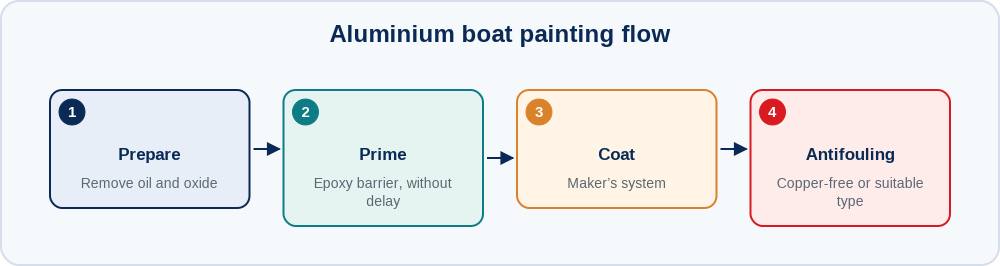
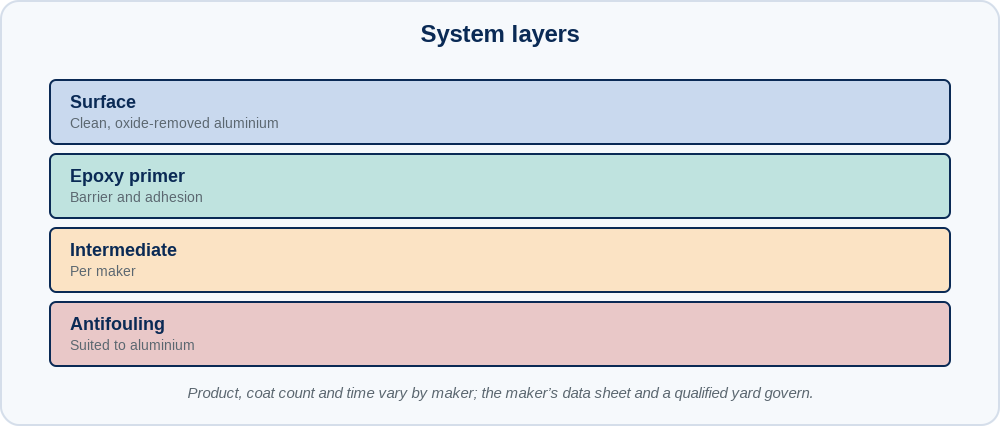
For paint to hold on aluminium, surface preparation is described; it mostly includes removing oil and dirt, removing the oxide layer and then applying an epoxy barrier primer without delay. For detail and order see the maker’s system.
2. Copper antifouling risk#
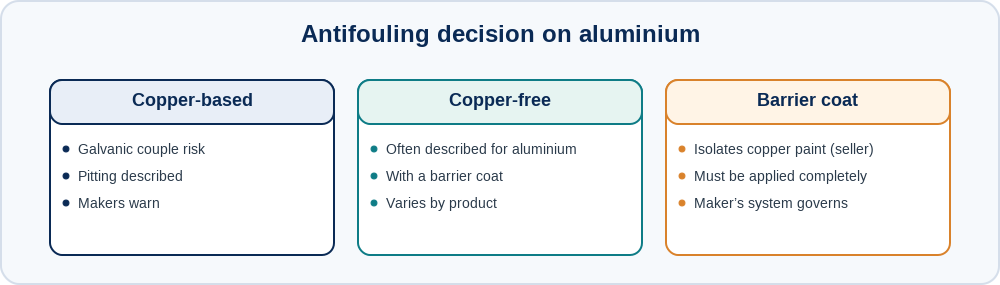
West Marine (seller) describes copper-based antifouling (cuprous oxide or metallic copper) forming a galvanic couple with aluminium that can cause severe pitting. International (maker) says to use only a copper-thiocyanate-based antifouling, properly primed, or to have the hull expertly protected by an impressed current system. Buster (maker) writes that copper should never be used on aluminium. These statements come from makers or sellers and should be read in the context of their own products; still, the shared message is that copper paint on aluminium needs care.
Options described are copper-free antifouling or a barrier coat isolating aluminium from copper. A composite paint guide describes an epoxy barrier with a copper-free ablative antifouling for wet salt-water slips; that is a source account and not a product recommendation.
| Option | Sources’ general observation | Caution |
|---|---|---|
| Copper-based | Galvanic couple and pitting risk (seller, maker) | Makers warn |
| Copper-free | Often described for aluminium | Varies by product |
| Barrier coat | Isolates copper paint (seller) | Must be applied completely |
3. Surface preparation and primer#
Sources describe paint sticking poorly to bare aluminium; so oxide removal followed by an epoxy barrier primer stands out. Buster (maker) writes that an aluminium-specific antifouling can be applied directly over a factory-applied epoxy primer. Pettit (maker) mentions epoxy primer systems. This article gives no coat count, thickness or waiting time; the maker’s data sheet governs.
For anodes sources describe not painting them, masking them and leaving them bare; a painted anode can lose its function. See the anode articles.
4. A practical frame#
- Find out the maker’s paint system for the boat.
- Clean the surface and remove the oxide layer (by the maker’s method).
- Apply an epoxy barrier primer without delay (maker’s system).
- Discuss a copper-free or aluminium-suitable antifouling with the maker.
- Mask the anodes and leave them bare.
- Ensure a complete and clean barrier coat.
- Keep records and inspect regularly.
5. Limits#
Sources agree copper paint is risky on aluminium; they differ on how to manage that risk. One maker accepts a properly primed copper-thiocyanate-based product while another says to use no copper at all. So there is no single right answer; the maker’s system, whether the boat has an impressed current system and a qualified yard’s assessment govern. This article is not application or engineering advice.
5b. Where sources differ#
International (maker) describes a copper-thiocyanate-based, properly primed antifouling or an expertly maintained impressed current system; Buster (maker) says copper should never be used; West Marine (seller) describes copper-free antifouling or a barrier coat as options. These are sources with different interests and each speaks in the context of its own range. This difference shows the importance of talking to the maker about your own boat.
This article summarises the sources’ general accounts; it may not hold for a particular boat. For product, coat count and time the maker’s data sheet and a qualified yard govern.
5c. A practical frame for reading the sources#
The sources here are makers, sellers and a composite paint guide; each writes in its own context. Makers describe their own product systems, sellers their range and guides a general approach. None knows your boat’s coating history, whether it has an impressed current system or its berthing conditions. So taking the shared message, that copper paint on aluminium needs care and that surface preparation and barrier primer matter, and consulting the maker for detail, is the most sensible approach.
If the boat has been painted before, knowing the type of the existing coating matters; applying a system over an unknown coating carries a risk of incompatibility. This article proposes no method for that; consult the maker and a qualified yard on compatibility. Electrical leakage and the influence of neighbouring boats can also affect corrosion on aluminium boats; see the related articles.
Finally, painting alone does not solve the corrosion issue; the anode system, electrical isolation and regular inspection should be considered together. If you see paint blistering or pitting consult a specialist. Recording decisions and keeping the maker’s instruction helps with later maintenance.
In addition, seller and maker statements in this article are the firm’s own account of its product and have not been independently verified. A product’s suitability for aluminium and its use with a primer and an old coating should always be checked in the product’s own technical document. Where a technical document and a guide conflict, the maker’s document and a qualified yard’s assessment should be used; this article recommends no product on the matter.
6. Common mistakes#
- Putting copper antifouling on aluminium (despite maker warnings).
- Delaying the primer after removing the oxide.
- Painting the anodes.
- Applying the barrier coat incompletely.
- Applying a system over an unknown existing coating.
- Mixing products without asking the maker.
- Keeping no records.
7. Checklist#
8. Conclusion#
Surface preparation, an epoxy barrier primer and the antifouling choice are critical when painting an aluminium boat; copper-based paint can form a galvanic couple with aluminium and makers warn of it. Options are copper-free antifouling and a barrier coat. This article is general information; it gives no product, coat count or time, and the maker’s data sheet and a qualified yard govern.
Frequently asked questions#
Can copper antifouling go on an aluminium boat?
International (maker) says use only a copper-thiocyanate-based, properly primed antifouling or protect with an impressed current system; Buster (maker) writes never to use copper. West Marine (seller) mentions severe pitting.
Why does paint stick poorly to aluminium?
Sources describe paint adhering poorly to bare aluminium; so oxide removal and a suitable epoxy barrier primer are described. See the maker’s system for detail.
Are anodes painted?
Sources describe masking anodes and leaving them bare; a painted anode can lose its function. See the anode articles.
Is a barrier coat enough?
Some seller accounts say copper paint can be isolated from the hull with a barrier coat; but the coat must be applied completely and the maker’s system governs. That is a seller claim.
What goes over a factory primer?
Buster (maker) writes that an aluminium-specific antifouling can be applied directly over a factory-applied epoxy primer. For your own boat ask the maker.
Was this guide helpful?
Thank you! Your feedback has been saved.
Guide content is for general information; in practice, the current technical data sheet of the product applies.
Keep reading
Related guides
Boat Colour Selection and Solar Reflectance: Effect of Heat Absorption on Surfaces
A study of the effect of boat paint colour on solar reflectance and surface temperature.
2 min read Paint and CoatingsCauses and Diagnosis of Paint Blistering
A study of the sources, types and diagnostic approach to blistering on boat paints.
2 min read Paint and CoatingsNumber of Coats in Epoxy Coating Systems
A study of the effect of the number of coats in epoxy coating systems on protective performance and thickness.
2 min read