
Hull Repair
Gelcoat Oxidation: How to Restore a Dull, Chalky Boat
The dullness and chalky powder that appear on a fibreglass boat over time are gelcoat oxidising in the sun. The good news is that gelcoat can almost always be restored if it is not completely worn through; but the method and product you choose decide how long the gelcoat lasts.
Short answer
Oxidation is the sun’s UV breaking down the top layer of gelcoat; light oxidation shows as slight dulling, moderate and heavy oxidation as a chalk-like powder. The removal order is wash, compound if needed, polish and finally wax or sealer. The key principle is to use the least aggressive product that does the job: each application takes a little gelcoat away. Do not polish in direct sunlight; the product dries too fast and becomes hard to remove. Waxing over oxidised or stained gelcoat seals the damage in. This article is general information; the product data sheet comes first.
Key points
- Oxidation is UV breaking down gelcoat; it shows from slight dulling to chalky powder.
- Order: wash, compound if needed, polish, wax or sealer.
- Use the least aggressive product that works; each step removes some gelcoat.
- Do not polish in direct sun; compounding and waxing over a dirty surface does harm.
- Gelcoat not completely worn through can almost always be restored; an annual polish and wax is advised.
1. What is oxidation and how do you recognise it?#
Gelcoat is the outer resin layer of a fibreglass boat and over time it is exposed to the sun’s UV, salt and dirt. A retailer guide says unless the boat is very new it will have some oxidation; light oxidation appears as a slight dulling of the gelcoat, moderate to heavy oxidation as a chalk-like powder at the surface. If your hand comes away with a white mark there is oxidation. One source says gelcoat is porous and susceptible to oxidation, stains and contaminants.
The good news is that, according to a retailer guide, nearly all gelcoat can be restored provided it is not completely worn through. A sailing magazine likewise writes that thanks to gelcoat’s thickness minor docking scuffs can be erased with compound, wax and polishing patience. But gelcoat is not endless; so the method you choose and how hard you apply it matter.
2. The principle: the least aggressive product that works#
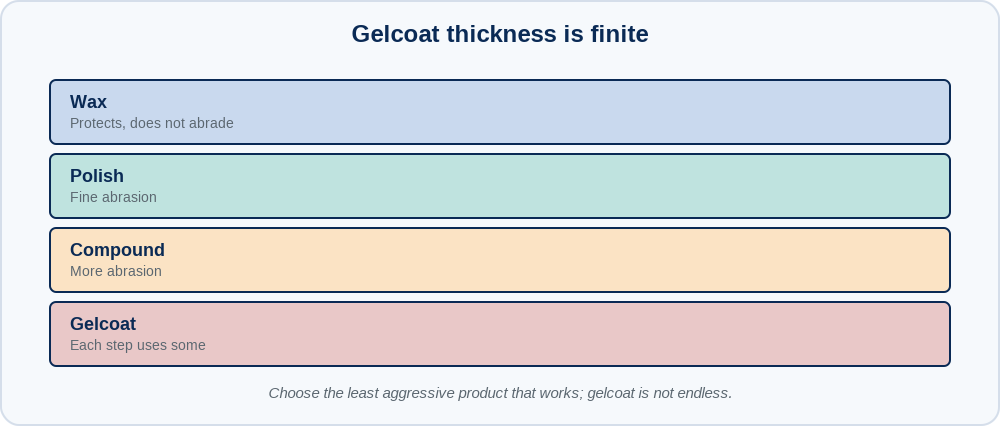
A retailer guide says that for heavily oxidised gelcoat you start with a coarse compound and follow with successively finer polishes, but each application removes a small amount of gelcoat, so always use the least aggressive product that will get the job done. A marine supplier’s guide likewise advises choosing the least aggressive product (compound versus polish) that achieves the result to preserve as much of the original gelcoat thickness as possible. On light oxidation it is generally possible to skip the heavy compound and go straight to a light compound or polish.
For heavy oxidation a magazine writes that after a heavy oxidation remover it will probably be necessary to go back with a lighter compound or polish to bring back the deep shine; kits often include both stages. A test publication also says that on old or severely oxidised boats it is typical to start with a coarse, fast-cut compound, follow with a finer compound, then move on to polish and wax.
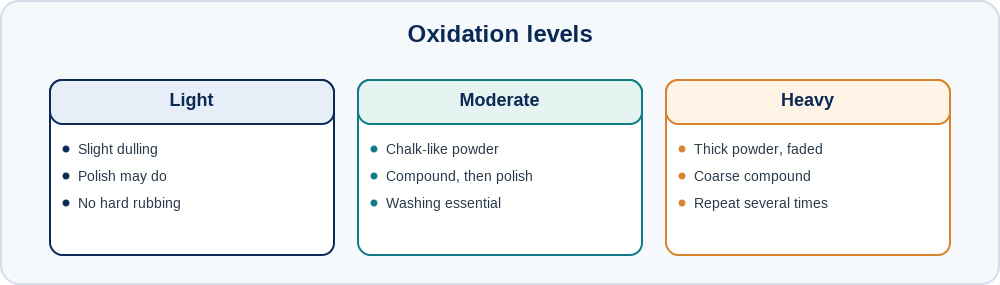
| Level | Appearance | Approach |
|---|---|---|
| Light | Slight dulling | Light polish; no hard rubbing |
| Moderate | Chalk-like powder | Compound, then polish, then wax |
| Heavy | Thick powder, faded colour | Coarse compound, fine compound, polish, wax |
3. Step by step: wash, compound, polish, protect#
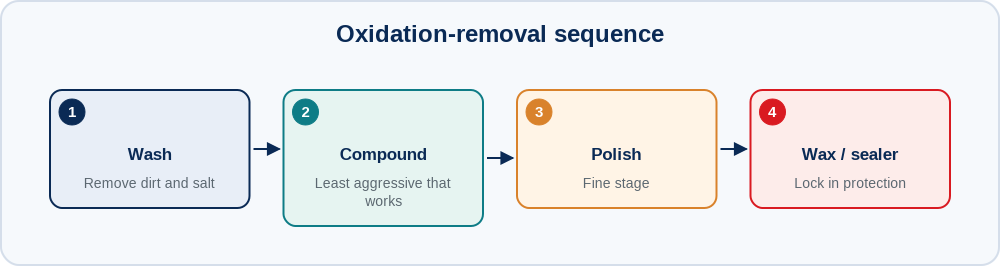
A retailer guide lists four steps: wash it, remove oxidation and restore the shine, polish it and wax it. Cleaning the boat first is essential; a sailing magazine writes that contaminants accumulate whether the boat sits in the water or on the hard, and that smearing compound and wax over a dirt- and grime-caked hull can do more harm than good. Household detergents can also strip existing wax and polish; marine low-sudsing boat soaps are preferred.
- Wash the boat; remove stains with a suitable cleaner.
- Remove oxidation with the least aggressive compound that works; coarse then fine if heavy.
- Bring back the deep shine with a finer polish.
- Protect with wax or sealer.
- Do not work in direct sun; the product dries fast and becomes hard to remove.
- Apply a second coat of wax if wanted.
A guide stresses not polishing in direct sunlight: the product dries too fast and becomes difficult to remove. A boating site suggests that one coat of wax or polish is never enough and a second coat should be applied for shine. If you use a machine, see the polisher section in our separate article.
4. Wax and protection#
According to a retailer guide wax seals out oxygen, which prevents oxidation, and most waxes contain UV inhibitors; choices include pure carnauba, carnauba/polymer blends and polymer-only formulations. The guide calls carnauba/polymer blends a good all-around choice for most boaters and suggests waxing at least once per season, ideally at the beginning. The same guide says never to apply wax over oxidised or stained gelcoat: the wax will seal the damage in rather than protecting clean gelcoat.
A test publication reports that wax is limited as UV protection: when a handful of waxes claiming UV protection were tested, none, even applied thick, absorbed a significant percentage of UVA and UVB rays. The same publication says the primary goal of a wax is to protect the top layers of gelcoat that already contain UV-protection agents. See our separate article on wax and sealant for detail.
5. Time, cost and expectations#
A boat-insurance body suggests allowing a complete day for the topsides of a 26-foot centre-console and budgets about $200 for compound, polish and pads and about $200 for a decent polisher. These figures come from one source and vary with country and period. What matters is that the job takes time and, if done roughly, can thin the gelcoat unnecessarily.
For upkeep one source says keeping a restored gelcoat looking good is as simple as rinsing after each trip and an annual polish and wax; another guide says most boats need a full polish and wax at least once a year. In strong sun and salty conditions, or on dark colours, more often may be needed.
5b. Delaying oxidation from the start#
The easiest way to prevent oxidation is regular washing and protection while the boat is still in good condition. A retailer guide says that on a new boat in good condition all you need to do is wash it and apply a quality wax, which will protect that like-new look and head off a time-consuming restoration project down the line. A supplier guide also says regular cleaning and protective measures can significantly extend the life of your gelcoat. In practice that means a fresh-water rinse after each trip, washing with a suitable marine soap and wax or sealer at the start of the season.
Dark hull colours may need a second treatment: one guide notes that for darker hull colours a second treatment may be needed. Since oxidation and scratches show more on dark colours it makes sense to shorten the maintenance interval. See our separate article on colour and heat.
6. Common mistakes#
- Waxing directly over oxidised gelcoat.
- Compounding a dirty hull.
- Starting with a harsher product and using up gelcoat needlessly.
- Polishing in direct sun.
- Washing with household detergent and stripping the existing protective coat.
- Expecting wax to remove oxidation.
7. A short case: the same dullness, two approaches#
Two boats have hulls that leave a chalky powder. The first owner puts a thick coat of wax over it; within weeks the look dulls again. The second owner washes the boat, removes the oxidation with a medium-cut compound, restores the shine with a fine polish and then waxes. The second approach takes more effort; but because the oxidation is really removed the result lasts longer.
8. Checklist#
9. Conclusion#
Dull gelcoat can usually be restored; but method matters. Wash first, choose the least aggressive compound or polish that works, do not work in direct sun, then protect with wax or sealer and repeat the upkeep yearly. Waxing over an oxidised surface only seals the damage in. This guide is a general framework; the product data sheet comes first.
Frequently asked questions#
What is oxidation?
The sun’s UV rays breaking down the top layer of gelcoat; it shows as slight dulling and, in moderate and heavy cases, a chalk-like powder.
Can oxidised gelcoat be saved?
According to one source nearly all gelcoat can be restored provided it is not completely worn through.
Compound or polish?
On light oxidation polish may be enough; on heavy oxidation start with compound then move to finer polish. Choose the least aggressive product that works.
How often should I wax?
One retailer guide says at least once per season, ideally at the start; another source advises a full polish and wax at least once a year.
Can I wax over oxidised gelcoat?
No. Waxing over oxidised or stained gelcoat seals the damage in; restore it first.
Was this guide helpful?
Thank you! Your feedback has been saved.
Guide content is for general information; in practice, the current technical data sheet of the product applies.
Keep reading
Related guides
Boat Colour Selection and Solar Reflectance: Effect of Heat Absorption on Surfaces
A study of the effect of boat paint colour on solar reflectance and surface temperature.
2 min read Paint and CoatingsCauses and Diagnosis of Paint Blistering
A study of the sources, types and diagnostic approach to blistering on boat paints.
2 min read Paint and CoatingsNumber of Coats in Epoxy Coating Systems
A study of the effect of the number of coats in epoxy coating systems on protective performance and thickness.
2 min read